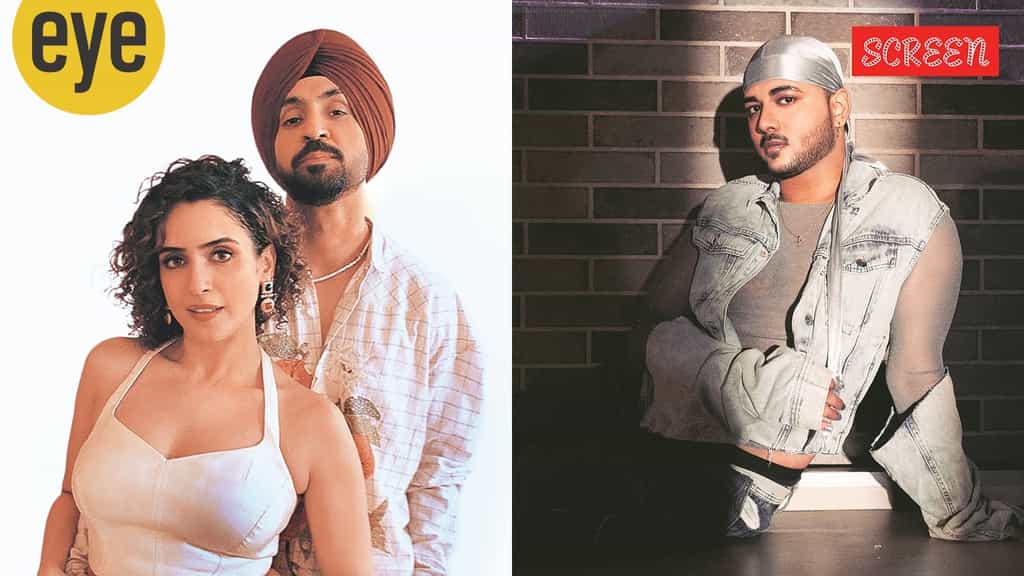
Having choreographed the Diljit-Sanya number "Charmer" that reached the #1 spot on YouTube within three days of its release on October 19 and has 37.8 million views, it is difficult to believe Yassh Kadamm was unsure about a career in dance.
A head and a shoulder pop, a body roll, swift arm gestures with a hand flick. A step-touch on the right and then left. All of it in 10 seconds. Sanya Malhotra in Diljit Dosanjh’s music video Charmer — released last year — does not have a single line to lip sync, yet she speaks volumes. While Malhotra lands the choreography with flair, behind the camera and her slick movements is choreographer Yassh Kadamm. “Sanya did everything beautifully despite last-minute changes on the set,” he says, adding, “At the beginning, you see Sanya applying lotion and then walking through a corridor. That was decided on the spot.”
All of 25, Kadamm is among the crop of Covid choreographers who have leveraged Insta reels to explore avenues beyond mainstream Bollywood — be it music videos, reality TV or concert performances. He first came into the limelight in 2021 when his cover of Daaru desi from Cocktail (2012) went viral. The reel reached two million views. “That is when people started following me,” he says.
Having choreographed the Diljit-Sanya number that reached the #1 spot on YouTube within three days of its release on October 19 and has 37.8 million views, it is difficult to believe he was unsure about a career in dance, especially when it was his constant, in good times and bad. “I was bullied in school. Dance became a way to release my anger,” recalls Kadamm, who has a diploma in filmmaking.
Things took a professional turn when Tangerine Arts Studio in Mumbai, a multi-disciplinary space, reached out to him in 2015 to take a workshop. “Until then I myself was attending workshops. I asked them for a year to refresh the basics,” says Kadamm. Largely self-trained through online tutorials, he did a three-month course at The Kings Dance Studio, Mumbai, where he brushed up his hip-hop skills. For his first workshop, he taught a cover of Tattoo from ABCD 2 (2015) and it was an “instant hit”.
One of Kadamm’s early influences was New Zealand choreographer Parris Goebel. “I discovered her with Justin Bieber’s Sorry. I hadn’t seen that dance in India. We are now catching up but at the time, the styles were restrictive,” he says. Like Goebel — whose Polyswagg blends modern hip-hop, dancehall and R&B with traditional Polynesian movements — Kadamm, too, has created a unique language of movement, blending the urban foundations of hip-hop and freestyle, the fluidity of contemporary, the energy of Bollywood and the groove of funk, a trademark in Sirra, Qatal, Azul and Charmer. “I didn’t want to stick to categories. I am driven by attitude and intention,” he says. In a way, Kadamm borrows a bit from dancing greats such as Saroj Khan, Remo D’ Souza, Vaibhavi Merchant and Farah Khan.
A decade ago, Kadamm’s dream was to choreograph “A-listers”. Now that he has, the goalposts have moved. “The more I learn about dancing, the more I want to work with people who are creatively charging. Star or no star,” he says.
Editorial Context & Insight
Original analysis & verification
Methodology
This article includes original analysis and synthesis from our editorial team, cross-referenced with primary sources to ensure depth and accuracy.
Primary Source
The Indian Express