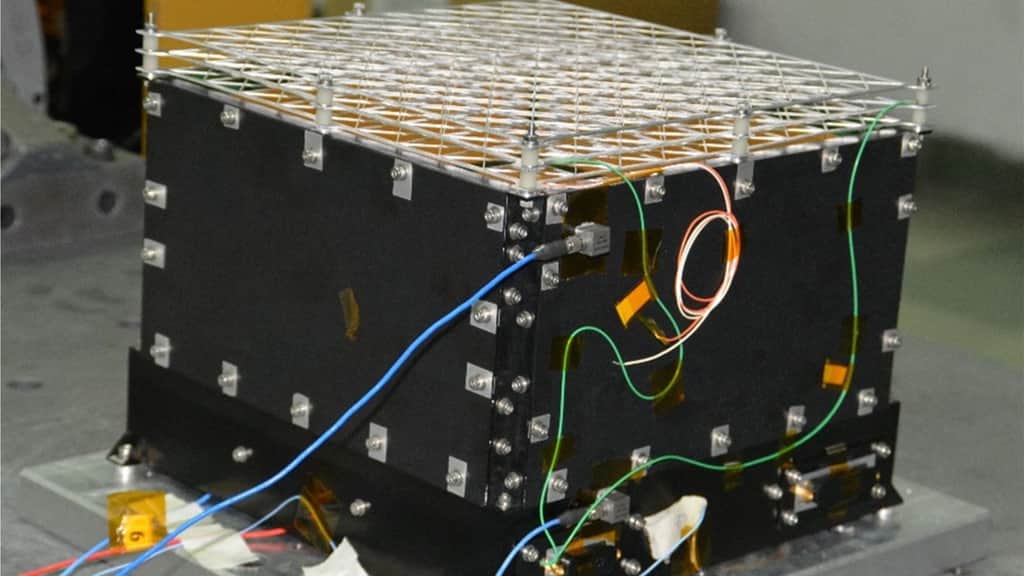
Developed by the Physical Research Laboratory, DEX detected microscopic interplanetary dust in Earth's atmosphere / Credit - ISRO
In its maiden experiment to measure minute atmospheric dust particles suspended around Earth, the Indian Space Research Organisation (Isro) confirmed on Monday that an interplanetary dust particle enters Earth’s atmosphere approximately every 1,000 seconds (or around 16 minutes).
Isro developed the Dust EXperiment (DEX), a 3 kg instrument that was launched into space onboard the XPoSat mission on January 1, 2024. DEX, created by the Physical Research Laboratory, is the first-of-its-kind instrument designed to detect such high-transient particles.
The detection was reported during the experimental tests performed in early 2024.
“The 140° wide-view detector of DEX successfully logged signals of orbital debris impact during January 1 – 9, 2024. While skimming the atmosphere on a 9.5° inclination, the detector registered several hits,” ISRO said in a statement released on Monday.
Earth’s atmosphere is primarily composed of gaseous matter along with suspended solid particles, or dust, originating from comets, meteors, asteroids, or similar hard-body celestial objects. While gaseous matter supports the formation of life on Earth and provides the air that we breathe, the dust particles are often classified as dangerous and hold the potential to interfere with the operations of spacecraft and satellites. Interplanetary dust also affects the quality of the space environment and influences space weather, which indirectly affects the Earth. Therefore, studying interplanetary dust particles is critical for safeguarding space assets.
At the core of DEX is the dust detector, which works on the hypervelocity principle, designed to capture high-speed space dust impacts with only 4.5 Watts.
Depending on the particle, the object or the projectile, its speed and size, the hypervelocity impacts can vary. The consequences of a projectile impact can range from minor dents to catastrophic failures, such as total deorbiting of spacecraft or satellites. When a projectile or solid particle exceeds a speed of 4 km/second, the impact can result in complete disintegration or melting of the projectile, risking the mission’s life. Space debris, for instance, is known to travel at velocities estimated to be 14 km/second and even higher for meteors.
During the experiment, Isro stated that DEX was able to measure dust flux (rate at which dust travels in the atmosphere) up to 6.5 × 10⁻³ / m−2 s−1 — a reasonably high rate that confirms the constant bombardment of particles.
Understanding and collecting data on interplanetary dust in Earth’s atmosphere will also be valuable for planning Gaganyaan missions, particularly for manned missions to space and the Moon. As India prepares for missions to the Moon, Venus, and Mars, the availability of DEX-like instruments will be crucial for studying the atmospheric compositions of these celestial bodies and enhancing our understanding of the universe.
The detection and measurements of space dust can add immense value while tracking space weather and space environment, which have direct links to the safety of space assets like space telescopes, satellites pertinent for communication and navigation purposes.
Editorial Context & Insight
Original analysis & verification
Methodology
This article includes original analysis and synthesis from our editorial team, cross-referenced with primary sources to ensure depth and accuracy.
Primary Source
The Indian Express