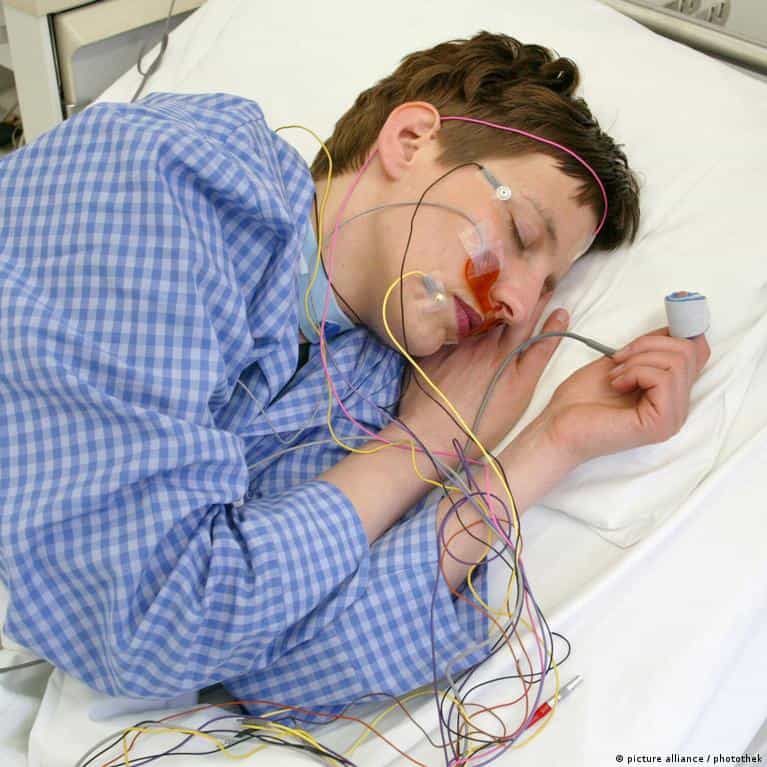
After just one night's sleep in a laboratory, during which physiological signals are recorded, a new artificial intelligence model can estimate a person's risk for around 130 diseases later in life. That includes risks for Parkinson's disease, dementia, heart disease and prostate and breast cancer.
The model is called SleepFM and it can make these predictions years before the first symptoms become evident, says Stanford University professor of biomedical data science, James Zou, a co-senior author of the the SleepFM study, published in early January in the journal, Nature Medicine.
SleepFM was fed nearly 600,000 hours of sleep data collected from 65,000 sleepers. The study and measurement of sleep is called polysomnography and it uses various sensors to measure brain waves, heart activity, breathing, muscle tension and eye and leg movements while the patient is asleep.
For SleepFM, the team used data collected primarily from Stanford University's Sleep Medicine Center in California in the US.
To view this video please enable JavaScript, and consider upgrading to a web browser that supports HTML5 video
First, SleepFM was shown signals from the brain, heart and body during normal sleep, with "normal" averages calculated statistically.
After that, SleepFM was taught about the different stages of sleep as well as sleep apnea, a disorder where breathing repeatedly stops and starts during sleep. The researchers then connected the sleep data with electronic health records going back 25 years and examined how later health diagnoses correlated with the measurements from polysomnography.
SleepFM was then able to detect patterns in the data and, out of around 1,000 possible diseases, identified 130 that could be predicted with medium to high accuracy using the data.
"Our results reveal that many conditions — including stroke, dementia, heart failure and all-cause mortality — are highly predictable from sleep data, further reinforcing the potential of sleep as a powerful biomarker for long-term health," said Rahul Thapa, a PhD student in biomedical data science and co-lead author of the paper.
"In principle, an AI model can be trained for a very large number of possible predictions, provided the basic data is available," says Sebastian Buschjäger, a German expert on machine learning at Dortmund's Technical University who has been working on a sleep-related project, Sleepwalker, in Germany (he was not involved in the US-based SleepFM project).
Analysis using advanced algorithmics showed that heart signals during sleep can help predict cardiovascular disease while brain signals are more significant for future neurological and psychological disorders. However, the most informative results come as a combination of all the different signals. For example, when the brain's electrical activity indicates a stable state of sleep but the heart actually appears more "awake."
Discrepancies like this between signals from the brain and heart may well point to hidden physical stresses caused by early disease, long before any overt symptoms are apparent.
"If our colleagues in sleep medicine suspect a connection, we AI specialists can incorporate this into a predictive system," Buschjäger explains, "and conversely, [we can] provide indications of where connections might exist."
Artificial intelligence can provide statistical correlations, he explains, but what they actually mean and any causal relationships must still be interpreted by medical experts.
SleepFM's predictions are primarily based on data from sleep labs, meaning data from people who were usually referred to doctors for sleep problems and who live in regions with access to high-tech medicine like this, which are likely to be more affluent areas.
The SleepFM researchers integrated data from US and European sleepers, but generally people without sleep problems and people from less affluent parts of the world are underrepresented in SleepFM's modelling.
SleepFM researchers also note that the artificial intelligence can't tell what caused a disease. It can only show correlations — that is, it identifies patterns that could be related to later diagnoses.
"Most AI methods do not learn causal relationships," explains computer scientist Matthias Jakobs from Dortmund's Technical University, who's also working on analyzing sleep data for the Sleepwalker project in Germany.
AI uses machine learning, programming that allows computers to find patterns in huge amounts of data. The machines "learn" from the patterns in the data.
But even if the computers only find statistical correlations, there is still potential for diagnosis and medical therapy, Jakobs wrote in an email interview with DW.
Models like SleepFM can record sleep stages or sleep apneas more efficiently, Jakobs says, which allows doctors to spend more time with their patients.
Buschjäger notes the crucial importance of interdisciplinary collaboration. "An AI [model] can be trained for planning therapy but it's humans — the doctors — who interpret the results and choose the therapy, often without knowing all the underlying causes," the data scientist explains.
There's also potential for sleep diagnosis like this that goes beyond the current correlations between polysomnography and disease prediction.
If certain sleep signals are repeatedly associated with specific diseases, they could well provide clues as to which processes in the nervous system, cardiovascular system or immune system are disrupted early on, experts say. This sort of information could help make everyone healthier, well beyond the sleep labs.
This story was originally published in German.
Editorial Context & Insight
Original analysis and synthesis with multi-source verification
Methodology
This article includes original analysis and synthesis from our editorial team, cross-referenced with multiple primary sources to ensure depth, accuracy, and balanced perspective. All claims are fact-checked and verified before publication.
Primary Source
Verified Source
Deutsche Welle
Editorial Team
Senior Editor
Marcus Thompson
Specializes in World coverage
Quality Assurance
Associate Editor
Fact-checking and editorial standards compliance