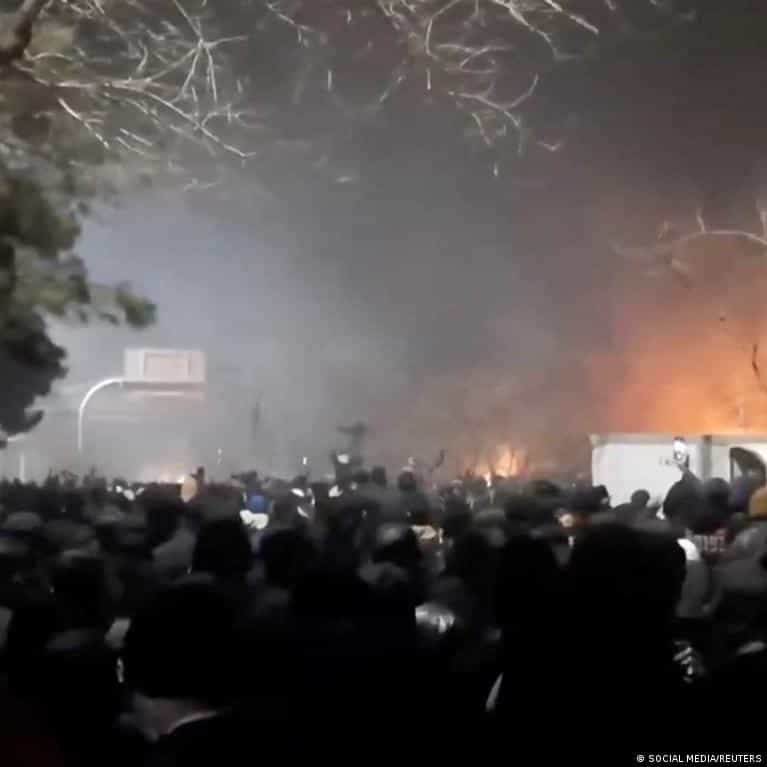
The death toll from Iran's crackdown on nationwide protests has risen sharply to at least 538 people, activists have said.
The US-based Human Rights Activists News Agency (HRANA) said more than 10,600 people have been detained.
According to the group, 490 of those killed were protesters and 48 were members of the security forces, adding that the toll is likely to rise further.
It said widespread internet shutdowns and blocked phone lines inside Iran have made it increasingly difficult to assess the scale of the unrest from abroad.
The activist group said its figures are based on cross-checked reports from activists inside and outside Iran and noted it has provided accurate casualty counts during previous waves of unrest. Iran's government has not released overall casualty figures
Journalists and rights groups are reporting that protesters are being killed in large numbers, according to information trickling out of Iran.
With an internet blackout and phone lines blocked, its been difficult to get an accurate picture of developments unfolding.
German-Iranian activist Daniela Sepheri spoke to DW about the dangers facing those who've taken to the streets.
"It's extremely dangerous for the people to go out and protest and they still do it. We are getting reports, horrible repords of massacres," Sepheri said.
She went on to say that regime security forces were directly targeting protesters and were "coming inside the hospitals to kidnap the wounded."
Sepheri spoke of the difficulty in verifying the numbers of dead and injured being reported.
"It's [very] difficult to verify the numbers that we are getting because of the Internet shutdown. Through Starlink it is possible to get some of the videos. Iranian exile media is verifying them all day long," Sepheri explained.
"We can only assume that there must be thousands of people that have been murdered only in these last two or three days," Sepheri said.
To view this video please enable JavaScript, and consider upgrading to a web browser that supports HTML5 video
On the question of why the regime was going to such measures to clamp down on protests, Sepheri said: "This is the only answer that the regime has, and this has been going on for decades. We have seen it in protests before, that the regime can only answer with violence because they do not care for the people's demands."
Sepheri said the type of violence was unlike anything she had ever seen before.
"But this kind of crackdown is the most brutal that we have ever seen," she said, adding: "Me personally, I have never seen anything like this before."
"The gap between rich and poor is so big that there is no middle class even left anymore in Iran and the richer the elite gets the poorer the people get," Sepheri said.
On the topic of how much longer the regime could last, Sepheri said she didn't believe Iran's leadership could hold onto power for much longer.
"I don't think that the regime can hold on for too long. The regime is weaker than ever before internationally. For example, in Syria, there is no Assad anymore or there's no Maduro in Venezuela as well," Sepheri said, adding that Iran's international partners were being taken down one after the other.
"People are not supporting this regime anymore. So the regime is fighting for its survival, but so are the people in Iran," Sepheri said.
Venezuela and Iran have been close economic and ideological partners for years and US actions in capturing Nicolas Maduro would have been cause for alarm in Tehran.
US President Donald Trump has also been threatening to take action should Iran kill protesters.
On the question of what happens next, Sepheri said she hoped for Iranians to choose their own destiny.
"My hope is that the people in Iran can change their future and change their country according to their own will, have free elections and a referendum," Sepheri said.
Touching on whether a collapse of Iran's clerical regime could lead to a restoration of the Iranian monarchy, Sepheri said: "This is something the people in Iran have to decide. There are some people who want the shah back, some people who don't," she said, adding that members of ethnic minority groups largely "do not want the shah back."
The exiled son of Iran's last shah, Reza Pahlavi, has said he wishes to return to Iran and play a political role.
His father, Mohammad Reza Pahlavi, was deposed in the 1979 Islamic Revolution.
Iran is highly ethnically and linguistically diverse, with a little over 60% of the population being made up of ethnic Persians.
Areas inhabited by the Kurdish and Baloch minorities have been major sites of unrest across multiple protest waves in Iran.
Israel's prime minister, Benjamin Netanyahu, hailed Iranian protesters and said he hoped for improved relations between Israel and Iran.
"We all hope that the Persian nation will soon be freed from the yoke of tyranny, and, when that day comes, Israel and Iran will once again be loyal partners in building a future of prosperity and peace for both peoples," Netanyahu said.
Iran was one of Israel's few allies in the Middle East between 1948, when Israel was founded, and 1979, when Shah Mohammad Reza Pahlavi was ousted in the Islamic Revolution.
Since then, Iran and Israel have been major regional adversaries, with Tehran also supporting the Palestinian militant group Hamas, as well as other militias that have come to blows with Israel such as Lebanon's Hezbollah and Yemen's Houthis.
Foreign Minister Gideon Saar said Israel backed the Iranian people.
"We support the Iranian people’s struggle for freedom and wish them success," Saar said in a post on X.
"We think they deserve freedom.. .. We don't have any hostility with the people of Iran," Saar wrote.
"We have a huge problem, which is not only our problem, it's a regional and international problem, with the Iranian regime which is the number one exporter of terrorism, radicalism," Saar added.
Iran and Israel are bitter enemies and were involved in a war in June, which culminated in an unprecedented Israeli attack on Iranian military and nuclear facilities.
The United States also briefly took part in the strikes, hitting three major Iranian nuclear facilities.
Iran backs a number of proxy groups operating around the Middle East, including Hamas in the Palestinian territories and militia groups in Iraq.
The US government estimates that Iran funds Hezbollah in Lebanon to the tune of about $700 million (€600 million) annually.
As protests against Iran's leadership intensify, access to accurate information is proving a challenge.
Iranian journalist Sima Sabet spoke to DW from London about what is happening, more than 60 hours into an internet blackout.
"No one is able to get into Internet from any part of Iran unless they have a Starlink. The news that we are receiving from Iran is extremely disturbing," Sabet said.
She said reports emerging from Iran spoke of hospitals in Tehran "full of injured and also bodies" of those killed during protests.
Sabet said that communication was proving to be a major challenge with phone lines disconnected.
"Most of the surgeons stay in the hospitals because there is no way of communication. Mobile phones are disconnected. Landlines are disconnected in many cities," Sabet said.
"So the picture that we have from Iran is very, very disturbing," Sabet said adding that families abroad had no way of communicating with loved ones.
On the question of how Iranians would respond to any US action amid reports of massacres, Sabet said: "I guess at the moment that could be the only hope for Iranians inside Iran because the government is killing in big numbers. Some sources they are saying within the first 48 hours of Internet blackout, they killed more than 2000 protesters."
"Of course, no one wanted international interference, but there is absolutely no way left because Iranians are on the streets. They are getting killed by the Iranian government and international help would really change the game," Sabet emphasized, adding that figures from different opposition factions signed a joint letter calling for "international action."
US President Donald Trump has said on multiple occasions that Washington could "help" Iran's protest movement in toppling Supreme Leader Ali Khamenei, while ruling out putting deploying US soldiers to the country.
On the topic of whether the son of the last shah of Iran, Reza Pahlavi, could return, Sabet said: "Yes ... he clearly mentioned that he's going back to Iran," she said, pointing to the last two messages Reza Pahlavi addressed to people in Iran.
"I understand that there are discussions about whether he represents everyone or not. I guess everyone who is in Iran, their main priority is that [the] Islamic Republic goes, they don't want [the] Islamic Republic in place," Sabet said.
The last shah of Iran, Mohammad Reza Pahlavi, was overthrown in the 1979 Islamic Revolution that established a cleric-led regime in the country.
His son, who has become a figurehead for part of Iran's protest movement, currently lives in exile in the United States.
By using violence and repression, Iran's theocratic regime has managed to cling to power and overcome several anti-government movements in recent decades.
Learn more about the history of protests challenging the clerical regime in Iran in this report.
As unrest grows in Iran, exiled Iranians and supporters have gathered across Europe in solidarity. Demonstrators demanded the justice, political change and basic human rights long denied to people in Iran.
Iranian President Masoud Pezeshkian has said the government will listen to protesters but warned that "rioters" shouldn't be allowed to disrupt society.
His remarks come after protests, which began in late December, have intensified in recent days.
"People have concerns, we should sit with them and if it is our duty, we should resolve their concerns," Pezeshkian said. "But the higher duty is not to allow a group of rioters to come and destroy the entire society."
Iranian state television aired the interview with Pezeshkian on Sunday. It had initially been suggested that it would be aired on Saturday.
Pezeshkian, a reformist, has previously said authorities should exercise "utmost restraint" when handling the demonstrations.
Iran Human Rights (IHRNGO) says it has confirmed the deaths of at least 192 protesters, as mass demonstrations continue across the country.
The Norway-based NGO cited some sources that say more than 2,000 people have been killed, but added that independent verification remained a "serious challenge under the current circumstances."
Iran's authorities have imposed a total communications blackout that has been in effect for nearly three days.
The NGO said it was deeply concerned over the killing of protesters and "the serious risk of mass executions of detainees."
"The killing of protesters over the past three days, particularly following the nationwide internet shutdown, may be even more extensive than we currently imagine," Mahmood Amiry-Moghaddam, the director of IHRNGO, said.
"The Islamic Republic is committing a major international crime against the people of Iran, and the international community is obligated, under international law, to use all available means to stop this crime," he added.
The human rights group pointed to official statements in which Iran’s Prosecutor General described all protesters as "mohareb" (enemies of God) — a charge that under Iranian law can result in the death penalty.
Anti-government protests in Iran show no sign of stopping. Human rights groups are say at least 116 have been killed, with 2,600 detained. US President Donald Trump has reaffirmed US support for the protesters.
More now from Niloofar Gholami from DW's Farsi Service, who says Iranian hospitals are "totally overwhelmed" by the number of killed and injured and people being brought in, according to reports emerging from the crisis-gripped nation.
"I've heard from hospitals in Tehran that are facing a severe shortage of blood supplies. Unfortunately, the risk of wounded people being abducted by security forces is also high," Gholami said, adding, "even hospitals are not safe for people."
"In many cases, security forces have also refused to return the bodies of those killed to their families. Another report from Tehran indicates that families were asked to pay huge amounts of money for the bullets used to kill their loved ones, claiming that the bullets were funded with public funds."
Gholami said that these protests appeared to pose a more serious challenge to the clerical regime than previous movements, which were met with security crackdowns.
"From the scale of the crackdown, the threatening statements by official and state media coverage, it is clear that the situation is completely different and it was unexpected for them," Gholami said, adding that the leadership appeared "unsettled" judging by their statements.
Protests in Iran are continuing amid an internet blackout that has now surpassed 60 hours, according to an online monitor.
Niloofar Gholami from DW's Farsi Service has been monitoring developments closely.
"Iran has now been offline for over 60 hours now, despite this, news and videos from yesterday have continued to emerge via Starlink connections," Gholami said.
"The protests are continuing with large crowds across many major and small cities. At the same time, the crackdown by security forces has become extremely violent and bloody."
Gholami said there were reports from a number of cities of "dozens of deaths," although verification of those details remains challenging.
"The regime is using every possible means to deter people from taking to the streets. This includes the use of drone patrols for the first time yesterday, an explicit threat to identify protesters through aerial surveillance," Gholami said.
Coupled with the internet blackout, electricity cuts had been experienced and phone services had also been disrupted.
Despite harsh repression, internet blackouts, and fears of dozens killed, activist Negin Shiraghaei tells DW demonstrators are still taking to the streets.
She says they're so fed up with the regime that they feel they have "nothing to lose."
The communications blackout that has blocked all internet and phone services in Iran has now passed the 60-hour mark, an internet monitor said.
"The censorship measure presents a direct threat to the safety and well-being of Iranians at a key moment for the country's future," monitor Netblocks said on X early on Sunday.
Editorial Context & Insight
Original analysis and synthesis with multi-source verification
Methodology
This article includes original analysis and synthesis from our editorial team, cross-referenced with multiple primary sources to ensure depth, accuracy, and balanced perspective. All claims are fact-checked and verified before publication.
Primary Source
Verified Source
Deutsche Welle
Editorial Team
Senior Editor
Sofia Andersson
Specializes in World coverage
Quality Assurance
Associate Editor
Fact-checking and editorial standards compliance