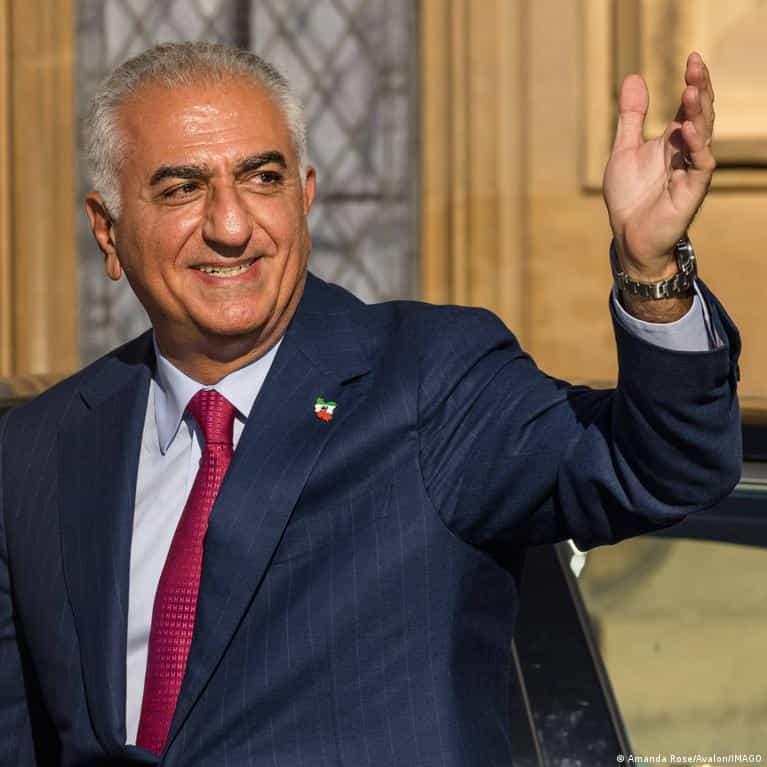
Since the overthrow of his father, Iran's last shah, Reza Pahlavi has spent nearly half a century exiled in the United States.
In uprisings in recent years, including at the start of 2026, Pahlavi has used his platform to call for greater action on the streets of Iran. As protests continue across Iran, he has cast himself as a pro-secular, pro-democratic voice in support of regime change.
Born in 1960, Pahlavi is the eldest son of Shah Mohammad Reza Pahlavi and his wife, Farah. He was formally named crown prince at the age of 7 during his father’s own coronation in 1967.
But Pahlavi has been unable to return to Iran since the overthrow of the US-aligned monarchy in 1979 in response to political suppression and rising inequality, leading to the theocratic regime that has ruled the country ever since.
Pahlavi had been undergoing fighter pilot training in the United States at the time of the revolution. He went on to study political science at the University of Southern California and permanently establish himself in the United States. He now speaks out against Iran's regime and has positioned himself as an advocate for democracy.
"My only mission is life is to situate that the Iranian people can ultimately determine their own future in a free and fair election," Pahlavi told DW in 2023. "The day that Iranians go to the poll to decide their future, that would be mission accomplished, and the end of my political mission."
Though he has publicly stated support for referendums that would allow Iranians to define their future governance, Pahlavi has also sought to position himself for a key transitional, and potentially longer-term, leadership role in Iran.
At the time of Israel’s 12-day war on Iran in June, Pahlavi put himself forward as an interim leader should the government collapse.
"I am here today to submit myself to my compatriots to lead them down this road of peace and democratic transition," he said at a press conference in Paris. "I do not seek political power, but rather to help our great nation navigate through this critical hour towards stability, freedom and justice."
At that press conference, he announced several plans and strategies for a democratic transition for Iran based on principles of "territorial integrity, individual liberties and equality of all citizens and separation of religion and state."
"The final form of this future democracy we seek will be for the Iranian people to decide in a national referendum," he said.
Pahlavi has flagged the potential for Iran to become a constitutional monarchy, similar to other states with figurehead monarchs and executive power handed to parliaments, potentially with an elected ruler.
To view this video please enable JavaScript, and consider upgrading to a web browser that supports HTML5 video
Exiled for nearly 50 years now, Pahlavi and his family still receive support from Iranian diaspora communities.
Many of the groups that most vocally support Pahlavi have a strong presence in the media and on social media, which is highly restricted within Iran, making it difficult to gauge how people within Iran feel about Pahlavi.
And, given that multiple generations of Iranians have never known monarchy, a key question is whether the country would support its return in 2026.
Pahlavi could, however, play a role in the transition from the Islamic Republic.
"At some point this movement needs a political figurehead as a manager, if not a 'rallying around' figure," Alex Vatanka, a regional security affairs expert at the US-based Middle East Institute, told DW in an email. "No one out there has the name recognition and pedigree Pahlavi can bring even as he has a steep climb ahead of him to convince the many skeptics that he can be a faithful manager of the transition to post-Khamenei Iran, and not going to consolidate [power] for himself at the first opportunity."
In fact, Pahlavi's own actions on the international stage could potentially undermine support for him within Iran. In recent years he has courted heads of state and people of influence around the world. Most notably, he met with Benjamin Netanyahu on a trip to Israel in spring 2023, and the prime minister has remained one of the exiled crown prince's major backers.
Given the decades of hostility between Iran and Israel, the partnership is an issue for many Iranians, who see Netanyahu’s government as an aggressor, particularly in the aftermath of the 12-day war in June.
There remains great uncertainty about whether the current protests could bring down the regime in Iran.
In messages posted to social media, Pahlavi has called for nationwide strikes and protests against the regime to continue. More recent messages have been cautious, particularly in the wake of the clampdown on protesters.
Though the opposition has been cheered by the participation of merchants historically supportive of the regime in protests in Tehran, observers are skeptical about the prospect of a suddenly democratic Iran.
"The Iranian state is very well entrenched and crisis-prone — both institutionally and in terms of the security organs," Arshin Adib-Moghaddam, co-chair of the SOAS University of London Centre for Iranian Studies, told DW in an email. "Therefore, these demonstrations alone will not replace the system. Serious scholars of Iran know that most of what we are hearing about the country is a political mirage and far from the reality on the ground."
That view is shared by Vatanka, who said the ability for protesters to sustain their street presence and pressure defections within the regime, and for external actors such as the United States and Iranian diaspora to "shape events" from outside Iran.
Vatanka said the regime's ability to hold on to power depends of whether it can again withstand public opposition.
"The question is not only can they overcome these protests but can they muster the strength to contain the next one, which is surely just around the corner, even if this one fails to bring down the regime," Vatanka wrote.
Editorial Context & Insight
Original analysis and synthesis with multi-source verification
Methodology
This article includes original analysis and synthesis from our editorial team, cross-referenced with multiple primary sources to ensure depth, accuracy, and balanced perspective. All claims are fact-checked and verified before publication.
Primary Source
Verified Source
Deutsche Welle
Editorial Team
Senior Editor
Sofia Andersson
Specializes in World coverage
Quality Assurance
Associate Editor
Fact-checking and editorial standards compliance