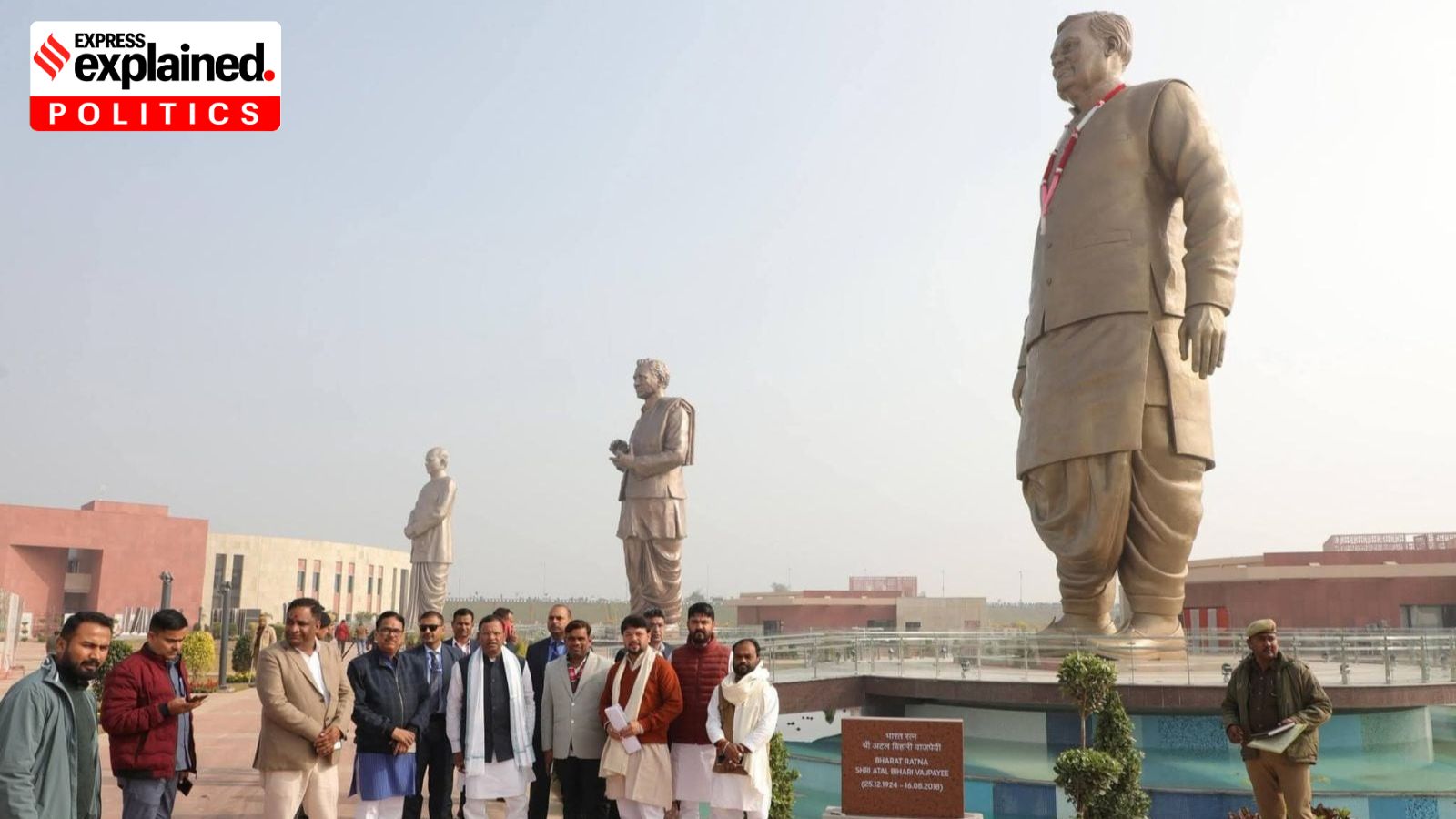
Prime Minister Narendra Modi inaugurated the Rashtra Prerna Sthal in Lucknow on Wednesday (December 25), unveiling grand statues of three iconic figures in the Sangh and Bharatiya Janata Party (BJP) pantheon: Dr Syama Prasad Mookerjee, Pandit Deen Dayal Upadhyay, and Atal Bihari Vajpayee.
Here are brief political profiles of these leaders, and how they were guiding forces behind Opposition politics and coalition efforts to stall Congress dominance post Independence.
Syama Prasad Mookerjee was the son of polymath jurist Ashutosh Mookerjee. Born in 1901, he studied law and followed on the footsteps of his father to become the youngest vice-chancellor of Calcutta University.
He entered politics in 1929; by the mid-1930s, he was among the foremost Hindu nationalists in the scene. He served as president of Hindu Maha Sabha between 1943 and 1946.
Jawaharlal Nehru appointed Mookerjee as the Minister of Industry and Supply in his interim government, formed on August 15, 1947. After Mahatma Gandhi’s assassination, Mookerjee fell out with the Mahasabha, eventually quitting the organisation 1948.
By 1950, he had also developed serious differences with Nehru; he resigned from the interim government on the back of the Liaquat-Nehru Pact. He was now searching for a new political path.
Meanwhile, the RSS, which had been implicated in Gandhi’s assasination, realised that it had no voice among the political classes, and no one to defend it. Several pracharaks, like Rajendra Singh, Bala Saheb and Bhaurao Deoras, Nanaji Deshmukh, Deen Dayal Upadhyay, and Atal Bihari Vajpayee, among others, were of the view that the Sangh should enter politics.
However, Sarsanghchalak M S Golwalkar did not agree. On the suggestion of his own colleagues and well-wishers outside RSS, Golwalkar gave a go ahead for a new party — the Bharatiya Jana Sangh (BJS).
Mookerjee would join hands with the RSS in its new political endeavour. Under him, the BJS was formed nationally in a convention in Delhi on October 20-22,1951. BJS contested 94 Lok Sabha seats in the first general elections and won three seats—Mokkerjee himself from Calcutta South East, Durgacharan Bandyopadhyay from Midnapore Jhargram, and Umashanker from Chittor in Rajasthan.
What was more interesting, that in the very first Lok Sabha in which Congress had as many as 364 out of 489 seats, Mookerjee formed a joint Opposition of 38 members (32 in Lok Sabha and 6 Rajya Sabha) comprising eight parties, including a few independents. Mookerjee was among the most vocal opponents of Nehru’s politics around Jammu & Kashmir. He launched a campaign against the Nehru-Sheikh Abdullah agreement of 1952. He was arrested on May 11, 1953, after he entered Kashmir to lead a satyagraha. He died in prison on June 23, at the age of only 51.
As one of the founders of the BJS, the political precursor to the BJP, and for his ideas on Hindu nationalism, especially regarding the integration of Kashmir with the rest of India, Mookerjee is remembered as an icon of the saffron party.
Deendayal Upadhyay was among the founders of BJS, who had been elected as its president in Calicut in the party’s 14th national convention in 1967.
Born in a village near Mathura, Upadhyay was a protégé to Golwalkar who asked him to study a book titled Daishik Shastra (written by Badrishah Tugharia). He studied the book in 1959 and came up with a philosophy of Ekatma Manavvad (Integral Humanism). This is now propagated as a driving force behind BJP economic ideals.
As general secretary of the BJS, he nurtured several young political activists who became leaders of BJS, and later, leaders for the BJP in the Centre and states.
After the 1962 polls, and particularly after the India-China war, efforts for Opposition unity against Congress were gaining momentum. In 1963, BJS formed an alliance with socialist Dr Ram Manohar Lohia and Gandhian J B Kripalani. Upadhyay, Lohia and Kriplani contested bypolls with each other’s support: Upadhyay from Jaunpur, Lohia from Farrukhabad, and Kripalani from Amroha. Although the latter two won, Upadhyay lost from Jaunpur.
Upadhyay rallied the Opposition against Congress in the 1967 general elections; that year, BJS was a part of successful coalitions in several states, such as UP, Bihar, MP, Punjab, and Haryana. This was a big setback for the Congress which was then under the control of Indira Gandhi.
After this, many Congress leaders quit the party, including Charan Singh in UP, Rao Virender Singh in Haryana, and Govind Narain Singh in MP, to join Opposition alliances. These Opposition victories can largely be credited to Upadhyay and Lohia.
On February 11, 1968, Upadhyay’s corpse was found near the Mughalsarai Railway junction near Varanasi (the station has now been named after him).
Unlike Mookerjee, who died very soon after the BJS’s formation, Upadhyay guided the party through several ups and downs over the years. Today, the policies and programs of the BJP often have a far greater impact of Upadhyay than of Mookerjee; his Integral Humanism remains a core philosophical tradition championed by the saffron party.
Atal Bihari Vajpayee was among the tallest leaders of Independent India, someone who was active in electoral politics from the first Lok Sabha polls in 1951-52, till 2009, when he quit active politics due to his failing health. In fact, much of BJS-BJP’s history can be viewed as a biography of Vajpayee.
While Mookerjee laid the foundation of BJS and Upadhyay nourished it into a significant political outfit by forming alliances and coalitions with other parties, Vajpayee was the first BJP leader to hold power at the Centre.
Just like in 1967 when Upadhyay formed an alliance to challenge Congress, 1977 saw the opposition unite once again to bring an end to the Emergency imposed by Indira Gandhi. Vajpayee was among the key personalities who played a big role in the formation of the Janata Party by merging four big and some small parties just before 1977 general elections. He served as the Minister of External Affairs under the government of Morarji Desai in 1977.
Considered among the moderate faces of the saffron outfit, Vajpayee was known to be a brilliant orator (he was afterall an accomplished poet), who brought his very own style in politics. His idiom was always accessible to the masses, and he enjoyed support across party lines like no other saffron party leader before (or perhaps even after) him.
His political journey was full of ups and downs. After former BJS politicians quit the Janata party to revive their own saffron outfit, now under the name of the BJP, the party struggled for a few years, winning only two seats in the 1984 polls. Vajpayee himself lost from Gwalior to Congress’s Madhavrao Scindia.
However, he remained a strong face in the Opposition, and together, with Lal Krishna Advani, he gradually helped consolidate the BJP’s position, particularly in North India. The Vajpayee-Advani duo remained at the helm of the BJP till 2004 when his government lost the mandate and he had to resign as Prime Minister (Advani was his deputy-PM).
He was the first Prime Minister from BJP and remained in power, between 1998 and 2004, heading a multi-party coalition called National Democratic Alliance (NDA). This was a significant achievement, given how the party’s hardline Hindutva politics had long kept coalition partners away. Vajpayee was able to change the perception: he kept allies close while also continuing to champion core BJP issues.
Vajpayee has had an outsized impact on the BJP, perhaps more than any other leader till date. Most BJP leaders who were in prime positions till a few years back, and many who still occupy high positions in the Centre, were nurtured by the Vajpayee-Advani duo, including Modi himself.
Even as the BJP goes through generational changes, the stature and impact of Vajpayee on the party, and on non-Congress politics in the country as a whole, remains unparalleled.