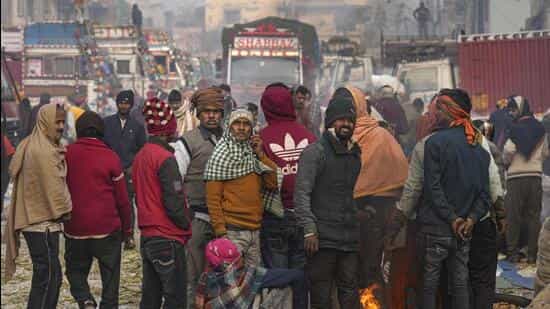
Cold wave conditions continued for a fifth day, as northwesterly icy winds and dense fog plunged the mercury 4.5 degrees below normal at Safdarjung, Delhi’s representative weather observatory, to 2.9°C, compared to 3.8°C on Wednesday and 3°C on Tuesday, and the air quality remained “very poor”. Air and rail traffic was disrupted as the visibility at Safdarjung dipped to 100 metres and 500 metres at Palam.
Data from the flight tracking website Flightradar24 showed over 200 flights were delayed at the Delhi airport. The average delay time for departures was 49 minutes. Trains were also running late, the Northern Railways said.
The minimum temperature at Safdarjung on Thursday was the lowest since January 18, 2023, when the mercury settled at 2.6°C. The Palam weather observatory recorded a minimum temperature of 2.3°C on Thursday, five degrees below normal and the lowest for it in 20 years. On January 8, 2006, the mercury at Palam plummeted to 0.3°C.
The cold wave conditions were expected to abate from Friday onwards as a feeble western disturbance was approaching and likely to raise the night-time temperatures. The minimum temperature is forecast to rise to a range of 6-8°C on Friday. By Sunday, it is expected to be between 8 and 10°C.
A cold wave is declared when the minimum temperature is below 10°C, while its departure is also 4.5°C or more below normal. The minimum temperature of 4°C or lower is also classified as a cold wave.
The western disturbance expected to start impacting the Himalayan region from Thursday is likely to change the wind direction.
Private forecaster Skymet Weather vice president Mahesh Palawat said the minimum temperatures should rise in the absence of cold northwesterly winds for a few days. “A second, more active western disturbance is expected to bring rain across the plains on January 22 or 23,” he said.
A 24-hour average Air Quality Index (AQI) of 349 (very poor) was recorded at 9am on Thursday, compared to 353 (very poor) at 4pm on Wednesday. “Very poor” air quality was expected until at least January 23.
Editorial Context & Insight
Original analysis and synthesis with multi-source verification
Methodology
This article includes original analysis and synthesis from our editorial team, cross-referenced with multiple primary sources to ensure depth, accuracy, and balanced perspective. All claims are fact-checked and verified before publication.
Editorial Team
Senior Editor
Aisha Patel
Specializes in India coverage
Quality Assurance
Quality Assurance Editor
Fact-checking and editorial standards compliance