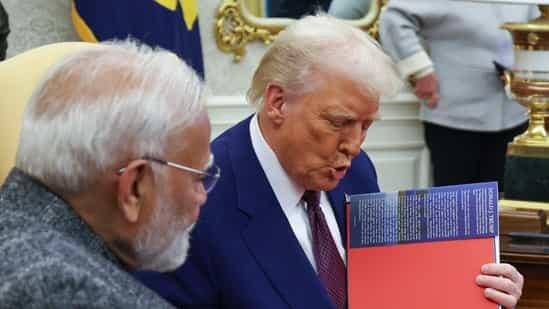
It's been nearly five months since the tariffs on Indian exports to the US hit a massive 50% — half of it termed “penalty” by President Donald Trump over India's purchase of Russian oil — and there continues to be uncertainty on when a trade deal may be struck, if at all.
Trade negotiations between officials of the two countries have been underway since before the tariffs took effect, having formally started in March-April last year after a February greenlight for talks. Statements made by Trump and some key officials in his administration over the past few days have further deepened the mystery.
One of Trump's key aides, US commerce secretary Howard Lutnick, claimed that a potential trade deal between India and the US fell through due to Prime Minister Narendra Modi “not calling” the US President. Another recently claimed that Trump has greenlit a bill which could potentially hike the tariffs on India to 500%. These looked like ominous signs of how Trump is seeing the future of US-India ties despite proclaiming friendship with PM Modi.
India was quick to reject Lutnick's claims. Hope re-emerged after the new US ambassador to India, Sergio Gor, recently said the US considers India an important partner, and that trade talks remain underway.
To gauge the situation as of now, here's who said what over the past few days: Donald Trump dropped a big hint earlier this month that his administration could further increase tariffs on India. During an interaction with the media aboard Air Force One, Trump called PM Modi “a good guy”.
“India wanted to make me happy. Modi is a very good guy and he knew I was not happy. And it was important to make me happy. We can raise tariffs on them very quickly,” Trump said.
These remarks came just a couple of months after he claimed that PM Modi had “assured” him that India would put an end to its oil trade with Russia, which was central too the US doubling its tariffs on India back in August 2025.
The US administration has long been miffed with the energy ties India and Russia share. Trump and his administration's officials have claimed in the past that Russia uses the proceeds of this energy trade with India to fuel the offensive in Ukraine. The tariffs on India, which earlier stood at 25%, were doubled as a way to put pressure on Russia to stop the Ukraine conflict, US officials have said.
Days after Trump hinted at hiking tariffs on India, Lindsey Graham, a US senator, made remarks that echoed the same sentiment. He claimed that the US President "greenlit" the Russia sanctions bill, which would not only increase sanctions on Moscow but also on its trade partners, including India.
“After a very productive meeting today with President Trump on a variety of issues, he greenlit the bipartisan Russia sanctions bill. I look forward to a strong bipartisan vote, hopefully as early as next week," Graham wrote in an X post last week.
One of the provisions of this sanctions bill, which is only a proposed legislation at present, stands to affect India. It calls on Trump to impose “at least 500% tariffs” for “all goods and services imported into the United States from countries that knowingly engage in the exchange of Russian-origin uranium and petroleum products". Graham said this would provide “tremendous leverage" against countries like China, India and Brazil.
US commerce secretary Howard Lutnick, who has been one of the most vocal supporters of Trump's 50% tariffs on India, recently made a big claim on the ongoing negotiations between the two countries.
In a podcast, Lutnick claimed that a possible trade deal failed right before it could be finalised because PM Modi “didn't call” Donald Trump. Lutnick said he was the one who set the agreement up, adding “I said I've got to have Modi call the President... they (Indians) were uncomfortable doing it, so Modi didn't call.”
He even said that the trade deal with India was supposed to be finalised before deals with countries like Indonesia, Vietnam and Philippines.
“The characterisation of these discussions in the reported remarks is not accurate," MEA spokesperson Randhir Jaiswal had said, adding that India remains open to a mutually beneficial deal.
Union minister Piyush Goyal also urged Indians to not trust foreign statements. “Trust your country, your motherland, not foreign statements,” Goyal told NDTV at the channel's event when asked about Lutnick's remarks.
As questions linger over the future of the India-US trade ties, external affairs minister S Jaishankar spoke to US secretary of state Marco Rubio over the phone on Tuesday.
They discussed bilateral cooperation, including trade, critical minerals, nuclear energy, defence and energy, officials said.
Jaishankar said he had a “good conversation” with Rubio, adding that the two would remain in touch on these and other issues.
Despite the US's repeated criticism of India's oil trade with Russia, New Delhi has always maintained that its energy sourcing are guided by "what is on offer in markets and prevailing global situation", and the needs of the Indian consumer.
Editorial Context & Insight
Original analysis and synthesis with multi-source verification
Methodology
This article includes original analysis and synthesis from our editorial team, cross-referenced with multiple primary sources to ensure depth, accuracy, and balanced perspective. All claims are fact-checked and verified before publication.
Editorial Team
Senior Editor
Aisha Patel
Specializes in India coverage
Quality Assurance
Associate Editor
Fact-checking and editorial standards compliance