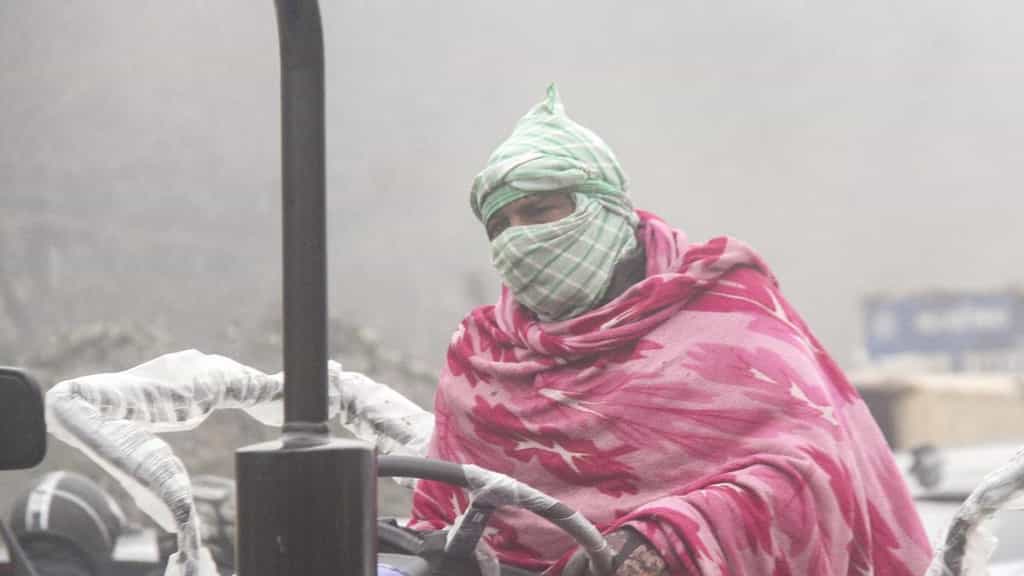
As fog floated across cityscapes and open grounds in northern states, the winter weighed much heavier, pushing mercury down to near-freezing temperatures in many areas which experienced the coldest night of the season.
Haryana’s Gurugram and Punjab’s Bathinda recorded a low of 0.6°C, while Fatehpur in Rajasthan’s Sikar district crossed the freezing point threshold to reach minus 0.4°, the local meteorological departments said on Monday (January 12, 2026).
Near sub-zero temperatures were reported from the NCR region, including in Faridabad and Rewari, leading to ground frost. A layer of ice covered the windshields of some vehicles parked outside homes in Gurugram and turned dry grass brittle. The frost was particularly visible in rural areas on farm boundaries and vehicle windows.
According to official records, Gurugram recorded a low of 0°C on January 11, 1971. However, it cannot be said if Sunday (January 11) night’s temperature is an all-time low for the city, as data for every year is not available.
The India Meteorological Department (IMD) has warned that severe cold and dense fog conditions are likely to persist across North India in the coming days.
In the national capital, the minimum temperature settled at 3.2°C, plunging 4.2 notches below the seasonal average, marking the coldest January day in the city since 2023, as well as the second consecutive day of cold wave conditions.
The maximum temperature in Delhi on Monday (January 12) was recorded at 20.6°C, which was 0.7 notches above normal.
The IMD said the city will witness mainly clear skies, with moderate fog at many places and dense fog at isolated locations during the morning hours. Cold wave conditions are expected to prevail at a few places across the city.
The minimum and maximum temperatures are expected to be around 4° and 20° on Tuesday (January 13).
In Rajasthan, intense cold conditions persisted as temperatures dipped sharply.
Several districts recorded near-freezing night temperatures, disrupting daily life and forcing people to stay indoors.
According to the weather office, night temperatures remained below 8°C in many areas. Isolated pockets of the state experienced severe cold wave conditions.
After Fatehpur, Lunkaransar in Bikaner at 0.4° and Churu at 1.3°C were the second and third coldest recorded places in the state.
Other places like Ganganagar and Karauli recorded a minimum temperature of 1.4 and 1.5°C, respectively.
Biting cold affected residents during the night and early morning hours.
Shallow fog reduced visibility in several regions, while dense fog in western Rajasthan slowed vehicular traffic during the early hours. Residents in several towns were seen using bonfires to keep themselves warm.
The meteorological department has forecast that cold wave to severe cold wave conditions will likely continue in parts of the state over the next day.
The department has advised the public, especially children and the elderly, to take necessary precautions as the cold spell persists.
In Punjab and Haryana, most places and their common capital, Chandigarh, have been swept by severe cold conditions over the past several days, with fog reducing visibility in many areas. Chandigarh recorded a minimum temperature of 3.3°C.
Gurugram residents said they have not witnessed such frigid conditions in years.
“During severe winters, minimum temperatures do dip in Gurugram. However, I do not recall the mercury dropping close to the sub-zero level in the past many years,” said Vinod Kumar, a local.
“Intense cold weather is likely to continue in Punjab and Haryana over the next three days. After this, the cold weather conditions will prevail, but severe cold is likely to abate,” Chandigarh Meteorological Department Director Surender Paul told PTI over the phone.
In Haryana, Narnaul was the second-coldest place with a minimum temperature of 1.2°C.
Devi Ram, a farmer from Haryana’s Binola village, described the biting cold on Monday (January 12) morning, noting, “When I went to the fields early this morning, it felt like a white sheet had been spread over the crops. Dew was falling, making my clothes wet within minutes. The cold was so severe that I had to start a bonfire. This frost is beneficial for the wheat crop, but the vegetable crops will suffer losses.”
While the frost benefits the wheat crop, it negatively impacts vegetable crops such as potatoes, peas, radishes, and mustard. Agricultural scientist Dr Anand Kumar advised farmers to perform light irrigation to protect mustard and other crops from frost damage.
Meanwhile, Kashmir received some respite from intense cold wave conditions as minimum temperatures rose by a couple of degrees, even as they remained below the freezing point, officials said.
The sub-zero temperatures and clear skies resulted in freezing of parts of the Dal Lake and other water bodies in the valley.
Srinagar recorded a minimum temperature of minus 2.4°C on Sunday (January 11) night, up from the previous night’s minus 5.2°C, officials said.
South Kashmir’s Pulwama town was the coldest place in the valley with a minimum temperature of minus 6.5°C.
In Himachal Pradesh, the local meteorological centre predicted a wet spell in the high hills from January 16 and issued a yellow warning for cold wave at isolated places in Chamba district till Wednesday (January 14).
It also issued a yellow alert for dense fog at isolated places in seven out of the 12 districts in the state -- Una, Bilapsur, Hamirpur, Kangra, Mandi, Solan and Sirmaur — till January 15.
“Light rain and snow are likely at isolated places in the high hills from January 16 to 18 as a fresh western disturbance is likely to affect the western Himalayan region from January 15,” the Met centre said.
The weather remained dry in the past 24 hours, with a severe cold wave in Berthin (Bilaspur) and Hamirpur and a cold wave in Kangra, Una and Mandi.
There were no significant changes in the minimum and maximum temperatures, with Kukumseri in Lahaul-Spiti recording the coldest night temperature at minus 9.6°C, it said.
In Uttar Pradesh, cold weather conditions prevailed across large parts, with day temperatures in major cities ranging between 13°C and around 19°C, according to the IMD.
In the state capital Lucknow, the temperature was recorded at 13°C with relative humidity at 72%, while wind speed stood at 9.3 km per hour, as per observations at 7:30 p.m.
Similar cloudy conditions were shown across several districts on the IMD weather map, including Meerut, Bareilly, Pilibhit, Bahraich, Gorakhpur, Prayagraj, Kanpur, Agra, Jhansi and Varanasi.
Among other major cities, Prayagraj recorded a temperature of 19.2°C with 68% humidity, while Bahraich reported 19°C. Bareilly logged 13.8°C and Gorakhpur 18°C. Jhansi recorded 18.8°C and Meerut 15°C during the day.
Wind conditions remained mostly calm in several locations, including Bahraich, Bareilly, Gorakhpur, and Meerut, while light winds were reported from the west or southeast in cities such as Prayagraj and Jhansi, according to officials.
Editorial Context & Insight
Original analysis and synthesis with multi-source verification
Methodology
This article includes original analysis and synthesis from our editorial team, cross-referenced with multiple primary sources to ensure depth, accuracy, and balanced perspective. All claims are fact-checked and verified before publication.
Editorial Team
Senior Editor
Dr. Elena Rodriguez
Specializes in India coverage
Quality Assurance
Fact-Check Editor
Fact-checking and editorial standards compliance