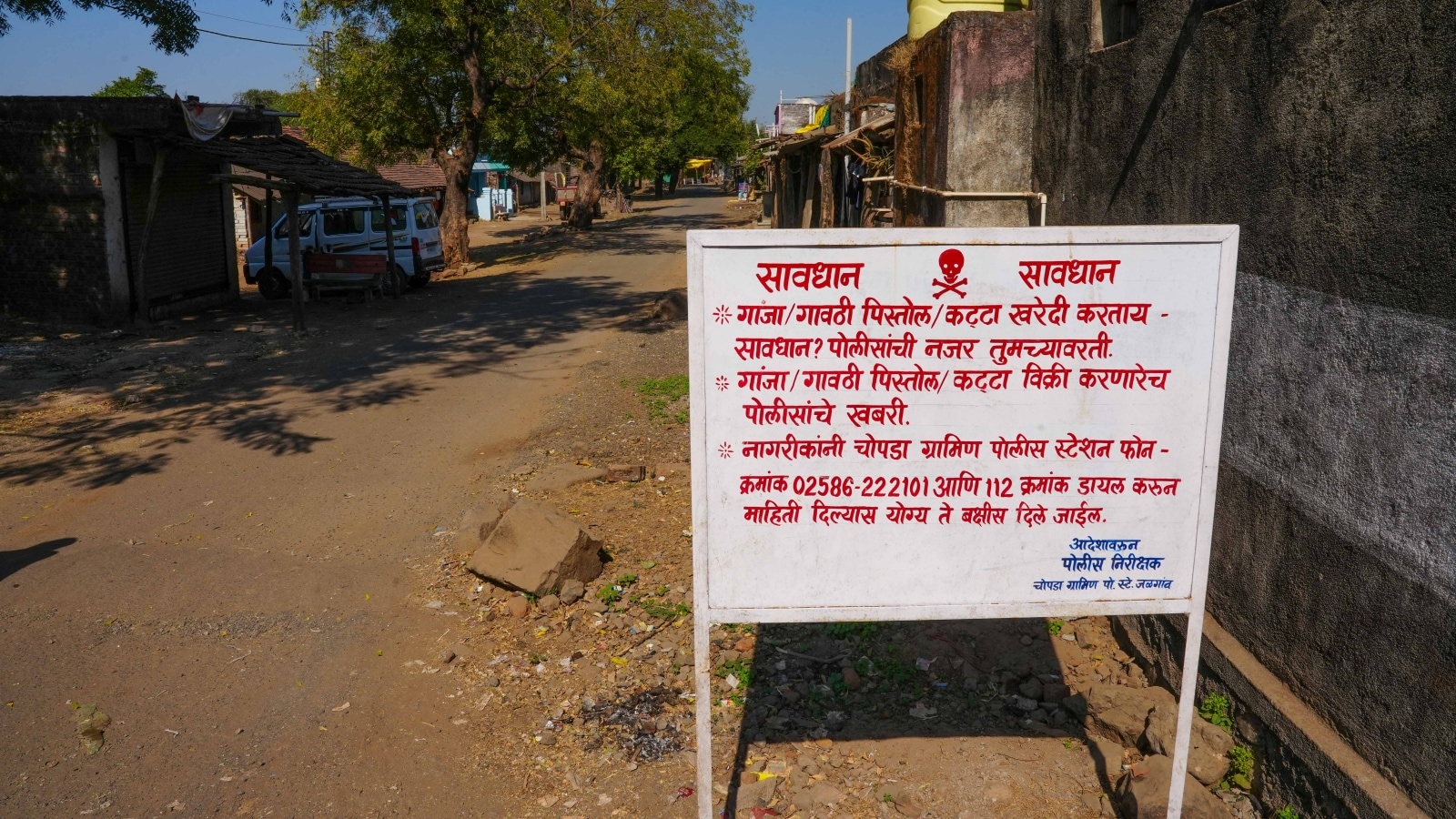
A board on the road towards Umarti village in MP warns: ‘Purchasing country-made pistols? Beware. Police are watching you’. (Arul Horizon)
“Saavdhan. Are you purchasing country-made pistols? Beware. Police are watching you…,” warns a board on a road leading towards Umarti. While the warning is meant for those going to Umarti village in Barwani district of MP, it is installed at Umarti village in Maharashtra’s Jalgaon district. The villages are connected by a small bridge over the river Aner on the Maharashtra-MP border.
There is a reason the warning is put up at Maharashtra Umarti too — the rise of its counterpart as a hub of illegal weapons, sold under the unofficial brand name ‘Umarti Sikligar Arms’, or ‘USA’. The village with around 300 homes has a population of about 2,000, mainly comprising a Sikh sub-community called Sikligars, and tribals from the Barela and Bhil communities. Last month, the Pune City police conducted one of the biggest raids on Umarti’s illegal firearm units, after probes into sensational gang war murders and seizure of country-made pistols kept throwing up the village’s name.
The raid came days after six minor boys detained from Pimpri-Chinchwad in Pune over a murder were alleged to have procured two pistols and as many cartridges from a weapons dealer in Umarti for Rs 50,000. Travelling about 500 km, 105 police personnel, led by DCP Somay Munde and accompanied by counterparts from Jalgaon and Barwani police teams, entered Umarti early November 22. DCP Munde, a recipient of Shaurya Chakra for his participation in anti-Maoist operations, says their preparation for Umarti was rigorous.
“We started the raid at 4 am, and carried arms, ammunition and bullet-proof jackets. A temporary wireless network was set up, and the men wore body cameras linked to a live-feed monitoring system in Pune. Drones were deployed for aerial surveillance.” Police claimed to have destroyed 50 kilns used for moulding and production of weapons, at four illegal units. They seized country-made pistols, cartridges, magazines, over a hundred barrels, 14 grinding machines, 15 pistol bodies, a few sharp weapons and several firearm spare parts buried in the ground. Forty-seven people, all Sikligars, were detained. Barring 10, all were released later.
While the units were found to be rudimentary, working out of households, an officer said this was deceptive. A trained Sikligar could manufacture a pistol in two-three days in Umarti, a source said. Narayan Rawal, in-charge of Warla police station, says the units are hard to crack as pistols are made from raw material “that is easily available in scrap and hardware shops”.
The Madhya Pradesh Police is investigating, however, if the Umarti gunmakers may now have links with inter-state racketeering, after the seizure of over a thousand gun barrels in the past few months. Inspector Kaveri Kamlakar, who has been part of operations in Umarti, says: “Not just desi kattas costing a few thousand rupees, we have recovered fine-quality pistols sold for up to Rs 1 lakh each…”
Umarti sarpanch Ramesh Tarole, from the Barela tribe, says the activities of a few are giving them all a bad name. Villagers proudly offer Umarti’s “success stories” instead — a Sikligar who is now an Indian Army Commando, a 12-year-old budding cricketer based in Mumbai.
Rajpal Singh Juneja, whose brother is in the Army, says: “Many are into farming, some have other businesses, nothing to do with firearms.” A teacher, Nishan Singh Juneja, points to the fact that “over 200 Sikligar children study in English-medium schools”. Umarti’s former deputy sarpanch Attarsingh Barnala says: “Our children do not want to join the weapons trade. My son did an MBA… We look for the government’s support to improve our situation.”
Jayanti Singh, District Collector, Barwani, admits that while they are trying to wean the Sikligars away from their traditional profession, “success is limited”.