Children’s relationship with games and activities is evolving. With changing lifestyles and early exposure to technology, the thrill kids seek today is no longer limited to soft toys or board games. What excites them now extends to smartphones, bigger screens, gaming consoles, remote-controlled toys, drones and augmented reality (AR) experiences.
All of the noise has resulted in an increasingly shrinking attention span. This change in pattern is particularly concerning for toy makers, who are running out of ideas to keep them engaged and entertained. This rising appetite for interactive, tech-driven play has also created pressure on manufacturers to innovate like never before.
It is within this shift that Mirana Toys has found its footing.
The startup is positioning itself as an AR-led toy company that blends physical toys with mobile apps, games and digital experiences. Its portfolio spans AR-enabled RC cars, creative and indoor games, terrain-based racers and AI-powered toys, all designed to be controlled via a proprietary mobile application.
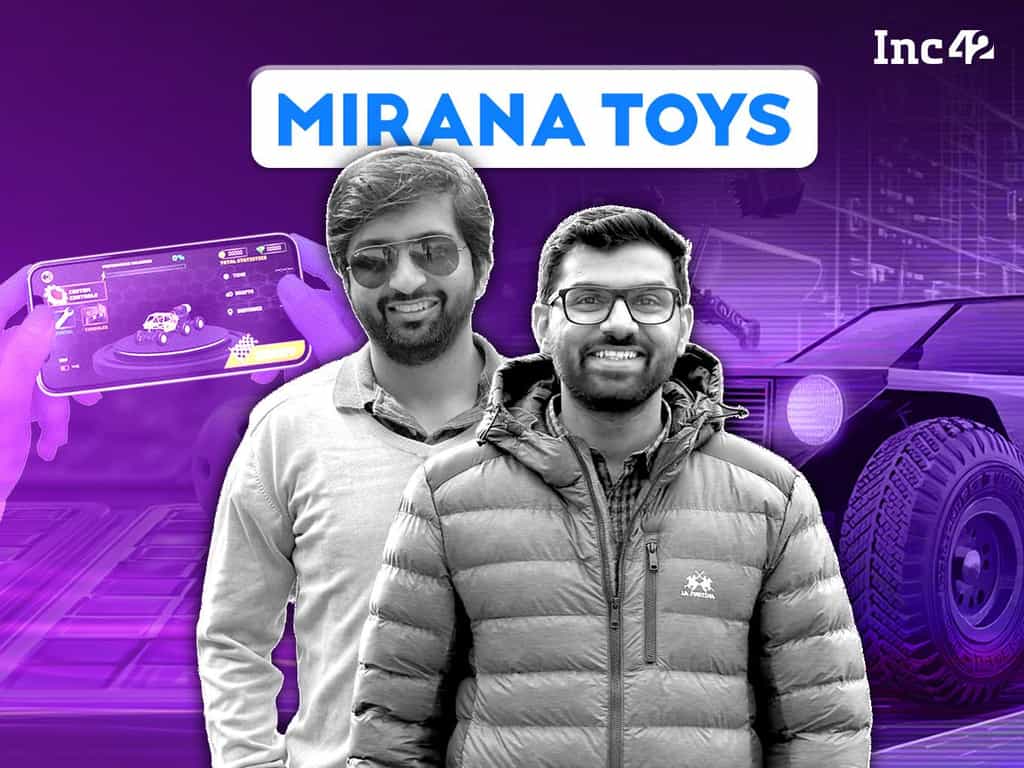
Founded by Devansh Sharma and Ravi Yadav in 2021, Mirana Toys designs and manufactures smart toys and educational products. The founders believe that the future of toys lies at the intersection of manufacturing, software and immersive play. However, what stands out is that Mirana Toys was born out of a smart home venture.
Sharma and Yadav, IIT Bombay alumni, founded Zemote Home Automation, an IoT-based smart home products venture, in 2017. The two had known each other for nearly a decade. They bonded early through their shared interest in robotics at IIT Bombay. Later, the two worked together at multiple startups.
The pivot to toys, however, was an unforeseen phenomenon.
During the Covid-19 pandemic, with vendors relatively free and the government imposing higher import duties on Chinese toys while pushing local manufacturing, Sharma found himself with time to explore a new category. Out of curiosity, and almost as a passion project, he decided to build a toy.
“I made a simple toy, a hover football, and launched it,” he said, adding that it became an instant hit.
The founder launched the hover football on ecommerce marketplaces. Soon, he was able to sell more than 4-5 Lakh units. The response triggered deeper conversations between Sharma and Yadav on whether toys could become a serious business.
Over the next three to four months, the duo conducted extensive research, studying the Indian and global toy markets, tracking Chinese toy factories, and analysing why the Indian government was aggressively backing the sector.
“One insight stood out… innovation in toys had stagnated. Most toys were still designed on concepts from 10–15 years ago,” Sharma said.
There was a clear chance to blend their technical expertise with manufacturing and digital innovation. And so they did with a thesis to make toys that can keep children engaged.
To achieve this, the founders began exploring mobile app integration, connected toys, and AR-based gaming. The aim — to increase play value and make toys more immersive and interactive.
The brand name Mirana Toys was already in place from day one. Sharma had registered multiple names during his Zemote days, anticipating future ventures, and Mirana felt like the right fit when the toy experiment began.
With early product-market validation and a strong innovation-led thesis, Sharma connected with InfoEdge. Within months, Mirana Toys raised a seed round of INR 18 Cr from InfoEdge, formally kickstarting the company’s journey.
Unlike most consumer toy brands that follow a pure B2C playbook, Mirana Toys operates primarily as a B2B-first company that focusses on large-format orders from brands and retailers.
The startup aims to position itself as an end-to-end toy design house and large-scale OEM manufacturer, which is capable of taking a concept from scratch to mass production.
From concept design to tooling and manufacturing, Mirana typically produces 5,000–10,000 units per SKU, completing the entire cycle in about six to nine months.
While Mirana began operations from a small facility in Pune, the unit was shut down a few months ago due to capacity constraints. The company has since moved to a medium-sized manufacturing unit in Ahmedabad. A much larger facility, nearly 3 Lakh sq ft, is on the anvil. According to Sharma, the upcoming unit will be among the largest electronic toy factories in India.
At scale, the Ahmedabad facility is expected to employ 500–1,000 contract workers initially, growing to more than 1,500 workers over time. Including vendors and ancillary suppliers, Mirana expects to generate direct and indirect employment for over 5,000 people, aligning with the government’s push for labour-intensive toy manufacturing.
Notably, over 80% of Mirana’s assembly-line workforce comprises women. Operationally, Mirana runs with a fully in-house team of around 100 employees and 300 contract workers, covering everything from industrial design, mechanical engineering, mould design, PCB and embedded systems to mobile app development, backend engineering, packaging, photography and video production.
“We don’t outsource design or development to China. Speed to market is critical in toys, and that’s why all expertise has to sit in-house,” Sharma said.
The company currently manufactures toys catering to children aged six months to 14+ years, spanning price points from INR 500 to INR 15,000. It offers everything from sound-based toys to hobby-grade RC cars, including models capable of reaching speeds of up to 50 kmph. This breadth, Sharma said, helps Mirana build technical depth across multiple electronic toy categories rather than focussing on a narrow age band.
While Mirana is largely B2B, all current production is sold domestically under its own brand, Mirana Toys. “Right now, whatever we produce is sold in India. Export is a six-to-12-month cycle because of certifications,” Sharma noted.
Within India, Mirana’s products are available across more than 4,000 retail stores, including D-Mart, Lulu Mall, airports and other modern trade outlets, alongside ecommerce platforms such as Amazon, Myntra and FirstCry, and its own website. Internationally, Mirana works with three overseas partners.
Mirana’s differentiation lies in its tech-first toys that merge physical play with digital gaming. Several of its products, including RC cars, connect to a proprietary mobile app that features AR-based games, challenges and quests.
The Mirana app has already crossed 1 Lakh downloads and users in India. The company uses its user data to continuously refine gameplay and features. Multiplayer, hybrid physical-digital gaming experiences are next on the roadmap. Sharma expects app-connected toys to become a major export driver, particularly in the US and Europe, where children are more accustomed to such formats.
The startup is also expanding into new categories, including AI-powered storytelling robots, talking companions, smart add-ons for soft toys, construction toys, hobby-grade vehicles, and water-based and amphibious toys.
Mirana has already delivered licensed toy projects, including a remote-controlled Mahindra tractor that was built end-to-end using only a reference image. Several similar B2B collaborations are currently in the pipeline.
Since its inception, Mirana Toys has raised around INR 113.5 Cr, including a recent INR 57.5 Cr Series A round. Backed by InfoEdge, Accel, Arkam Ventures and Riverwalk Holdings, the startup operates in the Indian toy market, projected to grow reach $6.95 Bn by 2034.
Without sharing revenue numbers, Sharma said the company has been doubling its top line every year. “Right now, the focus is on building technological depth and a manufacturing ecosystem that doesn’t exist in India. Once exports stabilise, we’ll focus on the bottom line,” he said.
Looking ahead, Mirana aims to establish a stable export business within the next year, positioning itself as India’s answer to China-led electronic toy manufacturing. Can it scale fast enough to become a global, tech-led toy brand from India?
Editorial Context & Insight
Original analysis & verification
Methodology
This article includes original analysis and synthesis from our editorial team, cross-referenced with primary sources to ensure depth and accuracy.
Primary Source
Inc42 Media