For generations, Marathi has carried its own hierarchies of language, where one dialect is upheld as superior, while others are asked to make adjustments. On stage, such differences are usually smoothed over in the name of clarity. Jikni resists that impulse by keeping the language on stage tethered to life. In allowing speech to remain uncorrected, the play avoids both sanitisation and spectacle, and simply lets the soundscape of lived experience remain intact. The children speak and sing exactly as they do in their everyday lives and in that refusal to adjust themselves for us lies the deepest nuance of this play.
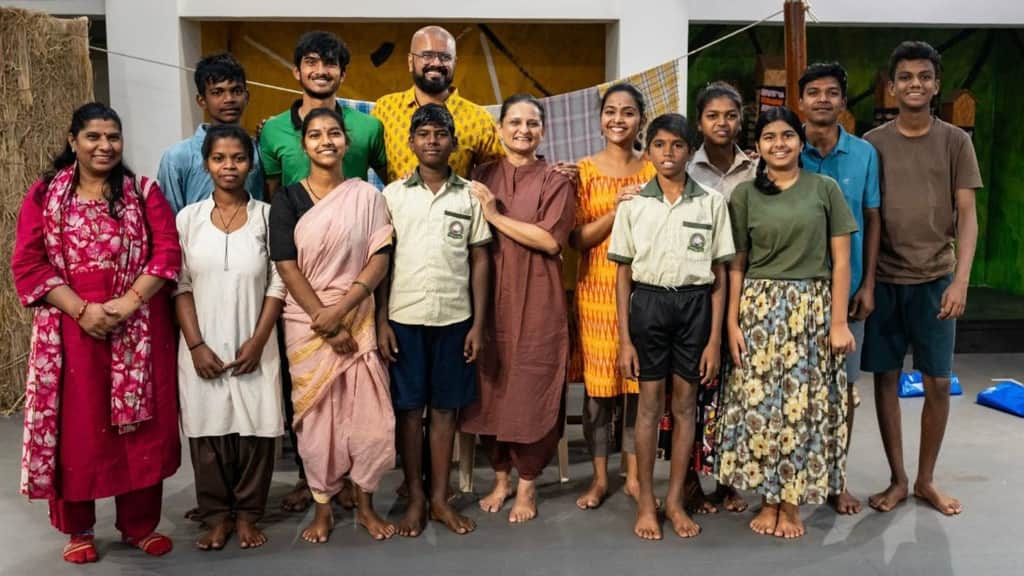
Jikni, meaning “riddle” in the Katkari language, is a musical docu-drama created by Ruchika Khot, Geetanjali Kulkarni and Archana Kulkarni, collaboratively with children from Vadavali and Sonala, adjacent villages in Maharashtra’s Palghar district. The play is a slice-of-life musical production exploring the seemingly routine stories from these villages. The production is packed with songs and jingles from everyday life, describing a variety of things – from folktales on fishing to songs about the monsoon and, of course, jiknis – aiming to show life as it is.
The play moves gently through the contours of the children’s everyday lives, from friendships and kinship in the village, to the way adults’ lives bend around the harvest, and how time itself is measured through the agricultural year. From the fallow months to sowing, reaping, and finally the processing and sale of rice, the play follows a cycle that holds the village together. The play ended with a short heartfelt section – almost in a Brechtian sense – in which a direct conversation was held with the audience, detailing the periods of distress caused due to these activities, following which the actors took their bow.
In an era where rural life is frequently aestheticised, moralised or folded into a narrow national narrative, Jikni innocently challenges the romanticised idea of “rural charm”, making one confront reality. The music is central and demanding, performed exceptionally by the budding storytellers, who sing complex melodies, play instruments, and coordinate dance performances with remarkable attentiveness.
The play was developed at Tarapa, a space that co-founder and actor Geetanjali describes not as an institution, but as an adda. “We never intended Jikni to be a theatrical debut,” she says. “We wanted these children to learn and experience life, and to portray their lived experiences.” Tarapa, she says, is a space where children play, read, encounter books and musical instruments, and participate in workshops that grow from curiosity, in an attempt to break the curriculum. It is open to people from all age groups to explore art, and this fluidity shapes Jikni profoundly.
Director, writer and composer Khot emphasises that nothing about Jikni was pre-designed. “It was always more about the process and less about the outcome,” she says. Songs emerged because the children liked a tune and the lyrics grew from their own experiences. “When they realised this was their song, they were so proud of themselves, so proud of owning something that was all theirs,” she says. A song about the monsoon existed simply because the children described how they play when it rains, which then evolved into a tune.
This is why the play never feels extractive. The children are not vessels for a message, nor are they performing someone else’s idea of authenticity. As Wasimbarry Maner, Associate Professor at the Film and Television Institute of India (FTII), observes, spaces like these offer an alternative to cultural monoliths, especially in a time of growing polarisation and rigid ideas of identity.
“They help us find joy in everyday life,” he says, adding that the linguistic “imperfections” were consciously preserved. Maner, an active member of Tarapa, was the moderator of the play’s audience interaction segment. “No kid knew how to pronounce ‘ळ’, and that is how we wanted to keep it. They don’t need to know how to say it. This is not an attempt at cultural purity.”
Audience responses echo this sentiment. Veteran actor and the winner of the revered Sangeet Natak Akademi Award, Dr Mohan Agashe’s response spoke about a memory. Watching the children perform, he was reminded of dramatist and theatre director Badal Sircar. “I don’t know if children today know about Badal Babu, but it is important to understand what theatre does,” he said.
Education, Agashe emphasised, does not reside only in books or formal instruction, but is also obtained through art and music. “Think of how a mother narrates a story to her child,” he said. “This play has a similar impact. Plays like these are important to educate people in a way that stays with them.”
For Marathi theatre writer and director Shrirang Godbole, the best part of the experience was its honesty. “What stayed with me was the authenticity,” he said. “This is not a borrowed story. It is a lived experience.” He insisted that Jikni should not be viewed as “just theatre” but as a window into Sonala village.
Perhaps this is where Jikni leaves us – with a question rather than an answer. What happens when we stop asking marginalised voices to sound like us? The songs are sung the way they were learned, the words are said the way they are spoken. Nothing is corrected to make the experience more palatable for the viewer.
Shreenija Dandavate is an intern with The Indian Express.
Editorial Context & Insight
Original analysis & verification
Methodology
This article includes original analysis and synthesis from our editorial team, cross-referenced with primary sources to ensure depth and accuracy.
Primary Source
The Indian Express