



Key takeaways
- That's the gap Xiaomi-Robotics-1 is trying to close.
- This setup lets you record manipulation tasks in kitchens, offices, stores, factory floors, and outdoor spaces without a robot even being present.
- The team says it labeled the full dataset in about two weeks.
What happened
That's the gap Xiaomi-Robotics-1 is trying to close. The model is designed to follow spoken or written commands in unfamiliar environments without prior exposure and adapt to new tasks with little extra training. To get around the data bottleneck, Xiaomi mostly ditched real robots during data collection. Instead, the team used portable handheld grippers with attached cameras that a person simply picks up and operates by hand.
A foundation model is most useful when it can adapt to new tasks quickly. Xiaomi tested Xiaomi-Robotics-1 on four tasks, including packaging a phone, loading laundry into a washing machine, feeding paper into a printer, and packing items into a box. With less than ten hours of training data for each task, the model reached an average success rate of 75 percent.
A competing model from Physical Intelligence managed only 40 percent in the same test. Xiaomi says its model performed especially well with soft, deformable materials such as paper and on tasks that required moving around a room. Robot data remains a major focus of robotics research, and teams are pursuing very different solutions.
Why it matters
This setup lets you record manipulation tasks in kitchens, offices, stores, factory floors, and outdoor spaces without a robot even being present. The result was over 100,000 hours of motion recordings. A dataset that large creates another problem because each recording needs a description the model can learn from. Labeling it all by hand wasn't practical, so Xiaomi used another AI model to describe each motion segment in text.
The team says it labeled the full dataset in about two weeks. Xiaomi then transferred that training to physical robots, including wheeled models and dual-arm systems. The model still had to account for the differences between a handheld gripper and a robot arm. Tests showed that a larger model improved performance, but more training data produced much bigger gains than more compute.
The researchers say progress in robot AI will depend mainly on collecting larger and more varied datasets. The finding matches what researchers showed for visual data in early March. For language models, the long-standing rule is that model size and data volume should grow at roughly the same rate to make the best use of a fixed compute budget.
That balance changes when a model must process images rather than just text. In that case, adding data helps far more than increasing model size. The same pattern appeared in tests with physical robots. As Xiaomi increased the amount of training data, the model's success rate in unfamiliar environments rose from about 25 percent to 75 percent.
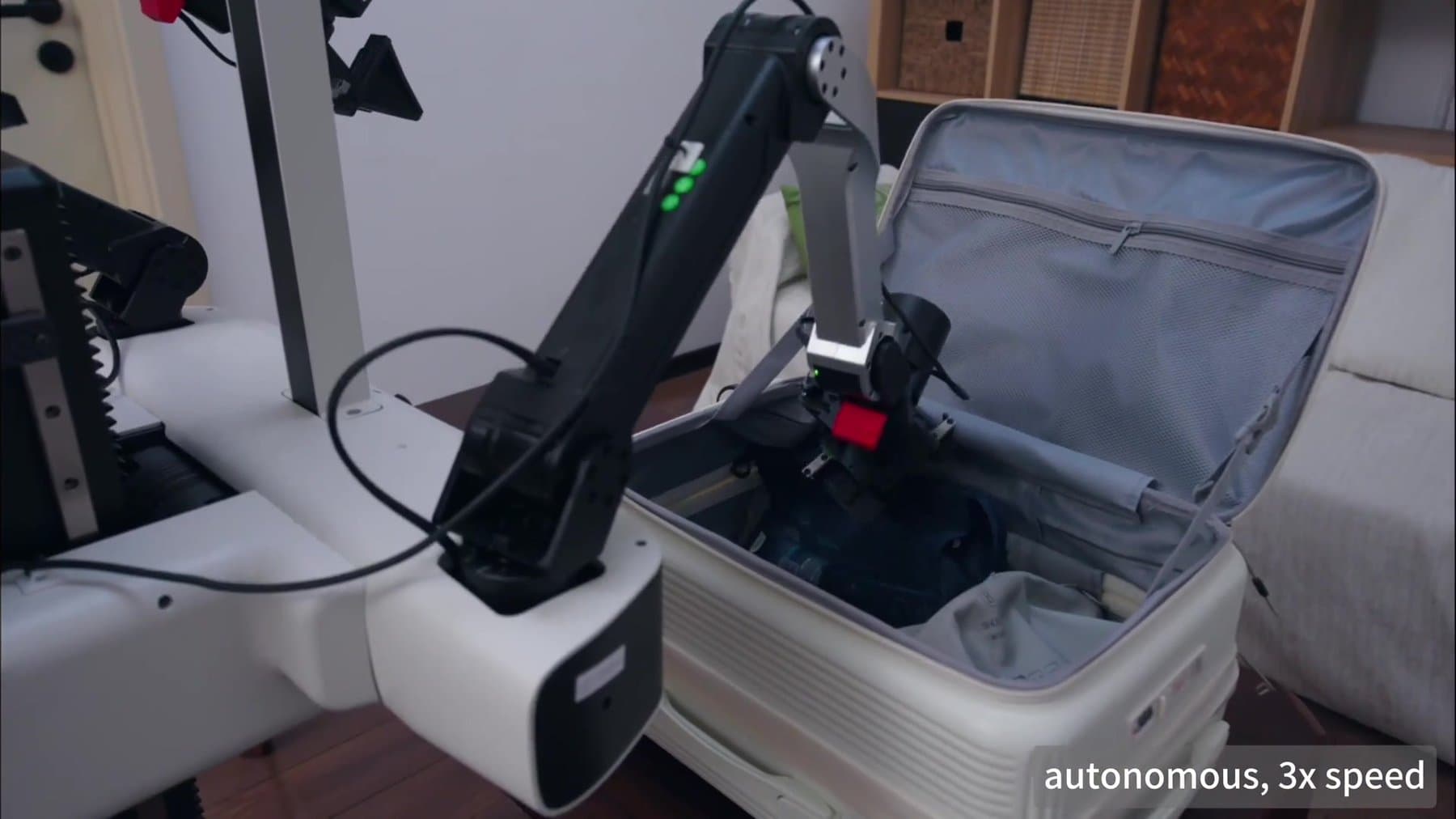
The researchers say they haven't reached a point where more data stops improving performance. Xiaomi says Xiaomi-Robotics-1 posted the best results to date across standard robot AI benchmarks. In one demo, a robot reportedly packed a suitcase without human help. The task took more than ten minutes and required the robot to move across an entire room.
What to watch
A May survey of World Action Models reviewed about 100 studies and found that teleoperation data is precise but costly and limited to a few settings. Xiaomi's handheld grippers are designed to address those limits. Nvidia, Carnegie Mellon University, and UC Berkeley used the ENPIRE project to have AI coding agents autonomously teach a fleet of eight robots how to grasp objects.
Nvidia also wants to turn robotics' data problem into a compute problem by generating synthetic training data. China's BAAI research institute is taking the opposite route. 5 model on five manipulation tasks. Xiaomi automates labeling and applies it at scale, while Orca tries to eliminate labels entirely. Physical Intelligence serves as the reference point in both cases. 7 in April after claiming the model could generalize when it may have been recalling similar train