Mains Examination: General Studies-III: Important International institutions, agencies and fora- their structure, mandate.
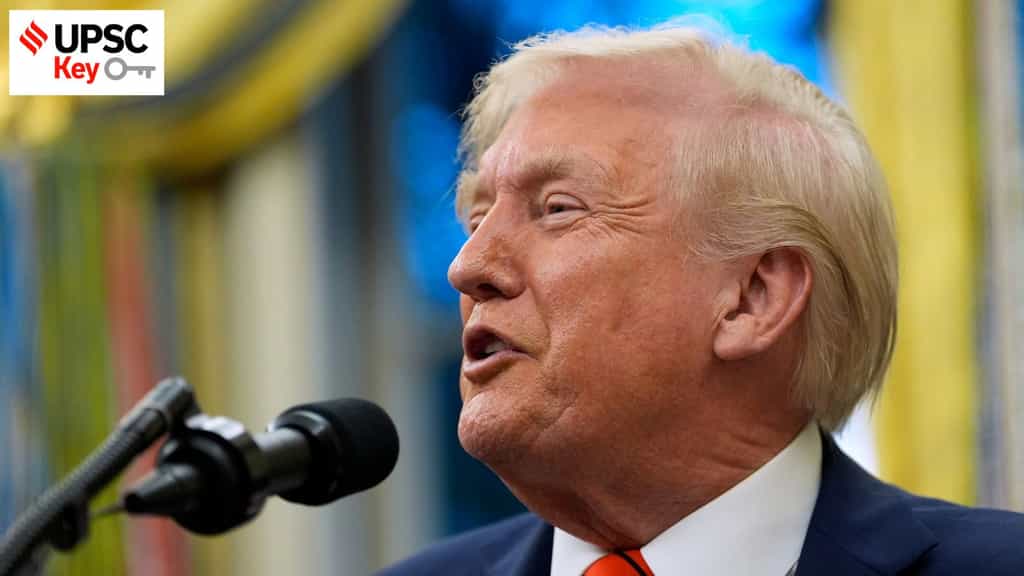
What’s the ongoing story: President Donald Trump has withdrawn the US from 66 international organisations, including UN bodies and the International Solar Alliance led by India and France, saying these institutions were “redundant” and “contrary” to his country’s interests.
— What is the role and function of the International Solar Alliance?
— What are the reasons for the recent withdrawal of the US from international organisations?
— How does it impact international organisations?
— How is it going to impact the fight against climate change?
— What is the Paris Agreement?
— How does US action reflect on the multilateral world order?
— Know about the objective of these organisations: Intergovernmental Panel on Climate Change (IPCC), International Solar Alliance (ISA), and International Renewable Energy Agency (IRENA)
— Signing a memorandum titled ‘Withdrawing the United States from International Organisations, Conventions, and Treaties that Are Contrary to the Interests of the United States’, Trump directed all executive departments and agencies to take immediate steps to put into effect the US withdrawal from these organisations “as soon as possible”.
— In Delhi’s assessment, the direct impact of Trump’s decision to withdraw from international organisations — from the World Health Organisation and UNESCO to the latest round of 66 global bodies, will be on the funding and leadership of these groupings.
— It will likely cast a massive shadow on the leadership vacuum in these organisations, and China is expected to step in given its leverage, resources and influence in terms of capital and capacity.
— WHO: The US withdrawal was initiated on January 20, 2025, the first day of the Trump 2.0 administration, and it is set to be fully effective by January 22, 2026. This means significant funding cuts since the US was the largest donor.
— UNESCO: While a formal notice of exit was given in July 2025, it is expected to create a funding gap and a leadership vacuum that countries like China may fill to promote their own agenda. The US withdrawal means less financial support for global heritage and education programmes, impacting sites and initiatives worldwide.
— UNHRC: With the US withdrawal ordered in early 2025, it reduces Washington’s ability to steer and shape discussions on human rights, international law.
— UNRWA: As the US suspended all funding and support for the Palestinian relief agency in February 2025, it will reduce the organisation’s capacity to provide humanitarian aid to Palestinian people in Gaza.
— Last year, immediately after Donald Trump took charge as President for his second term, the US withdrew from the 2015 Paris Agreement. That decision will become effective on January 20, after the one-year notice lapses. Over this past year, the Trump administration has also scaled down funding and staffing of its national agencies engaged in climate research.
— American discomfort with the international climate regime is not new. The US had played an important role in the finalisation of the UNFCCC, which acknowledged the problem of climate change and laid down the basic rules and principles for a global response. But it never became a member of the 1997 Kyoto Protocol, an instrument under the UNFCCC that assigned specific emission reduction targets to different countries.
— In fact, the United States led the efforts to put in place an alternative to the Kyoto Protocol, efforts that eventually culminated in the 2015 Paris Agreement. But its record in fulfilling its responsibilities under the Paris Agreement has been extremely poor.
— But Trump is a proud climate denialist, and has repeatedly mocked the global efforts being made on clean energy transition. Under his Presidency, the United States has acted overtly to undermine the progress made so far.
— The US move to sign out of the UNFCCC and other organisations was not surprising, even if not entirely expected. The withdrawal from the Paris Agreement and the scaling down of funding on climate research had already done most of the damage.
— But by disassociating completely from the climate regime, the United States might be jeopardising its own long-term interests, ceding the leadership in this area to its main rival China.
— The efforts of the Trump administration to go against the tide, by pumping in more oil in the energy market through its adventures in Venezuela or other measures, might slow down the pace of energy transition but are unlikely to turn the clock back.
— And it is here that China can press forward its advantage. Renewable energy deployment requires equipment and infrastructure, and China has an undisputed lead in their manufacturing and supply chains. By vacating this space, the US could be undermining its economic interests as well as political leverage.
— For India, the US decisions could result in lower pressure to decarbonise fast, but its plans to attract investments in clean technologies could also be affected. Before Trump’s second Presidency, India had a long-standing strategic partnership on climate and clean energy with the United States, which had been supporting a number of activities in diverse energy-related fields. Such collaboration is expected to stop, which could force India to revise its energy transition pathways.
— One of the organisations the United States has withdrawn from is the International Solar Alliance that India had helped set up in collaboration with France on the sidelines of COP21 climate meeting in Paris in 2015. The US had joined the ISA only in 2021 as the 101st member. It does not give any financial support to the ISA.
— At its last assembly meeting in 2025, the ISA had decided to charge an annual membership fee of USD 50,000 from developed nations and USD 25,000 from developing countries, but this decision is still to be operationalised.
— The ISA was predicated on the idea that the over 120 countries located in the tropics, between the Tropic of Cancer and the Tropic of Capricorn, could harness solar energy to meet their electricity needs. It was a “collaborative initiative between India and France aimed at uniting efforts to combat climate change by implementing solar energy solutions.” It is headquartered in Gurugram, Haryana.
— Its key theme is the ‘Towards 1000’ strategy, aimed at mobilising “$1,000 billion of investments in solar energy solutions by 2030 while delivering energy access to 1,000 million people using clean energy solutions and resulting in the installation of 1,000 GW of solar energy capacity.”
— The ISA has been working with governments and local institutions to create regulatory structures, draft power purchase agreements, and train human resources. For India, which had a central role to play early on, deployment of solar energy also had the larger strategic purpose of outreach to the Global South, particularly to countries in Africa.
1. The International Solar Alliance was launched at the United Nations Climate Change Conference in 2015.
2. The Alliance includes all the member countries of the United Nations.
Which of the statements given above is/are correct?
The West is fostering India as an alternative to reduce dependence on China’s supply chain and as a strategic ally to counter China’s political and economic dominance.’ Explain this statement with examples. (UPSC CSE 2024)
Mains Examination: General Studies-II: Bilateral, regional and global groupings and agreements involving India and/or affecting India’s interests.
What’s the ongoing story: While the Union Ministry of Law and Justice told Parliament in its last Session that Artificial Intelligence was being “explored” in Indian courts, it has been expanding its footprint – from courtrooms to lawyer chambers.
— What is the significance of technology in the judiciary?
— What are the challenges facing the judiciary system in India?
— How does the use of technology help to overcome the challenges facing the judiciary?
— What is Artificial Intelligence? — How is AI transforming the judicial system in India?
— What are the major areas where AI could be helpful in the justice delivery system?
— What are the cautions that need to be taken while using AI?
— What are the concerns related to the use of AI in the judiciary?
— A transcription system called ‘TERES (or Technology Enabled ReSolution)’ is now used during Constitution Bench hearings to convert oral arguments into text in real time, addressing a longstanding bottleneck in recording fast-paced hearings accurately.
— Developed in India, TERES is also being used by dispute resolution institutions outside the country now, including courts in Dubai, Abu Dhabi and Singapore.
— Another AI-enabled system, Adalat AI, operates in High Courts of nine states, and has pilot projects running in five others. In Kerala, Adalat AI’s use is embedded across courtrooms, rather than select benches.
— Court officials say that TERES is essentially used for live courtroom display and for publishing argument transcripts on the Court’s website, and their help in drafting judgments remains a matter of individual judicial discretion.
— The Supreme Court is also testing AI-assisted e-filing systems which automatically flag missing documents or incorrect annexures at the filing stage, and running other limited pilots, such as with Jhana AI whose courtroom module for case management is currently used in the Karnataka High Court.
— Adalat AI is also being used by judges to manage their workload. Saxena says the system puts cases listed across different stages in a single window, reducing the time spent locating files and context between matters. Transcription is built into this flow and trained in courtroom language, to take it further than a generic AI tool.
— In Kerala, where AI is in use at different court levels, the High Court deploys it principally at the filing stage to scrutinise vakalatnamas, pleadings and annexures. Sources said around 46,000 cases have been screened through this process, cutting time lost in correcting mistakes, without manual intervention.
— The court has also developed its own voice-to-text tools, which are being extended to district courts, along with systems that help judges navigate large case files and summaries.
— Another proposal under development is a WhatsApp-based interface through which case status can be accessed.
— Bhattacharya says Adalat AI has also factored in infrastructure constraints such as unreliable connectivity and power cuts, and prototypes were shown to judges and their feedback taken before any code was written. At the same time, says Saxena, they are clear that their role is of assisting rather than replacing court staff.
— The Supreme Court also deploys a translation platform called SUVAS (Supreme Court Vidhik Anuvaad Software) now, which converts judgments and orders into regional languages. As of March 28 last year, 83,783 Supreme Court judgments had been translated into 18 vernacular languages and uploaded on its portal.
— Research assistance is the third area where the judiciary is turning to AI. Tools such as SUPACE and LegRAA scan large volumes of judgments to extract facts, identify legal issues, and list relevant precedents.
— A tool Agami has designed is JIVA, to improve judicial access to legal texts during hearings, while it has also developed systems to track e-Gazette publications, monitor amendments, and create authoritative repositories.
— In due diligence exercises that once involved manually reviewing thousands of contracts, AI systems now go through large document sets and flag relevant clauses or missing provisions. Where the tool is uncertain, Gupta says, it explicitly signals that ambiguity.
— Firms also use tools such as CaseMine, which allow lawyers to find relevant precedents in seconds as well as identify precedents that have been overruled or should not be cited. Other tools, including Legora, integrate directly into MS Word, allowing lawyers to draft and revise documents alongside AI assistance.
— Artificial intelligence (AI) refers to the field of computer science which aims to make computer systems think, reason, learn, and act to solve a complex system like humans.
— The term artificial intelligence was coined by McCarthy. “McCarthy later admitted that no one really liked the name — after all, the goal was genuine, not ‘artificial’, intelligence — but ‘I had to call it something, so I called it “Artificial Intelligence”,’” wrote Melanie Mitchell in her book, ‘Artificial Intelligence: A Guide for Thinking Humans’.
— To enable computer systems to imitate the way that humans learn, and perform tasks autonomously (meaning, without instructions), machine learning (ML) is used. ML is implemented by training (this term will also be explained in subsequent explainers) computers on data so that they can make predictions about new information.
(2) With the present state of development, Artificial Intelligence can effectively do which of the following? (UPSC CSE 2020)
1. Bring down electricity consumption in industrial units 2. Create meaningful short stories and songs
5. Wireless transmission of electrical energy
Mains Examination: General Studies-I: Indian culture will cover the salient aspects of Art Forms, literature and Architecture from ancient to modern times
What’s the ongoing story: In less than two weeks, the conservation of monuments in the country will open up to the private sector, allowing corporate donors to directly engage conservation agencies — a responsibility that so far only rested with the Archaeological Survey of India (ASI).
— What is the significance of conservation of monuments? — Know about the history, role and function of the ASI
— What are the various schemes related to monument conservation?
— What are the reasons for inviting private players for monument conservation?
— What is the National Culture Fund? — What is the Adopt a Heritage scheme?
— What are the conservation regulations for monuments in India?
— What are the challenges in conservation of monuments?
— The Ministry of Culture is in the process of empanelling conservation architects, and more than 20 private agencies with experience in heritage conservation from across the country have applied to its Request for Proposal (RFP), The Indian Express has learnt.
— Once the RFP closes on January 12, an internal committee will be formed by the ministry to vet the applications and allow the empanelment of the conservation architects, sources said. The process is expected to take another week, and soon after, private donors can engage these agencies directly, they added.
— Among the criteria set for conservation architects is experience in executing conservation or restoration of centrally protected monuments under the ASI, state archaeology departments, Central Public Works Department (CPWD) or state PWD.
— The donor agency—which is offering funding for the project to the National Culture Fund (NCF), as CSR—needs to be provided independence to choose heritage conservation architects of their own choice, officials said on the rationale behind the move.
— The funds given by the donors should be utilised properly within the stipulated time, and the works should be completed within the time frame fixed by the donor. This will not only complement the ASI’s efforts in conservation but also help to create a national talent pool of human resources, they added.
— The execution of the approved Detailed Project Report (DPR) will be done by the executing agency under the guidance of heritage conservation architects and the overall supervision of ASI/concerned government agency to ensure that the work adheres to the approved plan and conservation norms.
— Earlier, the government had launched an ‘Adopt a Heritage’ scheme to let corporates and PSUs become ‘Monument Mitras’ and create amenities like ticket windows, toilet blocks, entry and exits, cafes, etc. However, this is the first time that private donors will be able to sign up for the execution of core conservation work at the monuments.
— The National Culture Fund was set up in 1996 with an initial corpus of Rs 20 crore by the government. The idea was to retain the base corpus and use interest amount for conservation activities at the monuments. Ever since, Rs 140 crore has come into NCF through corporate and PSU donations, which have been used to fund around 100 conservation projects at protected monuments.
— The NCF is managed by a Council and an Executive Committee. The Council is chaired by the Union Minister of Culture and has members representing the corporate and public sector, private foundations and non-profit organisations. The Executive Committee is chaired by the Secretary, Ministry of Culture.
— With donations to the NCF eligible for 100% tax exemptions, the aim is to encourage corporates to partner with it through CSR for promoting the cultural heritage of India.
1. It was set up in 1996 to mobilise extra resources through Public Private Partnerships (PPP) towards conservation of monuments.
2. It is managed by a Council and an Executive Committee and the Council is chaired by the Union Minister of Culture.
3. The donation to NCF is eligible for 100% tax exemptions. Which of the above-mentioned statements are correct?
Safeguarding the Indian art heritage is the need of the moment. Discuss. (UPSC CSE 2018)
Preliminary Examination: Indian Polity and Governance – Constitution, Political System, Panchayati Raj, Public Policy, Rights Issues
Mains Examination: General Studies-III: Various Security forces and agencies and their mandate.
What’s the ongoing story: When thousands of delivery workers went on a nationwide strike on New Year’s Eve, demanding better pay, safety protections and social security, the backlash didn’t take long to come. Zomato founder Deepinder Goyal, and the wider start-up and investor community, began posting data on X within days, arguing that critics don’t understand how the gig economy works.
— What is the significance of the gig economy?
— What are the provisions related to gig workers in the new labour code?
— What are the challenges faced by gig workers?
— What necessary steps need to be taken by the government to ensure safety and security of gig workers?
— What distinguishes gig work from traditional employment in terms of labour rights and protections?
— Gig work is seen as especially significant for women in India and across the Global South. Do you agree? Support your answers with examples.
— Himanshu writes: At the heart of the matter is the nature of the contract with the app-based aggregators, who refuse to be classified as employers even though they employ the services of these workers for delivery of their goods and services.
— It is this fundamental refusal to accept the employer-employee relationship that makes it difficult to regulate them using the existing labour laws and social protection measures.
— Unfortunately, in almost all cases, they are treated as self-employed without any explicit contract. Or when there is a contract in technical language, the workers are unable to understand the legalities of such a contract.
— It is this opacity of the relationship with the corporations that allows them to exploit the workers without any consequences. It also implies a reward-and-punishment system that puts the workers at the mercy of the corporations.
— The incentive structure is built around a system of self-exploitation, and any deviation is punished through an algorithm that no one understands. There is no grievance redressal mechanism, with the system designed to keep the workers subservient and docile.
— For corporations, these workers are outside the purview of any labour laws. To make matters worse, they are sought to be glorified as partners even though the partners have no idea of the nature of the corporation, its profits or even its basic functioning. But it is not just the corporations — even government regulations are silent on treating them as workers.
— Among the four labour codes, the most fundamental is the code on wages. While it is applicable everywhere, it excludes gig workers. They are included only in the code on social security, but again without any corresponding rights. The only obligation for the corporation is to contribute to the social security fund with no corresponding commitment on workers’ rights.
— In a country with a significant population living in precarious conditions and with a huge unemployment problem, gig work is unlikely to disappear. These are the new casual workers disguised as self-employed and partners, but their condition is as bad as, if not worse than, that of casual manual labourers.
— The response to the strike showed that the urban middle class, which is the biggest beneficiary of their services, is unlikely to come out in support. It is also not likely that the corporations dependent on these services are going to respond to the workers’ demand. It is here that the role of the government becomes important.
— A first step in this direction would be to recognise them as workers and corporations as employers. It is not entirely unheard of, and many countries in the Global North have moved towards such status.
— Srinath Sridharan writes: India’s gig economy occupies an unresolved legal space. Workers are acknowledged yet inadequately protected. Social security is promised but rarely enforced. The law recognises their presence while withholding certainty of rights. This ambiguity has benefited platforms and transferred risk almost entirely onto labour.
— Gig work is a practical response to an economy that struggles to generate enough formal employment and livelihood means. Workers opted for gig work not because it was ideal but because it was available, organised and immediate at a time when unemployment remains a constant worry.
— Gig employment is projected to grow from roughly 7.7 million workers today to over 23 million by 2030. That makes it one of India’s largest job-creation engines over the next decade. And yet policy response remains slow, fragmented and reactive.
— Defenders of the platform model argue that gig work reflects market-driven supply and demand. That workers choose flexibility. That platforms are not doing society a favour but merely enabling economic participation. This is all partially true.
— Much of the public discourse conveniently forgets another contradiction. Most gig platforms are still not meaningfully profitable, despite payouts that workers argue are insufficient. Customers, meanwhile, are acutely price sensitive. Many who express outrage on social media are rarely willing to pay more for the services they praise.
— Gig platforms did not create India’s informal labour tradition. They have industrialised it, digitised it and scaled it faster than our regulatory reflexes have adapted. Convenience without conscience is only efficiency borrowing from the powerless.
— The government’s role cannot be to arbitrage between capital and labour indefinitely. It must balance growth with fairness in labour pricing. That means moving beyond symbolic recognition towards enforceable standards. Not rigid employment reclassification but the minimum protections of a safety net, grievance redressal and algorithmic transparency.
— Delivery workers have said they face a range of issues — declining earnings, uncertain income, a low base pay, algorithms they say pushes them to ride for hundreds of kilometres a day in return for disproportionately low cash, rising fuel costs, no social security benefits, and a faceless management.
— States such as Karnataka and Rajasthan have passed laws to ensure that gig workers have dignity in their work.
— Under the Code on Social Security, 2020, ‘gig workers’, ‘platform workers’, and ‘aggregators’ have been defined for the first time, as a person who performs work outside of the traditional employer-employee relationship. It envisions the creation of a Social Security Fund for gig and platform workers with contribution from Central and state governments, corporate social responsibility, fines collected due to compounding, etc.
— Aggregators such as Amazon, Flipkart, Swiggy and Zomato will have to contribute 1–2 per cent of their annual turnover towards this fund, with the total contribution capped at 5 per cent of the amount payable by them to the workers.
(4) With reference to casual workers employed in India, consider the following statements: (UPSC CSE 2021)
1. All casual workers are entitled for Employees Provident Fund coverage.
2. All casual workers are entitled for regular working hours and overtime payment.
3. The government can by a notification specify that an establishment or industry shall pay wages only through its bank account.
Which of the above statements are correct?
Examine the role of ‘Gig Economy’ in the process of empowerment of women in India. (UPSC CSE 2021)
Preliminary Examination: Current events of national and international importance.
What’s the ongoing story: Soumya Kanti Ghosh writes: The sweeping overhaul of the erstwhile MGNREGA, to align with the Viksit Bharat 2047 vision through VB-G RAM G, has unleashed a wave of criticism. Emotive outbursts in a charged atmosphere, devoid of supportive data, require us to analyse the provisions of the new law factually and comparatively.
— What is the significance of this scheme? — What are the challenges associated with the scheme?
— How is MGNREGA different from the VB-G RAM G scheme? — What is the funding process in VB-G RAM G?
— How does the shift from a demand-driven to a top-down allocation model affect the scheme?
— What is the difference between the Centre Sector Scheme and the Centrally Sponsored Scheme?
— First, the new law attempts to attain a goal of guaranteeing 125 days of employment per rural household. This should incrementally enhance the workdays allocated to willing households in future as against the 100 days framework.
— Second, concerns over the increased fiscal costs to states on account of the conversion of the scheme from a central sector scheme (90:10 ratio) to a centrally sponsored scheme with a generic 60:40 ratio is not supported by hard data.
— During the last 19-years (FY07-FY25), the Union government has spent Rs 9.95 lakh crore under MGNREGA, around 80 per cent of the of funds (Rs 7.8 lakh crore) released during FY15-FY25 period alone.
— The estimated central share could go up to around Rs 95,692 crore in FY27. Separately, states’ borrowing is fixed at 3 per cent of GDP, and there is no possibility of higher borrowing by states for whatever reasons as has been argued.
— Third, MGNREGA fared poorly on the cardinal principle of adequate compensation for labour-intensive works, with wages unable to catch up. The average wage per person per day has increased from an average of Rs 88 during FY07-FY12 to currently around Rs 267. However, in real terms, the average wage per person has increased by 10 per cent in FY25 over FY08-FY12 on the back of stable and low inflation.
— Further, the law has explicitly removed the disentitlement provisions under the old MGNREGA. States have to now ensure that legitimate workers are adequately informed well in advance of the work to be undertaken so that the question of disentitlement provision does not even arise at first instance.
— Fourth, the current approach of the MGNREGA has been towards income generation for rural areas through engaging in works that may have little economic relevance. This faulty approach, dotted with short-termism, has often resulted in works that may not be aligned with the core idea of productive asset creation.
— Since inception, around 9.6 crore rural assets have been created, of which a staggering 84 per cent were created during the last decade (FY15-25).
— The CSS structure, with works focused across four interwoven broader areas of water security, rural infrastructure, livelihood infrastructure and climate resilience — wherein assets are aggregated and geo-tagged into the Viksit Bharat National Rural Infrastructure Stack and spatially integrated with national systems such as PM Gati Shakti — could ensure the harnessing of optimal benefits.
— Fifth, the shift to normative funding as opposed to an archaic demand-driven approach ensures that allocation will be state-specific, keeping in mind local parameters and uniquely optimal requirements amidst competing needs.
— This should reduce the fluctuation in grants to states across years, identifying areas of utmost importance and sharing best practices across states. We have aimed to weave a model similar to how the FC tax devolution is shared by allocating weightage to equity (say, the number of gram panchayats) and efficiency (share of women participating).
— Sixth, the 73rd Constitutional Amendment brought in the concept of rural local self-governance through the Panchayati Raj institutions advocating empowerment of grassroots democracy and decentralising power. The changes proposed nudge gram panchayats to be a spirited partner in Viksit Bharat plans…
— VB- G RAM G is a big step forward towards ensuring a well-intentioned scheme remains relevant in changing times, bringing accountability, responsibility, transparency, pooling of resources and technological integration that simultaneously benefits the bottom of the pyramid and also the local economy.
— Under MGNREGA, every rural household, whose adult members volunteer to do unskilled manual work, is entitled to get at least 100 days of wage employment in a financial year.
— Launched across India’s 200 most backward rural districts in 2006-07, the MGNREGS was extended to an additional 130 districts during 2007-08; and to the entire country from financial year 2008-09.
— Section 3 (1) of the MGNREG Act provides for “not less than one hundred days” work per rural household in a financial year. But it has become the de facto upper limit as the NREGA software does not allow data entries for employment above 100 days to a household in a year unless specifically requested by the State/UT.
— The government, however, allows additional 50 days of wage employment (beyond the stipulated 100 days). For instance, every Scheduled Tribe household in a forest area is entitled to get 150 days’ work under NREGS, provided that such families have no other private property except for the land rights granted under the Forest Right Act, 2016.
— Besides, the government, under Section 3(4) of the MGNREGA, can also provide an additional 50 days of unskilled manual work in a year, over and above the 100-day in such rural areas where drought or any natural calamity (as per Ministry of Home Affairs) has been notified.
(5) Among the following who are eligible to benefit from the “Mahatma Gandhi National Rural Employment Guarantee Act”? (UPSC CSE 2011)
(a) Adult members of only the scheduled caste and scheduled tribe households.
(b) Adult members of below poverty line (BPL) households.
(c) Adult members of households of all backward communities.
(d) Adult members of any household.
Mains Examination: General Studies-III: Conservation, environmental pollution and degradation, environmental impact assessment.
What’s the ongoing story: Eminent ecologist Madhav Gadgil, 83, passed away late on Wednesday in Pune after a brief illness. In a storied career as an ecologist, his seminal work as chairman of the Western Ghats Experts Ecology Panel (WGEEP) stands out, despite the fact that the report was eventually sidelined by the then United Progressive Alliance (UPA) government.
— What do you know about the Gadgil Committee Report?
— How is it different from the Kasturirangan Committee Report?
— What is the significance of western ghats?
— What are the reasons for frequent landslides in the western ghats?
— What are the ecologically sensitive areas? Why do they need to be protected?
— What are the threats to the Western Ghats? — What steps need to be taken to protect it?
— Gadgil continued to champion the cause of protecting the fragile mountains from mindless development. Despite the report’s fate, its recommendations are brought up to this date, whenever landslides and ecological disasters occur in the region.
— The Western Ghats are known as the water tower of peninsular India, with the Cauvery, Godavari, Krishna, Periyar, and Netravathi rivers originating here. The chain of hills spans from Gujarat to Kerala and Tamil Nadu. It is a globally recognised biodiversity hotspot with a high level of endemism, meaning that certain kinds of trees and animals are only found in this ecosystem.
— In March 2010, the WGEEP was constituted in view of the region’s environmental sensitivity and ecological significance, its complex geography, and the threat of climate change.
— After Gadgil led extensive consultations on the ground with communities and public representatives, the panel designated the entire 1,29,037 sq km extent of Western Ghats as an Ecologically Sensitive Area (ESA). It assigned three levels of sensitivity for various zones, categorising them as Ecologically Sensitive Zone (ESZ).
— Extensive guidelines were accordingly proposed for each sector. These included a prohibition on cultivating genetically modified crops across zones, and the creation of special economic zones or new hill stations.
— It also recommended the creation of a 24-member Western Ghats Ecology Authority (WGEA), a statutory authority appointed by the Environment Ministry under the Environment Protection Act, to oversee the protection of the ESZs.
— This authority was envisaged as an apex, multi-state authority for regulation, management and planning of activities impacting all ESZs in the six Western Ghats states — Gujarat, Goa, Maharashtra, Tamil Nadu, Karnataka and Kerala.
— The initial report was submitted to Environment Minister Jairam Ramesh in March 2011, and a final version was submitted in August 2011. Gadgil noted in EPW that under Jayanthi Natarajan, who succeeded Ramesh in July 2011, the report was not made public, but was subsequently circulated to the state governments to seek comments.
— The report was strongly opposed, especially by the governments of Kerala and Maharashtra. Maharashtra took issue with the recommendation to form an overarching authority, arguing that it would run parallel to existing government agencies. Several states also opposed the embargo on new hydroelectric projects.
— Following the opposition to the report, the Environment Ministry constituted a High-Level Working Group (HLWG) under the space scientist K Kasturirangan. Its mandate was to “examine the WGEEP report in a holistic and multidisciplinary fashion”.
— Subsequently, the HLWG report of 2013 proposed to demarcate 56,825 sq km of the Ghats region as ecologically sensitive. Like the Gadgil panel, it also called for restrictions on polluting industries, mining, new thermal power plants, and large townships in the ESAs. Unlike the previous panel, the Kasturirangan panel identified some villages as ESAs and published a list of such villages across states.
— Based on these recommendations, the Centre has issued the draft notifications demarcating the ESAs six times so far (the last iteration being in August 2024). The Centre and the states are yet to reach a consensus with the stakeholder states over the areas that should fall under the category.
(6) ‘Gadgil Committee Report’ and ‘Kasturirangan Committee Report’, sometimes seen in the news, are related to (UPSC CSE 2016)
Differentiate the causes of landslides in the Himalayan region and Western Ghats. (UPSC CSE 2021)
The report is prepared by the UN’s Department of Economic and Social Affairs (DESA) in partnership with the United Nations Conference on Trade and Development (UNCTAD) and the five United Nations regional commissions.
The European Space Agency (ESA) officials shared about this development during the annual media briefing held in Paris on Thursday.
The cancellation of this collaborative mission between ESA and National Aeronautics and Space Administration (NASA) comes in the aftermath of the Donald Trump administration’s heavy budgetary sanctions imposed on NASA since the return of the Republicans in 2025.
🚨 Click Here to read the UPSC Essentials magazine for December 2025. Share your views and suggestions in the comment box or at manas.srivastava@indianexpress.com🚨
Editorial Context & Insight
Original analysis & verification
Methodology
This article includes original analysis and synthesis from our editorial team, cross-referenced with primary sources to ensure depth and accuracy.
Primary Source
The Indian Express