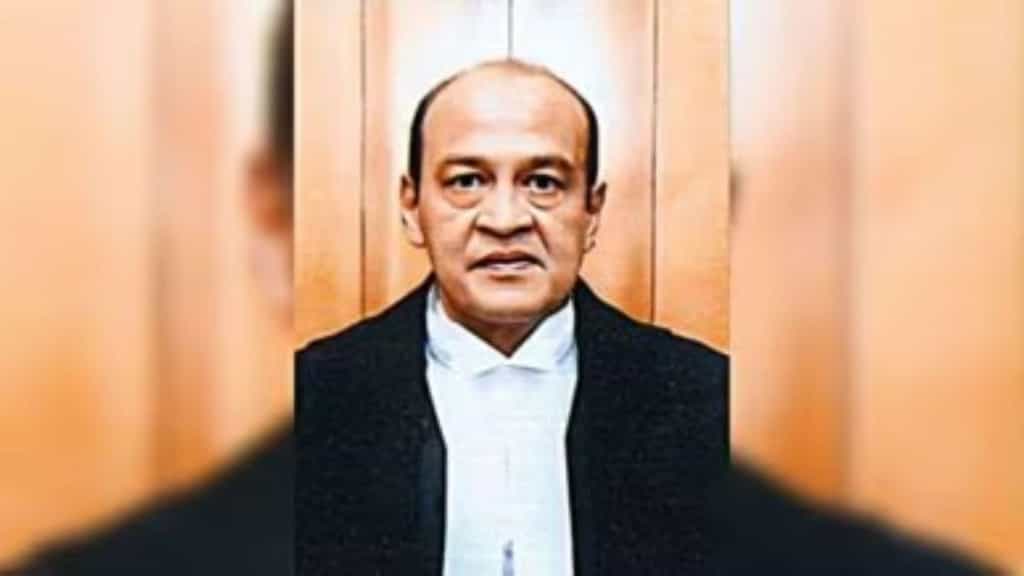
The Supreme Court Thursday reserved its decision on Allahabad High Court judge Justice Yashwant Varma’s plea challenging the legality of the parliamentary committee constituted by the Lok Sabha Speaker to inquire into allegations of recovery of burnt cash from his Delhi residence last year.
Presiding over a two-judge bench, Justice Dipankar Datta said, “We have to balance the rights of the judge to be preceded against as well as the members who have an independent right under the law to move a motion and get it admitted”.
Justice Dipankar Datta made the remarks in response to Justice Varma’s argument that the Rajya Sabha Deputy Chairman could not have exercised the powers of the Chairman Jagdeep Dhankar, who had resigned, and rejected the motion moved in the House for his impeachment.
The bench comprising Justice S C Sharma also refused to grant Justice Varma any further extension of time to respond to the notice issued by the committee on November 26, 2025.
A counsel appearing for Justice Varma pointed out that he had to respond by January 12, and urged the bench to extend the time. However, Justice Datta told the counsel to respond after it was pointed out that he had already been granted one extension.
Justice Varma had cited Section 3(2) of the Judges (Inquiry) Act to argue that the committee could have been set up only once both Lok Sabha and Rajya Sabha accepted the motion for impeachment. Pointing out that the Deputy Chairman, in the wake of Chairman Dhankar’s resignation, decided not to admit the motion moved in Rajya Sabha, he contended that the Deputy Chairman could not have taken over the duties of the Chairman and hence his action was ultra vires.
On Wednesday, the SC said it did not, prima facie, agree with the argument that the LS Speaker could not have set up the committee when the motion was not admitted by Rajya Sabha.
On Thursday, Senior Advocates Siddharth Luthra and Mukul Rohatgi, appearing for Justice Varma, submitted that Articles 124(4) and 124 (5) of the Constitution constitute a complete code governing impeachment proceedings. They also argued that Article 91 of the Constitution, which says the Rajya Sabha Deputy Chairman can perform the duties of the office of the Chairman in the latter’s absence, does not authorise him to exercise powers specifically vested in the Chairman under the Judges (Inquiry) Act, enacted under Article 124(5).
Luthra said the matter could have waited till the new Chairman took office. Rohatgi said Article 91 has no place in the scheme for the removal of a judge but applies only for the normal business of the house. Article 124(5) is a special provision intended to regulate the procedure for the removal of a judge; it is not part of the normal business of the House, he contended.
He also raised the apprehension that the Deputy Chairman himself could be a signatory to the motion.
Appearing for the Lok Sabha and Rajya Sabha Secretariats, Solicitor General Tushar Mehta, however, opposed the contention that the Upper House Deputy Chairman could not have performed the duties of the Chairman.
Mehta said that Article 91 says that while the office of the Chairman is “vacant”, the duties shall be performed by the Deputy Chairman. “Vacant would mean resignation, death or removal,” he said.
On the argument that the Deputy Chairman himself may be a signatory to the motion, Mehta said, “Legislative intent cannot be tested on the basis of hypothetical situations. We are dealing with individuals who are constitutional functionaries [and] it would [therefore] be normal to presume that they would understand that they may have a conflict of interest and may perhaps not be a signatory to the motion”.
“In the event they are a signatory, some solution will have to be found. But that will not be a ground to interpret and take away the powers conferred by the Constituent upon the Deputy Chairman in the absence of the Chairman.”
Stating that an interpretation which furthers the object of the Act will have to be adopted, Mehta said the purpose of Section 3(2) was to ensure that the Houses do not end up setting up two separate committees. “Provision takes care of only that anomalous situation where 2 committees are set up, which would mean 2 motions remain pending,” Mehta said.
On the petitioner’s argument that only a joint committee could have been set up after the Rajya Sabha also adopted the motion, the SC bench asked Mehta whether it would be possible now that a new Chairman is in place.
Mehta said it is possible, but added that it might be used to nullify all that happened after the committee was constituted, including the memo of charges served on the petitioner.
“It is not a case of differences between the Speaker and Deputy Chairman, and they may sit together and form a joint committee. But the difficulty would be if that route is taken, they may argue that such a decision would relate back to the date of the motion and whatever happened in the meanwhile is redundant,” he said.
“On November 26, the Committee served a memo of charges to the petitioner. Would the SC exercise Article 32 powers to truncate this and potentially permit an argument to be raised that now everything will have to be done afresh when there is no demonstrable or grave prejudice shown?”
He added that the Judges (Inquiry) Act and the Rules under it are a “legislative exercise to balance the people’s right to know the truth, and that is also in the interest of the person facing the charges.”
Editorial Context & Insight
Original analysis & verification
Methodology
This article includes original analysis and synthesis from our editorial team, cross-referenced with primary sources to ensure depth and accuracy.
Primary Source
The Indian Express