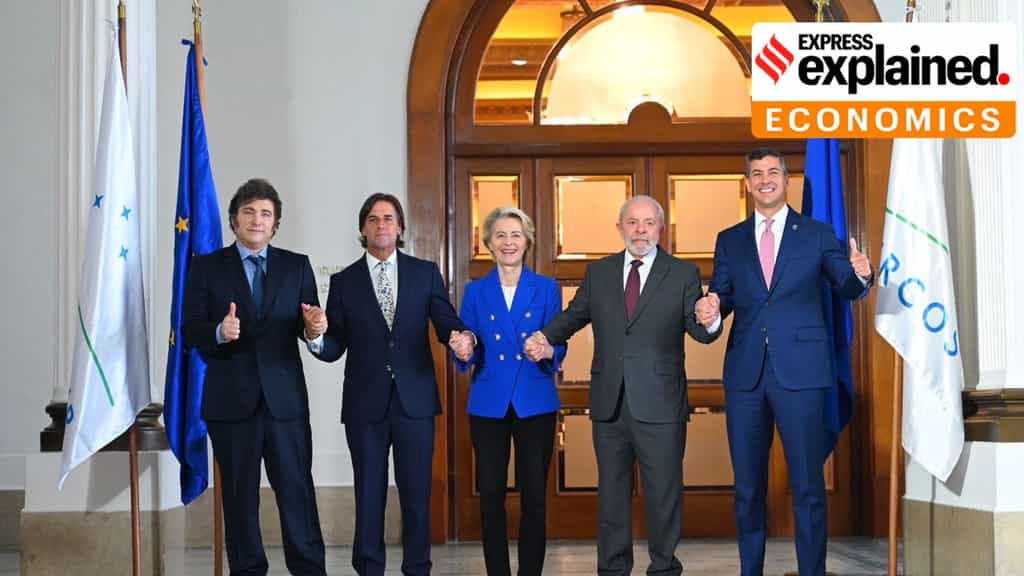
The European Union and Mercosur, the South American trade bloc, are set to finally sign a free trade agreement in Paraguay next week, concluding negotiations dating back to 1999.
While the deal was formally concluded in December 2024 by European Commission President Ursula von der Leyen, the EU member state ambassadors voted 21-5 to support the deal only on Friday (January 9). The deal is expected to be signed on January 17 in Asuncion.
However, not all EU members are on board, with France raising concerns over how lowering the trade barriers with Mercosur nations would affect domestic agriculture. French farmers protested in central Paris on Thursday, while demonstrations were taken out in Poland.
Mercosur comprises Brazil, its largest member by territory, economy and population, along with Argentina, Paraguay, Uruguay and Bolivia, the newest member. Venezuela, once a member, has been been suspended indefinitely.
According to the European Commission, the FTA is its largest ever in terms of tariff reductions, and will remove over €4 billion ($4.7 billion) in duties on EU exports. The Mercosur nations currently levy 35% on car parts, 28% on dairy products and 27% on wines.
Goods trade between the two blocs is currently valued at €111 billion. The EU mainly exports machinery, chemicals and transport equipment to Mercosur, while importing agricultural products, paper and minerals.
As part of the deal, Mercosur will remove duties on 91% of EU exports over 15 years, up from 35% currently, while the EU will progressively remove duties on 92% of Mercosur exports within a decade.
The EU will maintain quotas on items like poultry, pork, sugar, ethanol, rice, honey, maize and sweet corn, while Mercosur has quotas on milk powders and infant formula.
The EU will increase its quota on some sensitive farm products, including 99,000 metric tons of beef, while Mercosur will give the EU a duty-free 30,000-ton quota on cheeses. The extra imports represent 1.6% of EU beef consumption and 1.4% of poultry.
The deal also accords around 350 EU food and drink products geographic indications (GI tags) to protect them from imitation.
The European Commission has also instituted safeguards to suspend imports of sensitive farm produce. While the deal allows Mercosur countries preferential treatment in selling items like sugar, beef and poultry, this status can be suspended if certain conditions are not met.
Further, the EU has established a crisis fund, vowed to cut duties on fertiliser imports, accelerated €45 billion in monetary support for farmers, and has strengthened import controls on items like pesticide residues.
And why is there opposition to the deal?
France, Poland, Austria, Hungary and Ireland voted against the deal, while Belgium abstained. Italy, while previously opposed, reversed its veto on Friday.
Agricultural competition: These EU nations have chiefly expressed concern about losing market share to cheaper South American products. Irish farmers have expressed concern about the 99,000 tonnes of beef that will be sold in the EU after the deal.
Environmental protections: European farmers have also emphasised that the cheaper imports may not comply with the EU’s rigorous environmental standards. The opposing nations have called for stricter, enforceable safeguards on climate and biodiversity. Critics also say that the present deal lacks enforceable measures against deforestation, and that the deal would increase the resource depletion from forested areas like the Amazon.
The agreement signals the EU’s willingness to adapt and diversify away from its conventional trading partners in challenging times. Proponents of the deal say it will increase European engagement in the Global South in the face of increased Chinese engagement.
The deal also helps position the 35-year-old Mercosur as a credible trading partner despite its internal divisions.
An analysis by Bloomberg Economics estimates that the deal would boost the Mercosur economy by 0.7% and Europe’s by 0.1%.
Given the massive upheaval in global trade following Donald Trump’s return to the White House last January, EU members have argued that the deal will help the bloc make up for business lost due to Trump’s sweeping tariffs.
Most significantly, the deal could help the EU reduce its dependence on China for critical minerals. Brazil, for instance, is home to 20% of world’s reserves of graphite, nickel, manganese and rare earths as well as 94% of niobium, an important component in aerospace manufacturing. Similarly, Argentina is the world’s third-largest producer of lithium, a key component of batteries.
Editorial Context & Insight
Original analysis & verification
Methodology
This article includes original analysis and synthesis from our editorial team, cross-referenced with primary sources to ensure depth and accuracy.
Primary Source
The Indian Express