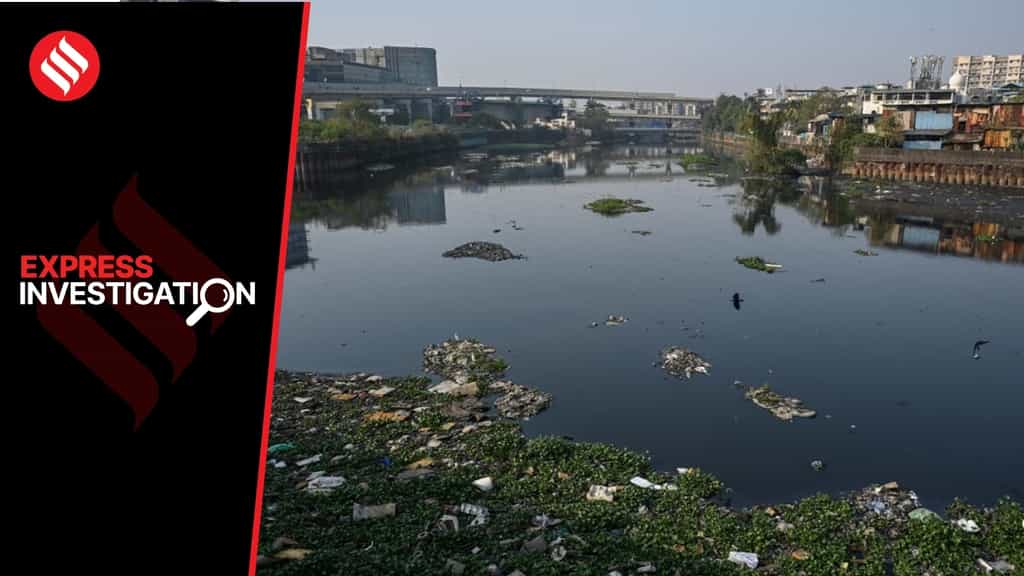
The Mithi river flowing through India’s financial capital under the country’s richest civic body became a national symbol of urban vulnerability after the devastating floods that claimed over 1,000 lives in 2005. Over two decades later, after repeated warnings and nearly Rs 1,297 crore spent, the river remains a vulnerable weak spot, an investigation by The Indian Express has found.
Records obtained by this newspaper under the Right To Information (RTI) Act show that Mithi’s water quality has deteriorated sharply, with persistent sewage contamination and rampant pollution, even as mitigation projects have stalled or been delayed with funds totalling over Rs 6,300 crore allocated and waiting to be spent.
As Mumbai votes on January 15 in the long-delayed elections to the Brihanmumbai Municipal Corporation (BMC) — a civic body that boasts of a budget of around Rs 75,000 crore — the condition of the city’s largest river stands as a powerful reminder of how successive governments of all political hues failed a key test of governance and accountability.
On its part, the BMC has been desilting the river every year, mitigating chances of flooding and preventing clogging — all measures that, experts say, have “definitely increased the holding capacity of the river”. And yet, as Water Quality Index (WQI) data investigated over the past 12 months by The Indian Express shows, this is cold comfort.
Over two decades later, after repeated warnings and nearly Rs 1,297 crore spent, the river remains a vulnerable weak spot, an investigation by The Indian Express has found. (Express photo by Sankhadeep Banerjee)
The Indian Express accessed records of the Maharashtra Pollution Control Board (MPCB) between 2008 and 2025, and analysed 101 WQI reports submitted by the Board under the National Water Monitoring Programme (NWMP) between January 2017 and May 2025. It found: This newspaper’s investigation also found how the administration has struggled to cope with the daunting task of cleaning the Mithi after the floods of 2005. Consider this: Records show the BMC spent Rs 881.14 crore from 2007 to 2020 on flood mitigation measures linked to the Mithi, such as widening, building retaining walls and drainage lines, and installing sewage interceptors. An additional Rs 415.68 crore was spent on desilting the river between 2007 and 2025. But the target is still a challenge with untreated sewage of 309 million litres per day (MLD) continuing to enter the river.
In one of the two major initiatives linked to the river, Mithi River Quality Improvement and Pollution Control Project, only one of the four packages has been completed. The most crucial package — pegged at Rs 1,700 crore involving measures such as floodgates at 18 spots — was awarded only in November 2025, eight years after the project was initiated in 2017.
The other initiative, Mithi River Rejuvenation Project, has seen zero expenditure because there has been zero execution despite a Rs 35.87 crore consultancy study commissioned in 2022.
And, records show, Rs 3,941 crore allocated by the civic body for the river quality and pollution project remains unspent — as also another Rs 2,437 crore under the BMC’s “Rejuvenation of Rivers” head.
When contacted about these findings, BMC officials declined to comment citing the Model Code of Conduct in place for the polls but privately acknowledged delays of nearly two decades in executing projects to clean the river.
In fact, nothing better illustrates the gap between intent and execution than the status of four packages awarded under the flagship Mithi River Quality Improvement and Pollution Control Project to treat the sewage flowing into the river. Consider this: Package 1, completed: 8 MLD sewage treatment plant, service road, sewer line. Sewage tapped: 8 MLD. Status: Started in 2018, completed in December 2022.
Package 2, delayed: Pending work 2007-2017, retaining walls, 10-km sewage network. Sewage tapped: 96 MLD. Status: Work started in 2021 with an initial deadline of December 2023, now deadline pushed to March 2027.
Package 3, stalled: Gate pumps at 18 outfalls, tap sewage network across 5.9 km. Sewage to be tapped: 37 MLD. Status: Letter of Approval issued only in December 2025 to a Special Purpose Vehicle (SPV) led by Adani Transport with Akshaya Construction and Ashoka Buildcon Ltd.
Package 4, delayed: 6.8-km-long tunnel to intercept and divert sewer. Sewage tapped: 168 MLD: Status: Work started in January 2021 with a deadline of September 2025; deadline revised to December 2026.
As for the other key initiative, Mithi River Rejuvenation Project, records show that in 2022, TPF Engineering Pvt Ltd and Pacific Consultants Co Ltd emerged as the lowest bidder at a cost of Rs 35.87 crore, and were issued a work order to study the plan in March 2022.
The consultants prepared plans, made presentations and submitted initial concepts to the BMC in October 2022, followed by revised plans in May 2024. Yet, records show, the final conceptual plan remains under administrative review.
According to a senior BMC official, who spoke to this newspaper on condition of anonymity, the river currently receives 309 MLD of untreated sewage through multiple outfalls, along with industrial effluents from “unauthorised units” in pockets such as Dharavi, but past efforts focused mainly on flood control.
The ongoing pollution-control project aims to intercept and treat the entire 308 MLD through phased work, the official said. “The first phase, treating 8 MLD, has been completed. Subsequent phases will treat 96 MLD over a 10-km stretch, 37 MLD along 5.9 km between CST Bridge and Mahim Causeway, and the remaining 168 MLD, with sewage treated at Dharavi and Dharavi-Bandra STPs,” the official said.
Asked about the separate rejuvenation project, the official said it would be taken up only after completion of the sewage treatment work.
Originating from the overflow of Vihar and Powai lakes and snaking through Andheri and BKC before draining into the Arabian Sea through the Mahim creek, the Mithi river is among only three in India listed by the CPCB as contaminated sites — apart from stretches of the Cauvery in Karnataka and the Swarnarekha in Jharkhand.
Of the river’s total length, 6 km lies under the purview of the Mumbai Metropolitan Region Development Authority (MMRDA) and the remaining 11 km under BMC.
A month after the floods of July 2005, which destroyed around 14,000 homes and caused direct losses of around Rs 5,500 crore, the Maharashtra government set up the Mithi River Development and Protection Authority to coordinate restoration and flood-mitigation efforts between the MMRDA and BMC.
An eight-member fact-finding committee, led by Madhavrao Chitale, was also set up to examine the causes of the disaster and recommend corrective measures.
The committee’s 2006 report identified pollution from industrial effluents, encroachments, inadequate sewage and solid waste systems, and reduced river capacity as key contributors to flooding. It recommended desilting, widening of the river, pollution control, gated outfalls, river flushing systems, and protection of riverbanks. Acting on these recommendations, agencies led by the BMC initiated river widening, construction of retaining walls, and related flood-protection works from 2007.
These measures, experts say, have clearly played a role in flood mitigation. “The desilting work has definitely increased the holding capacity of the river. It can now hold a greater volume of water, reducing the chances of flooding during high tide. Earlier, there were no channels for water to flow out, but with widening and drain-related work, conditions have certainly improved,” said Dr Rakesh Kumar, former director of the National Environmental Engineering Research Institute (NEERI).
Tuhin Banerji, a former scientist at NEERI, agreed that measures taken by the BMC, such as desilting and the construction of retaining walls, have been helpful. But he pointed out that they are not sufficient on their own. “The administration needs to focus on treating wastewater entering the river through the drains lining it. This treatment should be carried out in a decentralised manner, at the point of origin of these drains,” he said.
Records show that the BMC has also started allotting more money to desilt the river annually, based on recommendations of the Chitale committee. The annual costs for this exercise averaged Rs 20-30 crore from 2006 to 2020 but spiked to Rs 62.20 crore in 2023-24 — although the sharp increase is now being probed by the Enforcement Directorate (ED). The amount allocated for 2025-26: Rs 90 crore.
Meanwhile, the human cost remains a concern.
Experts say that for people living along the river’s banks, in places like Kurla, Dharavi and Saki Naka, the high faecal contamination raises risks of fever, diarrhoea and skin infection, particularly among children and the elderly. With untreated sewage flowing year-round, they say the river has effectively become an open drain running through dense neighbourhoods populated mainly by marginalised communities.
Former NEERI chief Rakesh Kumar said clean water normally has zero BOD and faecal coliform levels. “High carbon contamination increases bacterial activity, which depletes dissolved oxygen essential for aquatic life, thereby threatening marine ecosystems,” he said.
Kumar, who now heads the Mumbai-based Society for Indoor Environment (SIE), added that faecal coliform indicates sewage contamination, and even brief exposure to such polluted water can cause illnesses ranging from diarrhoea to high fever.
Editorial Context & Insight
Original analysis and synthesis with multi-source verification
Methodology
This article includes original analysis and synthesis from our editorial team, cross-referenced with multiple primary sources to ensure depth, accuracy, and balanced perspective. All claims are fact-checked and verified before publication.
Primary Source
Verified Source
The Indian Express
Editorial Team
Senior Editor
Dr. Elena Rodriguez
Specializes in India coverage
Quality Assurance
Associate Editor
Fact-checking and editorial standards compliance