In 2007, the Parliament and political circles in New Delhi and Chennai were abuzz with heated discussions on the Sethusamudram Shipping Canal Project. The objective of the project was to create a shipping route through the shallow waters of the Gulf of Mannar and the Palk Bay, an area marked by a chain of shoals between India and Sri Lanka.
These shoals are commonly referred to as Adam’s Bridge or Ram Setu. Although the idea of creating a shipping route around the Indian peninsula in this narrow strait had been mooted more than a century earlier, the Sethusamudram Shipping Canal Project was strongly promoted by T.R. Baalu, the Union Shipping Minister from 2004 to 2009, during the first term of the United Progressive Alliance (UPA) government.
The groundwork for the project was laid during the tenure of Atal Bihari Vajpayee as Prime Minister when the DMK was part of the ruling National Democratic Alliance (NDA). The project was formally inaugurated in July 2005 when Manmohan Singh was the Prime Minister. At that time, AIADMK supremo Jayalalithaa termed it “economically and ecologically” unviable, according to a report in The Hindu. The Supreme Court stalled work on the project in 2007 amid concerns that it could damage the Ram Setu.
The DMK and the BJP were engaged in heated arguments over the existence of Ram Setu, both inside and outside the Parliament. In 2007, Tamil Nadu Chief Minister M. Karunanidhi said the Ram Setu existed only in the imagination of some people and it was not a man-made structure. Senior BJP leader L.K. Advani strongly objected to Karunanidhi’s remarks on the “existence of Lord Rama” and demanded he withdraw his statement.
Against this backdrop, in September 2007, Vishwa Hindu Parishad (VHP) leader and former BJP MP Ram Vilas Vedanti (who died in December 2025) triggered a major controversy by saying that “whosoever chopped off the head and tongue of the DMK president [M. Karunanidhi] would be gifted in gold,” according to an archival report in The Hindu.
Vedanti’s remarks sparked widespread protests by DMK cadres across the State. Demonstrations were held in Chennai, Madurai, Tiruchi and Kanniyakumari, among other places. Protesters resorted to various forms of agitation including burning the effigy of Vedanti.
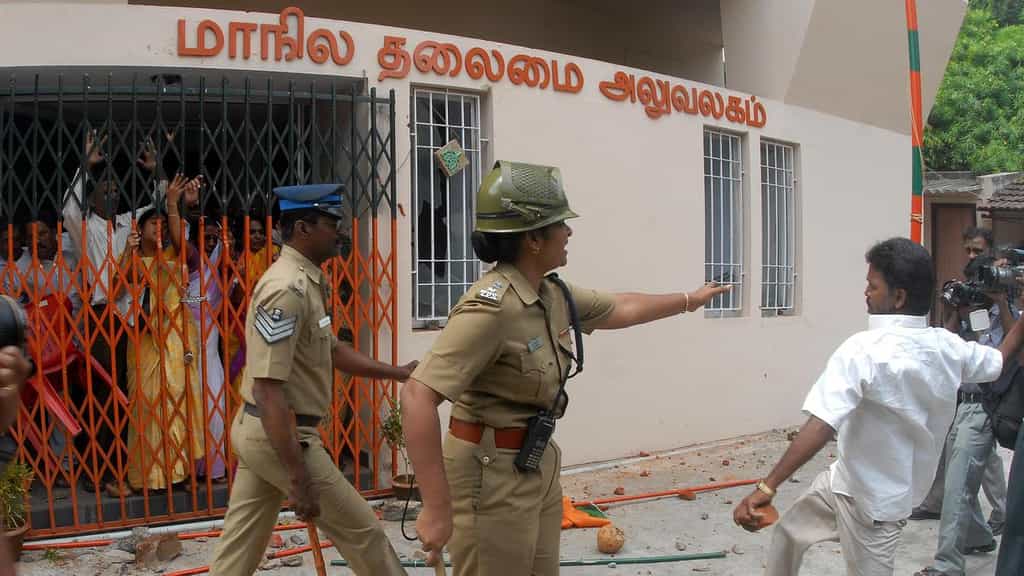
In Chennai, on September 23, 2007, a protest was held on South Boag Road in T. Nagar, near Vaidyaraman Street where Kamalalayam, the BJP’s State headquarters, is located. The demonstration was led by the then State Information Minister Parithi Ilamvazhuthi. Several DMK leaders from the city, including Chennai Mayor Ma. Subramanian (now Health Minister) and district secretaries Balaraman and J. Anbazhagan, were at the spot.
As DMK workers raised slogans against Vedanti and Mr. Advani, a section of the protesters entered Vaidyaraman Street around 10.15 a.m. and hurled stones at the BJP office, damaging window panes. A flagpost at the entrance of the party office was also uprooted. Nearly 15 BJP members including women sustained minor injuries, The Hindu reported, quoting G. Kumaravelu, then vice-president of the BJP’s State unit.
Around 11 a.m., the police detained the protesters. Later, Ilamvazhuthi claimed to journalists the protest was conducted in a “peaceful manner.” However, Mr. Kumaravelu, said similar attacks were reported in other parts of Tamil Nadu. BJP flagpoles were damaged in Villupuram district and the Hindu Munnani office at Chindatripet in Chennai was also attacked, he said.
BJP leaders alleged the attacks were carried out with police support. Mr. Kumaravelu said before the demonstrators assembled, Joint Commissioner of Police (South) G. Dorairaj had assured BJP leaders that the party office would be protected and there was no cause for concern.
One of the senior leaders who locked the gates of the BJP office from inside to escape the attack was former Governor Tamilsai Soundararajan, then general secretary of the BJP’s Tamil Nadu unit. She questioned whether the DMK was signalling that no party opposing its brand of politics should exist in the State.
However, the police denied allegations against them. Mr. Dorairaj said, “A few persons pelted stones. They were instigated by BJP members who came out of the office and said something.” He said he would not describe the incident as an “attack.”
Jayalalithaa reacted sharply to the incident, demanding the immediate dismissal of the DMK government. She accused it of unleashing violence with police support and charged those in high positions had resorted to “rowdyism.”
On the same day, Chief Minister Karunanidhi telephoned his Maharashtra counterpart Vilasrao Deshmukh, seeking protection for DMK members in Mumbai. A report inThe Hindu quoting an official release said the DMK office near Dharavi in Mumbai had been attacked by BJP and RSS activists while arrangements were being made for a meeting to stress the implementation of the Sethusamudram Canal Project.
The following day, BJP State president La. Ganesan, accompanied by Su. Thirunavukkarasar, the then BJP national secretary (now Congress leader), and Pon. Radhakrishnan, State vice-president, met Governor Surjit Singh Barnala at Raj Bhavan (now Lok Bhavan), and submitted a memorandum seeking the dismissal of the DMK government on the grounds of a “total breakdown of law and order” in Tamil Nadu.
On the same day, 10 DMK men were arrested in connection with the attack on the BJP office in T. Nagar and the Hindu Munnani office in Chindatripet, based on a complaint lodged by the BJP. A complaint was also registered against Vedanti for his provocative remarks.
Meanwhile, BJP members led by Ganesan and Hindu Munnani cadres led by its founder Rama Gopalan staged demonstrations in Chennai against what they termed the government’s “inaction” following the attack on the BJP headquarters. The BJP leadership in New Delhi convened an emergency meeting, chaired by national president Rajnath Singh, to discuss the situation in Tamil Nadu.
A few days later, BJP leaders Rajnath Singh, M. Venkaiah Naidu and Narendra Modi, who was then Chief Minister of Gujarat, visited Chennai and inspected the damage at Kamalalayam. The leaders were in the city to pay homage to Jana Krishnamurthy, former BJP national president, who died in September that year.
Editorial Context & Insight
Original analysis and synthesis with multi-source verification
Methodology
This article includes original analysis and synthesis from our editorial team, cross-referenced with multiple primary sources to ensure depth, accuracy, and balanced perspective. All claims are fact-checked and verified before publication.
Editorial Team
Senior Editor
James Chen
Specializes in India coverage
Quality Assurance
Associate Editor
Fact-checking and editorial standards compliance