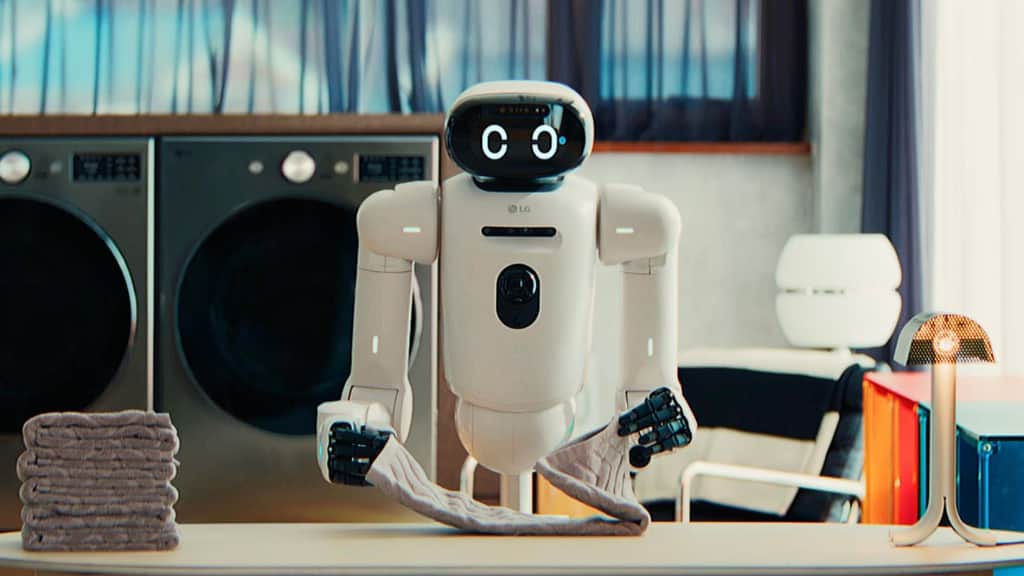
The robot features a humanoid design tailored for use in indoor environments. It consists of a head, two movable arms, and a wheeled, autonomous base. (Image: LG Electronics)
LG Electronics is set to launch an AI-driven home robot called LG CLOiD at the Consumer Electronics Show (CES) 2026 in Las Vegas. The launch represents LG’s most daring move in the home robotics segment.
The company asserts that CLOiD is intended to function as more than just a novelty or a device with a singular purpose. It is a key element in LG’s vision of future living environments, which envisions smart technologies autonomously managing routine household tasks. By monitoring routines and reacting to its environment, the robot is designed to act as a flexible assistant proficient in managing devices, aiding inhabitants, and seamlessly integrating into everyday life.
The launch aligns with LG’s long-standing ‘Zero Labour Home’ concept. According to the company, the aim is to shift labour-intensive tasks from people to AI-driven systems so that families can focus more on leisure, creativity, and personal well-being.
Through live demonstrations, CES attendees will have the chance to see that vision in action. LG claims that CLOiD can help a resident prepare for the day by setting up breakfast, gathering supplies, and adjusting tasks based on the person’s schedule. The robot can also handle laundry and assist with other cleaning tasks.
In addition to tasks, CLOiD is meant to engage directly with individuals. The robot is capable of responding to verbal commands, aiding in tasks like home exercises, and modifying its actions according to learned household routines. LG states that CLOiD can analyse intricate situations and convey messages in a manner that seems organic instead of rehearsed.
LG chose a wheeled design over a bipedal one, highlighting stability and practicality as significant benefits. The bottom part relies on the firm’s expertise with independent technologies implemented in robotic vacuums and service robots. This design allows the robot to stay stable in lively households with kids or animals, while also simplifying mechanics and enhancing its chances for broader market acceptance.
CLOiD functions as a portable smart-home centre. The robot is powered by LG’s Q9 AI platform, which is programmed to process hardware, cameras, sensors, speakers, and a display, allowing it to control connected devices and act as an interactive interface for the household.
With regards to software, the robot depends on vision and language AI systems created by LG itself.
LG also aims to launch a new robotics component brand at CES 2026, highlighting its goal to broaden its presence within the robotics value chain.
Company executives describe the unveiling of CLOiD as more than just the launch of a new product. Instead, they frame it as a statement of intent – a signal that LG aims to reshape everyday living by weaving AI and robotics deeper into the home, with the promise of reducing household labour and changing how people interact with their living spaces.
Editorial Context & Insight
Original analysis & verification
Methodology
This article includes original analysis and synthesis from our editorial team, cross-referenced with primary sources to ensure depth and accuracy.
Primary Source
The Indian Express