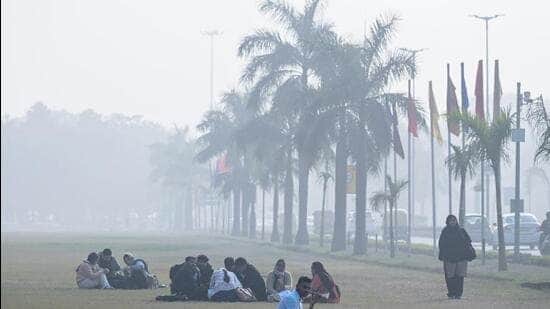
The Supreme Court on Tuesday termed the Commission for Air Quality Management’s (CAQM) inability to clearly identify the causes of air pollution in Delhi-NCR and their relative contribution as a “complete failure of duty”, directing the statutory body to complete a source-identification and apportionment exercise within two weeks and place the findings in the public domain.
A bench comprising Chief Justice of India Surya Kant and Justice Joymalya Bagchi rejected CAQM’s plea for two months’ time to examine issues relating to traffic congestion and the collection and utilisation of environmental compensation charge (ECC), making it clear that the court would monitor the matter every fortnight regardless of prevailing air quality levels.
“We are not going to adjourn this case by more than two weeks. We will be taking this case regularly irrespective of whether the AQI in Delhi-NCR is zero or 700. We have to monitor this case and find a solution,” the bench told additional solicitor general Aishwarya Bhati, appearing for the CAQM.
The court expressed strong dissatisfaction with the commission convening a meeting only on January 2, despite a detailed order passed on December 17 emphasising the urgency of long-term planning. “By holding a meeting on January 2, and telling us that we need two more months is not acceptable to us… ; the CAQM would be failing to perform its duties,” the bench said.
At the core of the court’s concern was what it described as the absence of basic, publicly available information on what actually drives pollution in the region. “First, you have to identify the causes and their apportionment to the rising pollution,” stressed the bench, noting that solutions could not be meaningfully discussed unless this foundational exercise was completed.
During the hearing, the court said it was conscious that it could not act as a “super-expert” and would be guided by domain specialists. However, it questioned why an expert statutory body needed repeated judicial nudges to place factual data before the public. “Why do they not want to come out with information in the public domain -- the causes and their apportionment in pollution?” asked the bench, adding that it was not interested in taking credit but in seeing solutions emerge from the system.
The bench flagged contradictions in existing source-apportionment studies, observing that different institutions had assigned varying levels of responsibility to sectors such as transport, with estimates ranging from 12% to 41%. “Unfortunately, even these studies by different institutions have given different findings,” the court noted, even as CAQM informed it that fresh studies were being undertaken byan Indian Institute of Technology and AERI.
The court further cautioned against disproportionate attribution of blame, particularly on farm fires. “It could ultimately be found that farmers being blamed for farm fires are the least contributors. They are being blamed disproportionately. Why do you not want real facts to come out?” the bench remarked, recalling that during the pandemic, when stubble burning reportedly increased, Delhi-NCR witnessed unusually clear and blue skies.
Senior advocate Aparajita Singh, assisting the court as amicus curiae, echoed the concern, prompting the bench to candidly acknowledge that decades of reports and recommendations had failed to deliver real solutions. “Despite all the reports and recommendations, the problems, if not aggravating, are persisting,” said the court, underlining that identification of causes was the essential first step.
The bench indicated that future hearings would be issue-specific, including the issue of vehicular pollution and the role of heavy vehicles, construction activities -- where it recognised competing concerns of housing needs and environmental protection. Blanket bans, it cautioned, could not be a prudent response without viable alternatives. It also referenced Singh’s note that urged the bench to consider the matter issue-wise on subjects like vehicular pollution, air quality governance, operation of power plants, industrial pollution, waste management, road and construction dust, among other.
The court also addressed submissions on toll plazas – considered a cause of severe congestion at several entry points to Delhi. While the Municipal Corporation of Delhi defended toll plazas as a revenue source, the bench said it would not hesitate to order their removal if expert opinion justified it. It took note of applications by Gurugram authorities seeking a share of ECC (environmental compensation charges) collections and criticised local bodies for prioritising revenue arguments over pollution control.
In its order, the court recorded that CAQM had cited transport, industrial waste, power plants, domestic and solid waste burning, road and construction dust, and emissions from hotels and restaurants as sources of pollution, but had failed to indicate their proportionate contribution. It noted that despite repeated monitoring and expert inputs, the commission had submitted only a status note “silent on most of the issues” raised earlier, including recommendations by the amicus.
Calling this delay unacceptable, the court issued a series of directions. It ordered CAQM to convene a meeting of shortlisted domain experts within two weeks and submit a report identifying major pollution sources and their attribution, both to the court and the public. The commission was also directed to simultaneously work on long-term measures, prioritising the most significant contributors to AQI deterioration, and to independently examine the issue of toll plazas.
The court underscored that public awareness could itself address certain pollution sources if people were informed of their role, reiterating the need for transparency and a public-centric approach. While recognising that transitions such as a shift to electric vehicles required careful examination of fiscal and social consequences, it said phased, evidence-based alternatives must be explored without delay.
Tuesday’s order builds on the Supreme Court’s December 17 order, where it termed existing anti-pollution measures a “total failure” and sent the CAQM “back to the drawing board” to devise a comprehensive long-term strategy for Delhi-NCR’s annual air crisis. Since then, the bench has signalled sustained and frequent scrutiny, making it clear that institutional inertia would no longer be tolerated.
The Supreme Court has been monitoring air pollution in Delhi-NCR for nearly four decades, beginning with a public interest litigation filed in 1985 by environmentalist MC Mehta. Successive benches have passed orders directing the conversion of Delhi’s public transport fleet to compressed natural gas (CNG), regulating industrial emissions and restricting polluting vehicles. These interventions led to the conferral of statutory powers on the CAQM.
Editorial Context & Insight
Original analysis & verification
Methodology
This article includes original analysis and synthesis from our editorial team, cross-referenced with primary sources to ensure depth and accuracy.