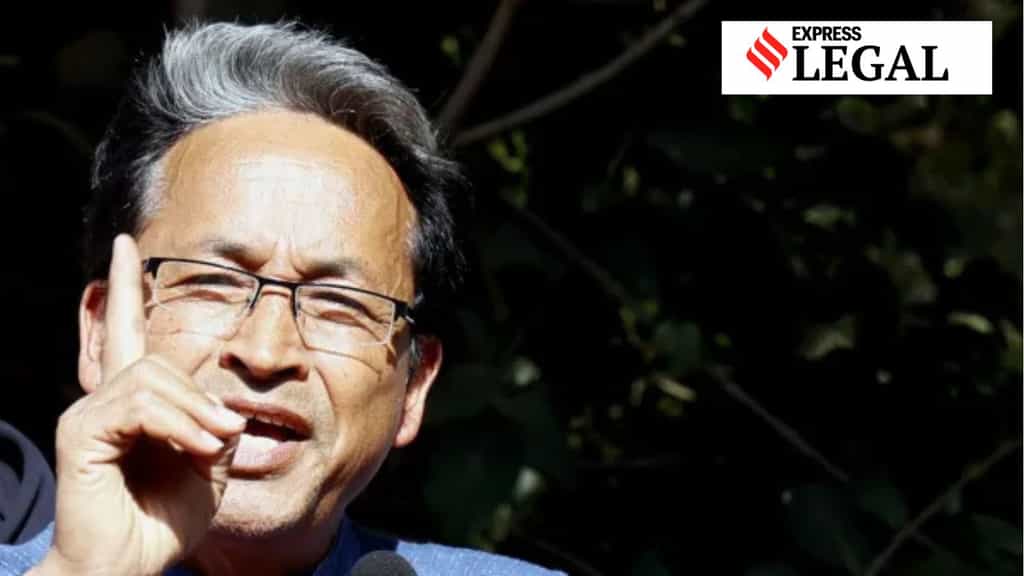
Sonam Wangchuk was detained under the the National Security Act on September 26, 2025, two days after violent protests demanding statehood and Sixth Schedule status for Ladakh.
Appearing before the Supreme Court on Thursday, senior advocate Kapil Sibal, representing Gitanjali Angmo, wife of jailed climate activist Sonam Wangchuk, argued that his speech to end the hunger strike following the violence in was not to propagate violence but to quell it.
Wangchuk, booked by the Khaltsi Police Station in Leh District, Union Territory of Ladakh under Section 3 (2) of the National Securities Act, 1980, is accused of inciting violence in the region. He was leading a movement seeking statehood and protections under the Sixth Schedule for Ladakh before his arrest.
“Tenor of speech not in any sense with intent to propagate violence but to quell it. It is the opposite of what the detention order says,” Sibal said, referring to the detention order.
Sibal began his arguments with the submission that the climate activist was not provided with complete grounds of detention and never afforded a proper opportunity to make a representation to the authority concerned against detention.
Emphasising that the law mandates that if the grounds of detention are not supplied to the detenu, the order (detention) is “vitiated”, Sibal referred to the case law on detention and the supply of grounds.
Referring to those four videos, he further questioned that if it is not the duty of the local authority to hand over the facts to the detaining authority so that all facts come out before the decision.
“I don’t have to ask. It is their constitutional duty to supply (complete grounds of detention) for me to make the representation,” Sibal said. He added that the “infraction” was not that they (detaining authority) didn’t have these documents, but that they didn’t supply.
The matter would continue on January 12.
Wangchuk was detained on September 26, 2025, under the NSA, which empowers governments to act pre-emptively against individuals seen as a threat to public order or national security. He was later shifted to Jodhpur. His detention came two days after violent protests demanding statehood and Sixth Schedule status for Ladakh left four people dead and 90 injured in the Union territory. The government had accused him of inciting the violence.
Wangchuk has been known as an education reformer, a climate activist and an innovator for three decades. He has actively worked to highlight the impact of climate change on Ladakh’s fragile ecosystem. Born in 1966 in a far-off village of Leh, Wangchuk became a mechanical engineer and later transformed himself into an education reformer to set up the first alternative school — Students Educational and Cultural Movement of Ladakh (SECMOL).
Editorial Context & Insight
Original analysis & verification
Methodology
This article includes original analysis and synthesis from our editorial team, cross-referenced with primary sources to ensure depth and accuracy.
Primary Source
The Indian Express