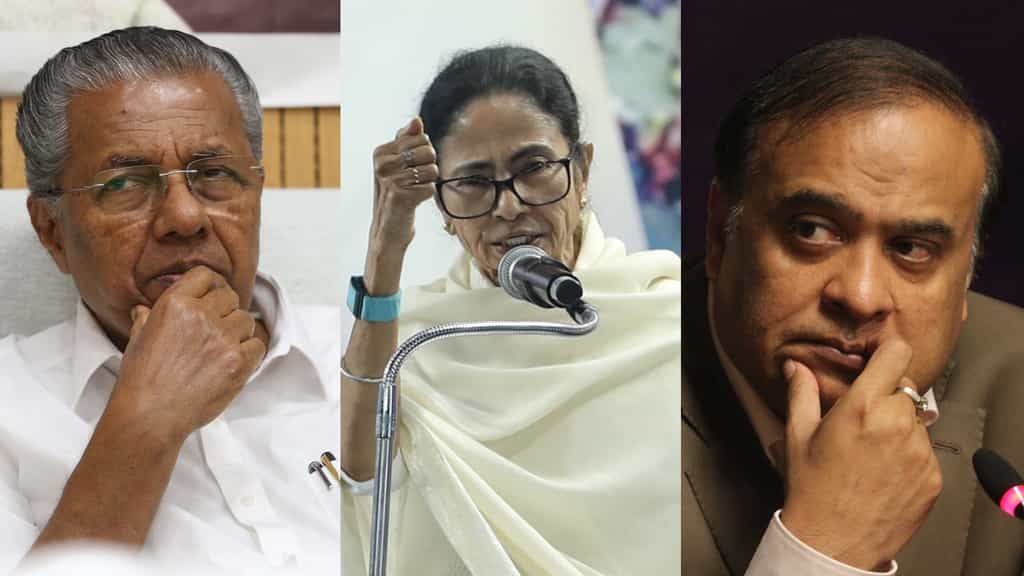
India is heading into another high-stakes electoral season in 2026. The terms of the Legislative Assemblies in Assam, Kerala, Tamil Nadu, West Bengal and Puducherry are nearing their constitutional end setting the stage for elections that will test governments, reshape oppositions, and offer early clues to national political currents.
Exercising its constitutional authority under Article 324 read with Article 172(1) of the Constitution and Section 15 of the Representation of the People Act, 1951, the ECI has reiterated its commitment to free, fair, inclusive and secure elections.
Together, these five regions span more than 800 Assembly seats, cutting across the Northeast, the South, the East and a Union Territory each with its own political rhythm and ambitions.
The term of the Kerala Legislative Assembly ends on May 23 2026, with elections expected in April 2026. The previous election, held on May 24, 2021, rewrote the state’s political history when the Communist Party of India (Marxist)-led Left Democratic Front (LDF) returned to power for a second consecutive term an unprecedented feat in Kerala since 1977.
LDF vs UDF Kerala 2026: The LDF secured 99 of 140 seats improving its tally from 2016, while the Congress-led United Democratic Front (UDF) was reduced to 41 seats. The BJP-led NDA lost its only seat, showing a decline in its electoral footprint in Kerala.
Chief Minister Pinarayi Vijayan emerged as the central figure of the victory, becoming the first Kerala CM to be re-elected after completing a full five-year term. His second cabinet, sworn in on 20 May 2021 featured a largely revamped team including eight first-time MLAs and three women ministers.
Kerala recorded a 74.02 per cent voter turnout in 2021 despite pandemic-related constraint slightly lower than the 77.35 per cent turnout in 2016. Northern districts such as Kozhikode, Kannur, and Kasaragod traditionally showed higher participation and remain LDF strongholds.
The LDF’s governance model focused on welfare delivery, pension schemes, and crisis management rather than overt “freebie politics” has reshaped voter expectations.
Now the question is as the 2026 election nears, can the LDF repeat the trick? With Vijayan seeking a third term and the Congress-led UDF struggling to rediscover momentum, Kerala’s 2026 election could once again hinge on whether voters prioritise stability over change.
The Assam Assembly’s term concludes on May 20, 2026, following elections last held in April 2021. With 126 Assembly constituencies Assam has become a critical battleground for the BJP in the Northeast.
The BJP-led National Democratic Alliance (NDA) retained power with 75 seats, marking the first time a non-Congress alliance won consecutive terms in Assam. The Congress-led Mahajot improved its tally to 50 seats, while independent candidate and jailed activist Akhil Gogoi registered victory from Sibsagar.
Post-election, a leadership transition saw Himanta Biswa Sarma take over as Chief Minister, replacing Sarbananda Sonowal, after high-level consultations with the BJP’s central leadership.
Assam witnessed an estimated 77 per cent voter turnout in the first phase of polling in 2021. Issues of citizenship, identity, governance delivery, and regional aspirations are expected to dominate the 2026 narrative, as the BJP seeks to defend its expanding political footprint in the state.
Tamil Nadu’s Assembly term ends on May 10, 2026, and the state is already showing signs of political churn beneath a seemingly stable surface.
The DMK’s return to power in 2021, under M K Stalin ended a decade of AIADMK rule and closed a long chapter shaped by towering leaders like J Jayalalithaa and M Karunanidhi. Stalin’s victory was both personal and political with a slow climb finally leading in the top job.
MK Stalin DMK vs Vijay TVK: But while the DMK has focused on governance and welfare, including the newly announced Tamil Nadu Assured Pension Scheme, the opposition space remains unsettled. The AIADMK continues to grapple with internal fractures, while actor turned politician Vijay’s Tamilaga Vettri Kazhagam (TVK) has begun attracting sidelined leaders hinting at a possible realignment ahead of 2026.
Add to this the frequent face-offs between the DMK government and Governor R N Ravi over NEET delimitation and Centre–state relations and Tamil Nadu’s election narrative is likely to be as much about federalism as it is about local governance.
Around 62.6 million people were eligible to vote in the state in the 2021 assembly polls, comprising 3.09 million men, 3.19 million women, and 7,192 voters from the third gender category.
Polling on April 6, 2021, saw an overall voter turnout of 72.81 per cent. Karur district registered the highest participation at 83.92 per cent, while Chennai recorded the lowest turnout at 59.06 per cent. The overall turnout was about two percentage points lower than in the 2016 elections, when voter participation stood at 74.81 per cent.
High stakes elections across the nation for 2026. (Source: AI generated)
The West Bengal Assembly’s term ends on 07 May 2026 with polls expected in the first half of the year. The state has 294 Assembly constituencies making it one of India’s largest electoral contest.
In 2021, Mamata Banerjee-led Trinamool Congress (TMC) delivered a decisive victory while the BJP emerged as the principal opposition with 77 seats. For the first time, neither the Congress nor the Left won a single seat showing Bengal’s bipolar shift.
West Bengal recorded nearly 80 per cent voter turnout in 2021, though the election was marred by sporadic violence. With ongoing confrontations between the TMC and the Centre ranging from MGNREGA funding to I-PAC raids the 2026 election is shaping up as a direct contest over federal autonomy and governance control.
The Puducherry Assembly’s tenure ends on May 15, 2026. Despite having just 30 Assembly seats, the Union Territory holds disproportionate political significance due to its nominated MLAs and power shifts.
The NDA formed the government in 2021 benefiting significantly from nominated members aligned with the BJP which made it the second-largest party despite limited direct electoral wins.
As Puducherry heads toward another election this year, questioning around democratic representation, nominated MLAs, and coalition stability are likely to dominate the discourse.
Editorial Context & Insight
Original analysis & verification
Methodology
This article includes original analysis and synthesis from our editorial team, cross-referenced with primary sources to ensure depth and accuracy.
Primary Source
The Indian Express