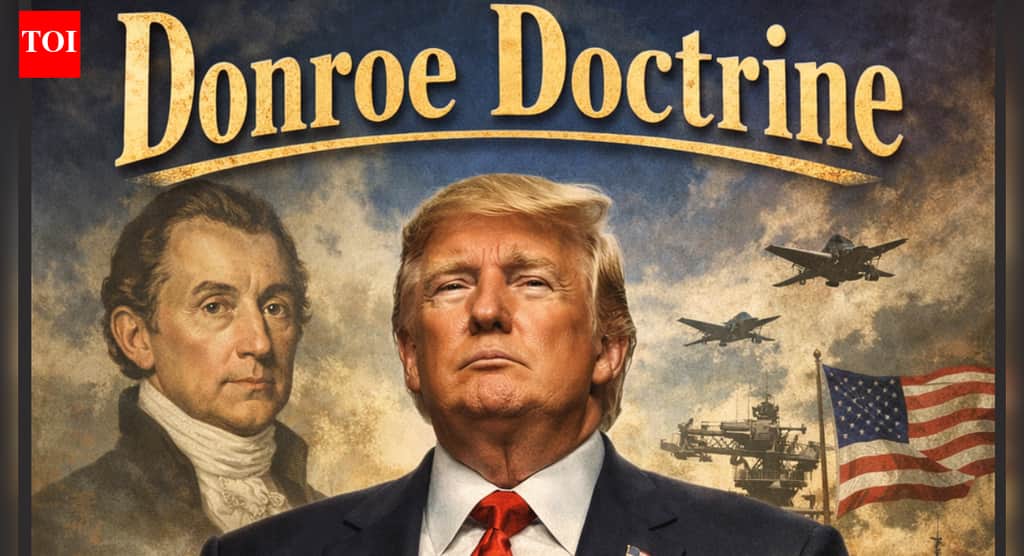
What began two centuries ago as a warning to European empires is being reborn as something far more Trumpian.US President Donald Trump’s offhand quip -- the "Donroe Doctrine" -- is no longer just a rhetorical flourish.
Framed by Trump as being "about peace on Earth," it is fast emerging as the organising idea behind his posture across the Americas and the wider Western Hemisphere.
"It's about PEACE on Earth. We gotta have peace. It's our hemisphere. The Monroe Doctrine was very important when it was done, and other Presidents — a lot of them — they lost sight of it. I didn't. I didn't lose sight," he said, casting his recent actions as a deliberate revival of Monroe's original mandate.
From Venezuela to Greenland, Cuba to Colombia, Trump is reaching deep into 19th-century history to justify a far more assertive, 21st-century projection of power.
For much of the 20th century, the Monroe Doctrine evolved in fits and starts.Theodore Roosevelt’s early-1900s "corollary" transformed it from a warning into a justification for intervention, allowing Washington to act as what Roosevelt called an "international police power" in Latin America.
That approach, too, eventually receded. By the early 21st century, the Monroe Doctrine was widely regarded as a relic of another era, so much so that former US secretary of state under Obama -- John Kerry once declared it "over."Trump has brought it back -- and pushed it further.Trump has wrapped himself tightly in this souped-up, personalised Monroe Doctrine, now rebranded the "Donroe Doctrine" -- to justify audacious, intimidating and at times destabilising moves in the Americas.
If Monroe sought to keep foreign powers out of Americas, Trump appears intent on reshaping the entire hemisphere around American dominance.The emphasis has shifted from deterring outside powers to asserting American dominance within the hemisphere itself, which can also be associated with the term "Trump corollary."
Digging deep into the past, Trump pulled out a 19th-century justification for his 2026 strikes on Venezuela.
The United States will reassert and enforce the Monroe Doctrine to restore American pre-eminence in the Western Hemisphere.
The campaign unleashed by Trump only pumps up his "expansionist" agenda. The rip-roaring US strikes on Venezuela under Operation Absolute Resolve, leading to the capture of Venezuelan leader Nicolás Maduro, have become the clearest signal yet that Trump intends to wield American dominance across the region.What raised even more alarms was Trump's argument that military action was necessary because "we want to surround ourselves with good neighbours."
At his Mar-a-Lago press conference, he rattled off threats to Cuba and Colombia. In an earlier interview he hinted Mexico and Canada could be next.Fresh off the Venezuela operation, Trump has revived his long-running push for an American acquisition of Greenland, framing it as essential to US national security. He has publicly threatened Colombia with military action over the cocaine trade. His top diplomat has warned that Cuba's communist regime is "in a lot of trouble."Even Canada, the Western Hemisphere's largest country by landmass, has not escaped the Trump's range of rhetoric. His musings about taking The Great White North over and turning it into the "51st state" have continued to make headlines, raising a larger question: just how expansive is this "Donroe Doctrine" vision supposed to be?In Trump's hands, Monroe's cautious 1823 message has returned as a 21st-century blueprint for dominance -- louder, brasher and unmistakably Trumpian.What it calls the “Trump Corollary” is a nod to the “Roosevelt Corollary”. The 26th US president turned Monroe’s defensive, exclusionary stance into “big stick” hegemony.On his imagined map, Trump had folded Canada in as America's "51st state," relabelled Greenland as "our land," renamed the Gulf of Mexico the "Gulf of America," and declared the Panama Canal firmly back under US control.
Trump himself embraced the term "Donroe Doctrine," first floated by a New York tabloid to echo then-President James Monroe.
"The Monroe Doctrine is a big deal. But we've superseded it by a lot. By a real lot. They now call it the Donroe Document," a bleary-eyed Trump boasted at a news conference after staying up nearly the entire night to monitor the lightning-fast US operations in his private club Mar-a-Lago in Florida.
American dominance in the Western Hemisphere will never be questioned again.
For years, the Monroe Doctrine had been consigned to foreign-policy history -- an era that even John Kerry, as Barack Obama's secretary of state, declared "over."
But Trump is dragging it back, turbocharged and rebranded, with implications that spread far beyond Caracas.With thinly veiled threats and a posture of unshakeable bravado, Trump is jolting allies, alarming adversaries and injecting a new, unsettling question into global strategic circles: who's next?
Trump, flexing military muscle, turned his sights on Venezuelan leader Maduro, launching a rapid overnight attack on Caracas under Operation Absolute Resolve.
The strikes, sharp, explosive, and reportedly over in less than 30 minutes, ended with Maduro and his wife Cilia Flores in US custody.
The operation unfolded after months of deepening hostility between Washington and Caracas. The US has long accused Maduro of drug trafficking, cocaine-fuelled corruption, allegations Venezuelan leader denies. The US, since September, has carried out more than 20 strikes in waters near Venezuela.
But this time, Trump went all the way.For the first time, Uncle Sam under Trump successfully seized Maduro -- a leader long been seen as an "eyesore" for Washington leadership. Maduro was handcuffed, flown out, and "perp walked" in footage shared by the White House’s Rapid Response unit."Maduro was the kingpin of a vast criminal network responsible for trafficking colossal amounts of deadly and illicit drugs into the United States.
He personally oversaw the vicious cartel known as Cartel de las Solas, which flooded our nation with lethal poison. Responsible for the deaths of countless Americans," Trump said.
Hours later, he was transferred to the US military prison in Guantanamo Bay.The mission was months in the making. Since late 2025, Washington had quietly assembled a formidable naval and air armada off Venezuela's coast, guided-missile destroyers, amphibious assault ships, a nuclear submarine, and the powerhouse USS Gerald R Ford carrier strike group with its F-35 jets.The Pentagon described the deployment as a "show of force far beyond any past counter-narcotics effort".Trump, unsurprisingly, basked in the spectacle. He hailed the mission to capture Maduro as one of the "most stunning, effective and powerful displays of American military might and competence in American history".Maduro and Flores were flown to New York, where they now face charges of "narcoterrorism" and conspiracy to import cocaine.
In Caracas, chaos and condemnation followed. Venezuelan vice-president Delcy Rodríguez decried the "kidnapping" of Maduro, insisting he remains "the only president of Venezuela", as world capitals urged de-escalation.Trump, meanwhile, vowed the US would "run" Venezuela and tap its enormous oil reserves, though he offered few details on what that meant.Just two days later, Trump doubled down, issuing a fresh warning that the US would strike again "if they don't behave."
Asked who was in charge of post-Maduro Venezuela, Trump shot back: "Don’t ask me who's in charge because I'll give you an answer and it’ll be very controversial... We're in charge."
Oil is the giant shadow behind everything.Venezuela holds 303 billion barrels of crude, about one-fifth of all global reserves, the largest proven stash on the planet. Yet production has collapsed after years of mismanagement and sanctions, falling from over 3 million barrels a day to barely a million by 2025.Trump made no secret of his plans: American oil giants would move in. "We're going to have our very large United States oil companies – the biggest anywhere in the world – go in, spend billions of dollars, fix the badly broken infrastructure and start making money for the country," he said. He even promised they'd be "reimbursed" for whatever they rebuilt, hinting at a sweeping US role in Venezuela's energy future.
Pressed aboard Air Force One about the implications of the Venezuela strike, Trump widened the scope, dramatically.When asked if there will be an operation by the US, Trump said, "It sounds good to me. Because they kill a lot of people." He took aim at Colombia and its president, Gustavo Petro, accusing the country of being "run by a sick man who likes making cocaine and selling it to the United States."
He warned, "He's not going to be doing it for very long," adding, "He has cocaine mills and cocaine factories."The comments landed amid escalating US maritime strikes in the Caribbean and eastern Pacific, putting intense pressure on Colombia, long the central hub of the global cocaine trade.
When asked whether he might authorise an operation against Colombia, Trump didn't hesitate: "It sounds good to me."
Is Greenland next on the Trumpian horizon? The signals seem to be clear.Katie Miller, wife of Steven Miller, Trump's deputy chief of staff, even said the US would make a grab for Greenland "soon".Trump revived his long-standing ambition to take over the Danish-controlled island, calling it essential to US security security.
"We need Greenland. ... It's so strategic right now. Greenland is covered with Russian and Chinese ships all over the place," he claimed. "We need Greenland from the standpoint of national security, and Denmark is not going to be able to do it."He said that US ownership and control of the island is an "absolute necessity".He insisted even Europe supported the idea: "The European Union needs us to have it, and they know that."
Denmark, however, was unequivocal. Prime Minister Mette Frederiksen dismissed the idea, saying "It makes absolutely no sense."
But Trump's fascination on his dreamland of "Greenland" is easy to decode. The Arctic is warming four times faster than the rest of the world, exposing vast reserves of rare earth minerals, oil, and natural gas, resources central to US strategic competition with China.
Trump suggested Cuba may be collapsing on its own. "I don't think we need any action," he said.
"It looks like it’s going down."He argued Cuba's economy, long propped up by Venezuelan oil, was on the brink.Secretary of state Marco Rubio struck a harder tone. When asked whether Cuba could be the next target, he replied, "The Cuban government is a huge problem… They are in a lot of trouble, yes." He accused Havana of "propping up" Maduro's security apparatus, including personal bodyguards.
Trump has repeatedly floated the idea of absorbing Canada into the US, calling it the "51st state."
He's threatened to seize the Panama Canal, slapped tariffs on key North American partners, and expressed willingness to rip up the Canada–Mexico trade pact.Canada's initial response to the Venezuela strike was notably timid. Prime Minister Mark Carney posted on X that Canada "welcomes the opportunity for freedom, democracy, peace, and prosperity for the Venezuelan people," urging respect for international law, words that had little to do with the actual situation.But the days ahead matter far more. The strikes made one thing clear: Washington intends to enforce the "Trump Corollary".Trump insists he won't use military force against Canada, but economic coercion is another matter. Tariffs, threats, and pointed rhetoric have already rattled Ottawa.Since his re-election, Trump has repeatedly talked about making Canada the "51st state," enraging Canadian leaders and residents.
He even referred to then-Prime Minister Justin Trudeau as "governor," and mused about erasing the 5,525-mile border altogether.In Trump's imagined geopolitical map, the Lower 48 would expand northward, swallowing the vast Canadian territory between the US mainland and Alaska, leaving Hawaii as the lone non-contiguous state.
Trump signed an executive order renaming the Gulf of Mexico the "Gulf of America."The order has authority only within US borders, but it fits neatly into the administration’s broader expansionist push.
Mexico and international bodies have no obligation to recognise the change, though Trump made clear he didn’t particularly care.Trump's executive order specified that the renamed Gulf includes the "US Continental Shelf area bounded on the northeast, north, and northwest by the State of Texas, Louisiana, Mississippi, Alabama, and Florida, extending to the seaward boundary with Mexico and Cuba.""I took this action in part because, as stated in that order, ‘the area formerly known as the Gulf of Mexico has long been an integral asset to our once burgeoning Nation and has remained an indelible part of America,’" Trump said in his proclamation.The Gulf has carried its name for more than four centuries.And to add more American element, Trump also restored the name Mount McKinley to Denali, reversing Barack Obama's 2015 decision to use the Alaska Native name. Trump said he wanted to "restore the name of a great president, William McKinley, to Mount McKinley."
Editorial Context & Insight
Original analysis & verification
Methodology
This article includes original analysis and synthesis from our editorial team, cross-referenced with primary sources to ensure depth and accuracy.
Primary Source
Times of India