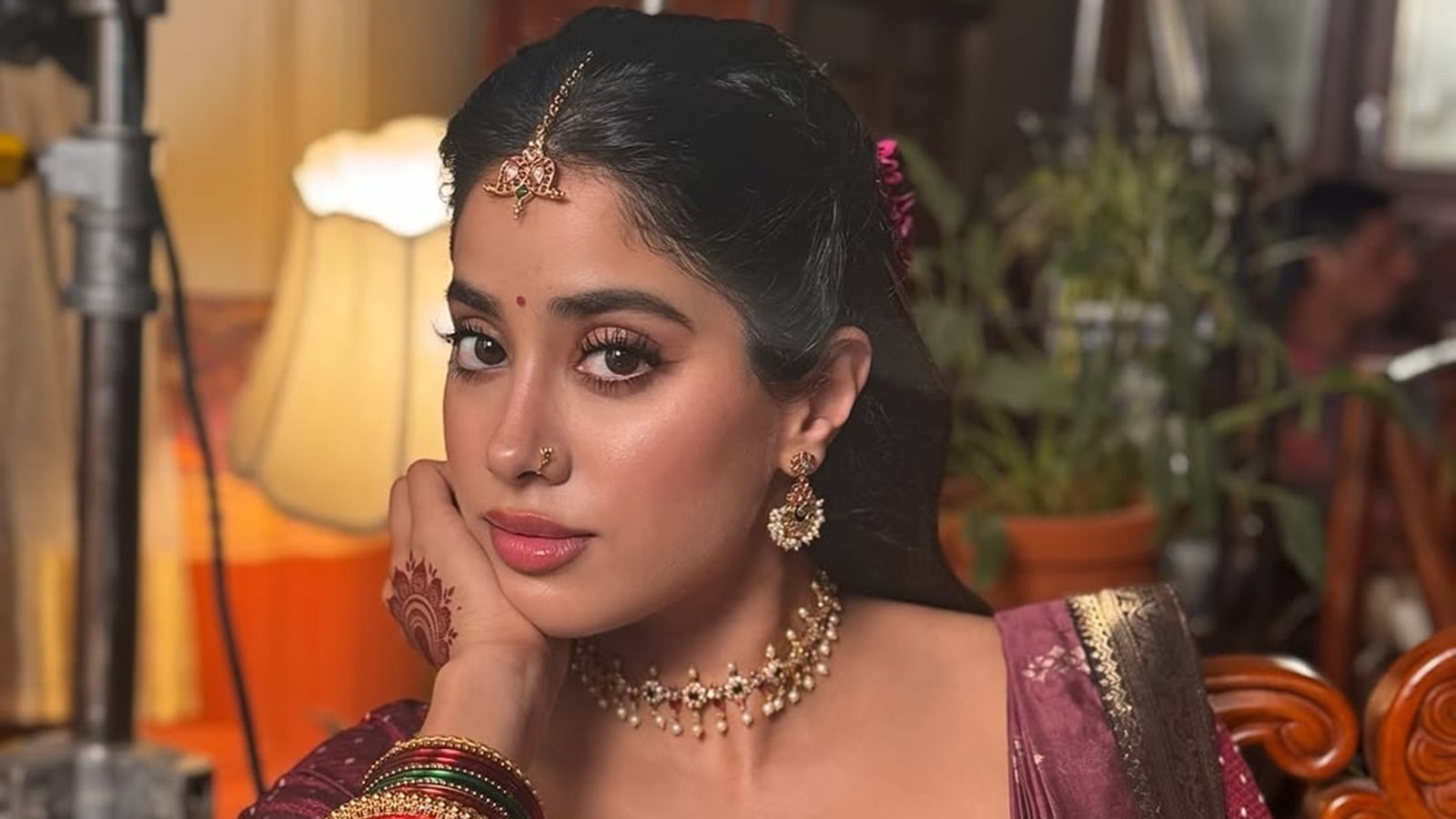
Janhvi Kapoor opened up about managing male egos (Source: Instagram/Janhvi Kapoor)
It’s not unusual for women, in both professional and social settings, to feel the need to downplay their intelligence or opinions to keep the peace, especially in male-dominated environments. Recently, actor Janhvi Kapoor opened up about this dynamic in the film industry during her appearance on Two Much With Twinkle and Kajol, hosted by Kajol and Twinkle Khanna, with Karan Johar also joining as a guest.
Janhvi shared that navigating male egos has been one of the biggest challenges in her career. “I understand that I am coming from a place of privilege in my work environment. But I feel for me it’s been (about) navigating egos, male egos. If I have an opinion, recently, I am in rooms where I can say what I want without feeling the need to tiptoe around. But I have been in rooms and situations where I kind of need to precede someone and pretend to be dumb. You need to pick your battles and manoeuvre how you need to put your point across without rubbing anyone the wrong way,” she said.
Twinkle Khanna quickly related to Janhvi’s experience, admitting that she faced similar challenges as a young actor in the 1990s. “I had the same problem when I was young, and I never understood the need to be diplomatic,” Twinkle said.
While the conversation focused on the film industry, many women across different fields might find this sentiment familiar, choosing silence or self-effacement over confrontation, not out of weakness but as a form of strategic survival.
Psychologist Rasshi Gurnani tells indianexpress.com, “When women repeatedly downplay their intelligence or ‘pretend to be dumb,’ it can create a deep psychological conflict known as cognitive dissonance, where their true abilities and external behaviour don’t align. Over time, this can lead to imposter syndrome, lowered self-esteem, and chronic anxiety about being ‘found out.’
Suppressing one’s competence to protect others’ egos can also result in emotional exhaustion and learned helplessness, Gurnani notes, where women begin to internalise the belief that being authentic or ambitious will invite rejection. This constant self-censorship chips away at one’s sense of self-worth and can distort identity, leading to long-term stress and resentment toward the professional system they’re part of.
These power dynamics persist because many workplaces still operate under patriarchal conditioning, where leadership traits are unconsciously coded as masculine. Gurnani mentions that when women display these traits, they often face backlash bias, being labelled as “aggressive” or “difficult.”
There’s also a strong element of social conditioning at play; women are often taught to prioritise harmony over confrontation. In male-dominated environments, this can create an unspoken rule that women must self-edit to avoid threatening the status quo.
Women can begin by practising assertive communication, Gurnani states, a balance between passivity and aggression that allows expression of ideas with clarity and respect. Building emotional intelligence helps manage tone and timing, while self-validation ensures they don’t rely solely on external approval. Mentorship and allyship from both men and women can also help normalise strong female voices.
“On a systemic level, workplaces need to foster psychological safety, where employees can speak without fear of social punishment. Regular gender-sensitivity training, inclusive leadership, and clear accountability policies can dismantle these outdated hierarchies,” suggests Gurnani.