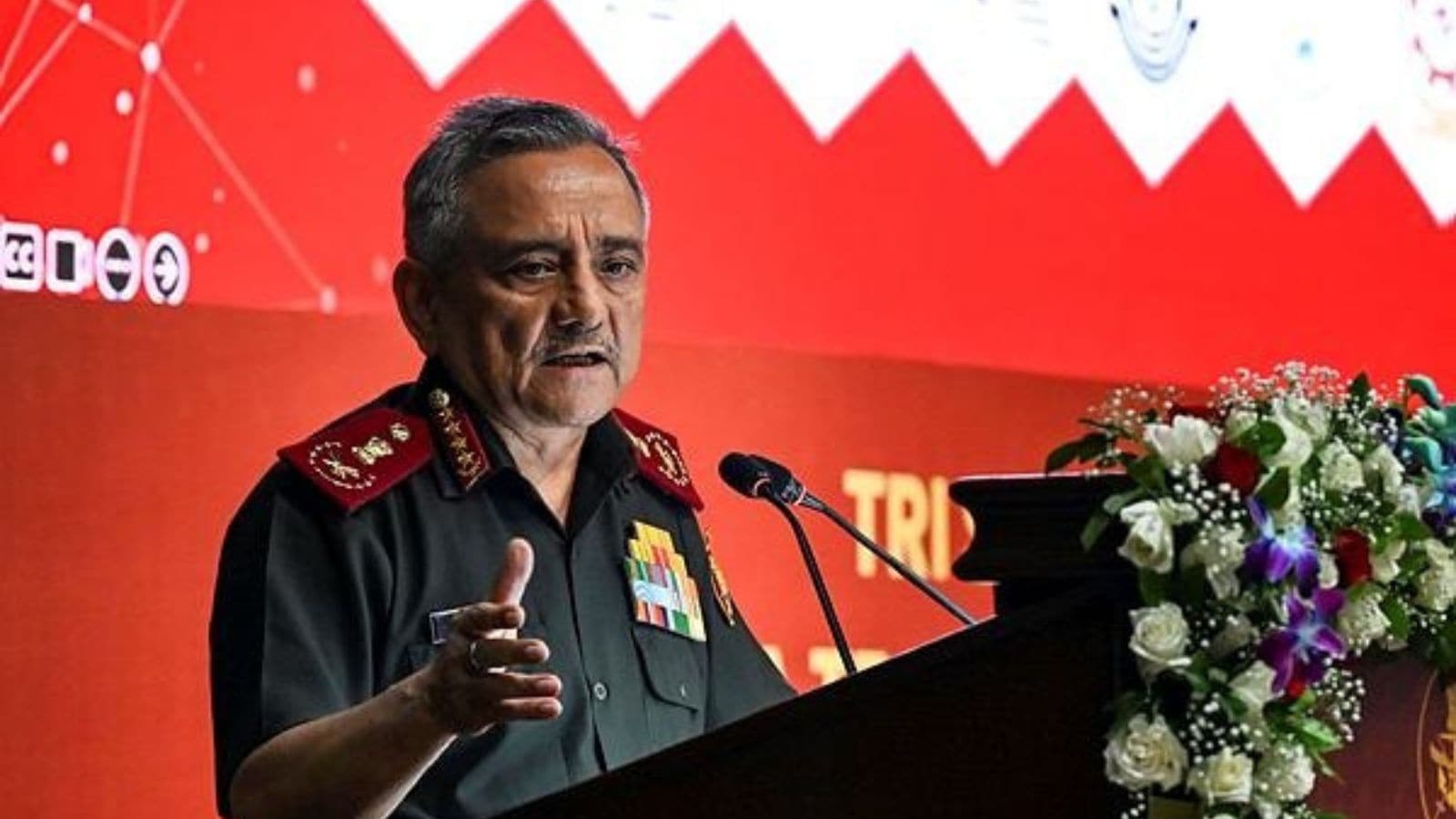
Chief of Defence Staff General Anil Chauhan underscored the growing importance of multidomain operations in modern warfare (File photo)
As the nature of warfare rapidly evolves with technology playing a decisive role, the Indian Institutes of Technology (IITs) have a crucial responsibility in driving innovation, said Chief of Defence Staff General Anil Chauhan on Monday. He underscored the growing importance of multidomain operations in modern warfare, which require close coordination not only among the Army, Navy and Air Force, but also across cyber, space and cognitive domains. General Chauhan was delivering a talk titled ‘India’s strategic defence: vision, technology, integration, and future warfare’ at Techfest, the annual technology festival of the Indian Institute of Technology (IIT) Bombay, which began its three-day run on Monday.
Highlighting the expanding contours of warfare, Chauhan said, “We are at the cusp of an era in which warfare is going to expand into newer and unknown domains: cyber, space, electromagnetic spectrum, cognitive domain. These are no longer elite spaces, we depend on them every day, which makes them critical, and therefore contested for any kind of future warfare.”
He further noted that warfare in these emerging domains is faster and shorter in duration, with a high operational tempo. “Decisions are compressed in time and effects of that war are felt almost instantaneously. This was clearly visible in Operation Sindoor, which lasted only about four days, giving India a decisive victory,” Chauhan said, adding that similar dynamism was evident during the Israel-Iran conflict.
Emphasising the role of academia in defence innovation, Chauhan said, “Innovation is a responsibility of academia, of which IIT is an important part.” He added that the government of India recognises the need for collaborative efforts to strengthen the country’s innovation ecosystem. “We have MoUs with a number of IITs – including IIT Bombay–in fields of aero engines, small turbo fan engines, advanced aircraft structures, compound semiconductor technology etc,” Chauhan said, noting that multiple research verticals are also active within DRDO.
Among the various innovations showcased at Techfest, a DRDO stall highlighted the development of a new vertical in the defence selection process aimed at recruiting manpower for Remotely Operated Aircraft. These systems are expected to be useful for tasks such as surgical strikes and weapon delivery.
Speaking at the event, IIT Bombay director Shireesh Kedare spoke about the institute’s newly established Centre for Defence Technology Innovation and Strategy. “In the last ten months, nearly 20 research projects have already started under this centre. Whereas in the recent senate meeting, a PhD course is also approved under the centre. This will involve various research and innovation projects pertaining to defence,” Kedare said.
In addition to the lecture series featuring prominent speakers, several innovative technologies — including those relevant to the warfare domain — are on display across IIT Bombay’s campus during the festival. One of the major attractions in the international exhibition section this year is humanoid robots.
Among other speakers at the Techfest lecture series on the first day were Infosys founder Narayan Murthy and Union Minister for Road Transport and Highways Nitin Gadkari. Encouraging students to become entrepreneurs and job creators, Murthy said, “Only way a country can remove poverty is by way of entrepreneurship.”
Reflecting on his professional experience abroad, Murthy said, “I was a strong leftist when in India. But that went away. France was never leftist but people there were healthy, roads were clean, there was nourishment for people. My belief in leftism and socialism was a solution for our country, crumbled badly and I decided to come back to India to contribute to growth.”
Minister Gadkari also urged students to focus on becoming job creators rather than job seekers. Observing that a nation’s potential can be judged by its present research and planning with a forward-looking vision, he stressed the importance of developing industries based on natural resources, where IIT students could play a vital role in shaping India’s future.