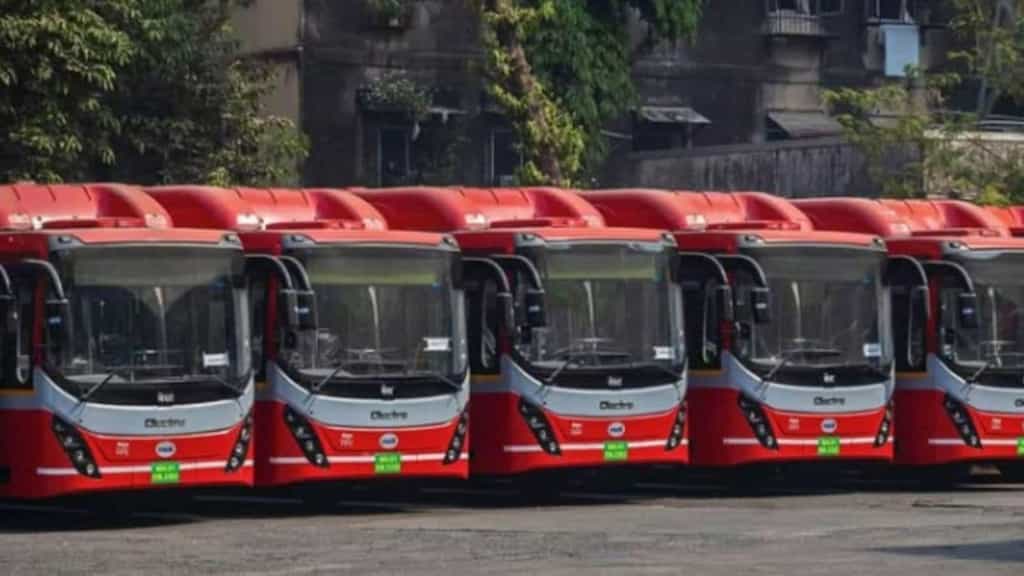
Along with promising a range of civic amenities and upgrades to existing infrastructure, the Bharatiya Janata Party (BJP)- and Shiv Sena-led Mahayuti’s manifesto for the BMC polls, released on January 11, also proposed a 50 per cent fare reduction for women passengers travelling on Brihanmumbai Electricity Supply and Transport (BEST) buses.
The announcement has drawn criticism from transport experts and urban planners, who argue that the move would further strain the finances of the already cash-strapped transport undertaking.
At present, BEST relies heavily on grants from the Brihanmumbai Municipal Corporation (BMC). For the financial year 2025–26, the civic body allocated Rs 1,000 crore to BEST, compared to Rs 850 crore in the previous year. Despite this support, BEST’s financial records show that its total liabilities in the current financial year stand at Rs 9,286 crore, while its annual deficit is pegged at Rs 2,200 crore.
“For a transport undertaking facing such a severe cash crunch, the first option should be to chalk out alternate methods of fund generation instead of cutting down the fares,” Vivek Pai, a transport expert and urban planner from Mumbai Mobility Forum (MMF), told The Indian Express. “Because, on one hand, this move is not going to generate any revenue for the undertaking, and on the other hand, it is going to increase the liability further.”
In an effort to boost revenue, BEST doubled bus fares in May last year. The minimum fare for non-air-conditioned buses was increased from Rs 5 to Rs 10, while that for air-conditioned buses rose from Rs 6 to Rs 12. According to sources in the civic body, the fare hike resulted in an increase of around Rs 1 crore in daily revenue.
Previously, BEST earned between Rs 2.25 crore and Rs 2.5 crore per day. Following the fare revision, daily revenue increased to between Rs 3.3 crore and Rs 3.5 crore. Civic officials said the revised fare structure was also intended to rationalise distance-based pricing.
Pai suggested that BEST should focus on alternative revenue streams, such as monetising its land bank and expanding advertising revenue through billboards.
“These two models can generate good revenue for the undertaking, and only after it reaches a sustainable position in terms of finances, should it think of subsidies,” Pai added.
Given BEST’s dependence on BMC funding, the proposed fare subsidy is also expected to impact the Mumbai civic body’s finances. The Mumbai Municipal Corporation Act of 1888 mandates that BMC strengthen public transport systems and fund them through its own budget.
Shashank Rao, head of the BEST union, defended the decision, stating that fare reductions would benefit citizens since BEST is entirely dependent on BMC for financial support. “The MMC Act clearly states that even if the BMC faces a budgetary shortfall, it must reduce expenditure from its internal departments to ensure adequate grants to BEST,” Rao told The Indian Express.
“On the other hand, being a public transport undertaking, BEST doesn’t have any profit or loss mechanism since its balance sheet only has two categories of deficit and surplus. Which means just as BMC backs BEST in the times of deficit, if there is surplus generated will also go to the civic body,” he added.
The Mahayuti’s proposal to subsidise bus fares reinforces the likelihood that BEST will continue to rely on BMC funding rather than function as an independent entity — a move proposed during the previous undivided Shiv Sena-BJP regime in the BMC.
However, BMC’s own financial position has weakened over the past three years. The civic body’s fixed deposits have declined by Rs 12,000 crore due to substantial capital expenditure on major civic projects.
According to BMC data, its fixed deposits fell from Rs 91,690 crore in 2021–22 to Rs 79,498 crore in 2024–25. More than half of the current fixed deposit amount comprises bank guarantees from contractors, as well as provisions for pensions, salaries, and employee allowances.
Editorial Context & Insight
Original analysis and synthesis with multi-source verification
Methodology
This article includes original analysis and synthesis from our editorial team, cross-referenced with multiple primary sources to ensure depth, accuracy, and balanced perspective. All claims are fact-checked and verified before publication.
Primary Source
Verified Source
The Indian Express
Editorial Team
Senior Editor
James Chen
Specializes in India coverage
Quality Assurance
Senior Reviewer
Fact-checking and editorial standards compliance