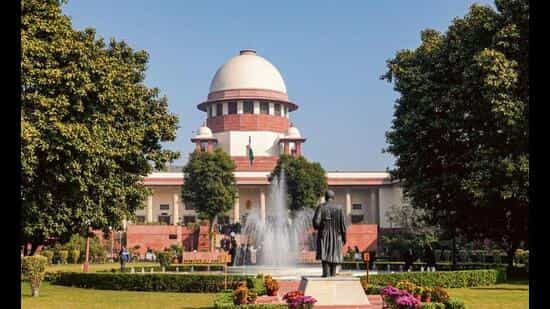
The Supreme Court on Tuesday said that it may impose “heavy compensation” on states for every dog bite and every death caused by stray dogs, while also holding dog feeders accountable for attacks that result in serious or “lifelong” consequences. Questioning why stray dogs should be allowed to roam freely in all areas, the court remarked that those feeding them should instead take responsibility by keeping the animals within their homes or premises.
A bench of justices Vikram Nath, Sandeep Mehta, and NV Anjaria also reproached states and Union territories (UTs) for failing to implement existing statutory rules, observing that decades of inaction had caused the stray dog problem to multiply “a thousand times, a zillion times”.
“For every dog bite, for every death, we are likely to fix heavy compensation to be paid by states for not making the requisite arrangements and not doing anything. And we will also fix liability on dog feeders. You take them to your house, keep them. Why should they be allowed everywhere…roam around, loitering, frightening people, biting and chasing? Remember that the impact of a dog bite is lifelong,” observed the bench during the hearing.
The court posed a pointed question on accountability, asking who should bear responsibility when children and old people are attacked by dogs being fed by organised groups or institutions. “Who should be made responsible when a nine-year-old child is killed by dogs, who are fed by a particular organisation? Should the organisation not be made liable for damages?” the bench asked.
The observations came on the fourth day of hearings in the court’s ongoing proceedings on stray dog management, which stem from concerns over rising dog bite incidents and persistent non-compliance by municipal authorities with the Animal Birth Control (ABC) Rules. The bench said it would continue hearing the matter on January 15.
The court also expressed frustration over the pace and nature of arguments, saying the proceedings had begun to resemble a public debate rather than a judicial hearing.
“What started in the 1950s, we can continue now and take it to a logical conclusion by taking authorities to task and ensuring that concrete measures are taken. Nobody is allowing us to pass orders, and everyone is simply arguing. We are on the fourth day, and arguments are not concluding,” the bench responded to submissions by senior counsel Menaka Guriswamy, who read out parliamentary debates from 1957 on the stray dog management.
It made clear that it was not questioning the validity of the ABC Rules or the Prevention of Cruelty to Animals Act, but was concerned about their chronic non-implementation. “We are not saying the ABC Rules are bad or that the Prevention of Cruelty to Animals Act should go. We want the implementation of statutory provisions. But allow us to work and proceed further,” the court said.
Describing the situation as the result of decades of failure by authorities, the bench added: “There has been a failure on their part in the last 75 years, and they have created a worse situation. Therefore, we want to pass effective orders.”
At the same time, the court repeatedly emphasised that feeding stray dogs without assuming responsibility for their conduct could not be justified in the face of serious public safety concerns.
“We are also going to fix accountability on those who are feeding the dogs. Take the dogs home or take them inside your campus and houses. Why should they be everywhere?” it said. The judges remarked that they were unwilling to “shut our eyes to the problem” when vulnerable groups such as children and the elderly were being injured or killed.
Senior advocate Guruswamy, appearing for animal trusts and shelters, argued that killing dogs was ineffective and that sterilisation remained the only viable solution. She said funds were under-utilised and that the ABC Rules were not merely about population control but also reflected a legislative choice against cruelty and confinement. “No argument allows for cruelty and culling,” she submitted, adding that compassion could not be in short supply.
Senior advocate Arvind Datar, appearing for an organisation, supported the court’s November 7 order relating to institutional areas and said no expert committee was required, as reports were already on record. He also raised concerns about feral dogs in wildlife areas, particularly Ladakh, citing reports of nearly 55,000 free-ranging dogs threatening critically endangered species. Datar urged the court to extend its directions to airports, pointing out that airport authorities often claim they cannot act because captured dogs must be released back.
At this point, the bench said that the issue had now reached even the court premises, referring to a recent dog bite incident at the Gujarat high court. “The worst part is when municipal authorities went to capture dogs, they were attacked by lawyers -- so-called dog lovers,” the bench said.
Senior advocate Vikas Singh cautioned against framing the issue as humans versus animals and highlighted the ecological role of dogs, including rodent control. He urged the court to balance public safety with ecosystem concerns.
Senior advocate Pinky Anand stressed that while incidents of violence had occurred, the law required animals to be treated with compassion. She pointed to the limited number of ABC centres across the country and warned that removing dogs without proper measures could lead to more aggressive replacements.
The court’s strong remarks on Tuesday follow its January 9 observation, when it declined to issue blanket directions on alleged harassment of dog feeders, holding that individual complaints must be addressed through cases and the criminal justice system. The bench had made it clear that it could not act as a fact-finding forum for scattered incidents and that law-and-order issues fell within the domain of local authorities.
The court has consistently maintained that it has not ordered the killing of stray dogs and that its directions are confined to removing strays from high-risk institutional areas such as schools, hospitals, and transport hubs, in the interest of public safety under Article 21 of the Constitution.
Reiterating that the problem lay in the failure of states and municipalities to implement sterilisation, vaccination, shelter creation, and waste management measures, the bench has signalled that continued non-compliance may now attract financial consequences and fixed accountability. The case will be taken up for further hearing on January 15.
Editorial Context & Insight
Original analysis and synthesis with multi-source verification
Methodology
This article includes original analysis and synthesis from our editorial team, cross-referenced with multiple primary sources to ensure depth, accuracy, and balanced perspective. All claims are fact-checked and verified before publication.
Editorial Team
Senior Editor
Aisha Patel
Specializes in India coverage
Quality Assurance
Associate Editor
Fact-checking and editorial standards compliance