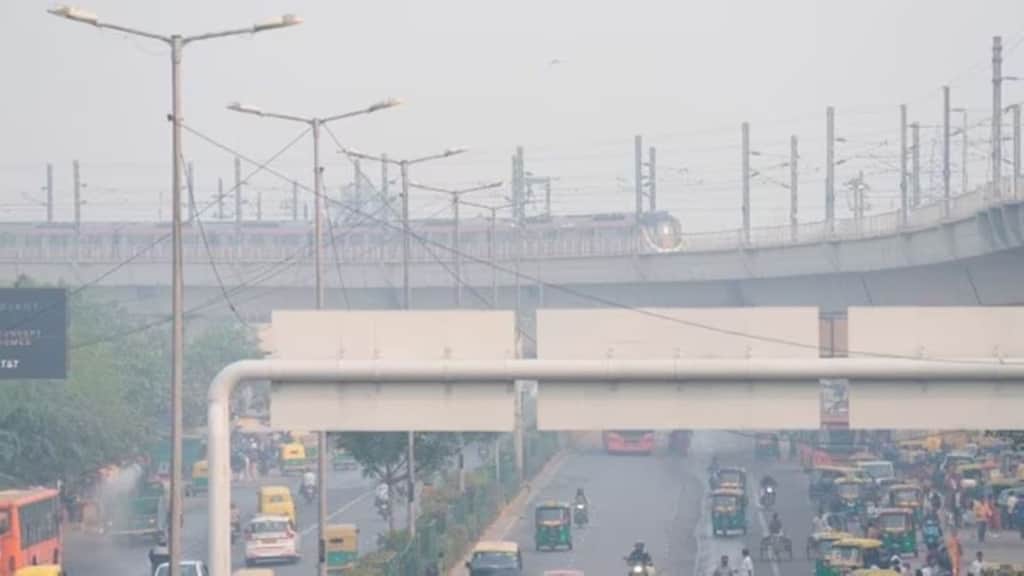
An advocate has filed a Public Interest Litigation (PIL) petition in the Calcutta High Court demanding that the authorities recognise the deteriorating ambient air quality in the Kolkata-Howrah metropolitan region as a public health emergency.
A division bench led by Acting Chief Justice Sujoy Paul will hear the matter on January 19.
According to the PIL, in the latter half of November 2025, as winter conditions had begun to set in, there were sharp and alarming fluctuations in Kolkata’s air quality between November 20 and 28, with Air Quality Index (AQI) values ranging from 144, categorised as “moderate”, to 417, categorised as “severe”, within a week.
On November 23, Kolkata briefly entered the “severe” AQI category, indicating an early onset of winter pollution rather than a transient or festive anomaly, according to the petition, filed by Akash Sharma.
On November 29, while Delhi was witnessing severe smog, Kolkata’s AQI was repeatedly entering the “poor” and “very poor” categories and, at times, approaching the national capital’s pollution levels, the petition stated, adding that reports highlighted that AQI touched 417 during Kolkata’s toxic hours.
Also, between December 1 and 5, with a further dip in night-time temperatures and reduced wind speed, particulate matter began accumulating near ground level. Between December 6 and 12, real-time AQI data revealed an unprecedented trend: Kolkata’s AQI remained consistently higher than that of Delhi for seven consecutive days. During this period, AQI values in Kolkata fluctuated between 184 and 439, repeatedly entering the “very poor” and “severe” categories.
On the evening of December 11, Kolkata recorded an AQI peak of 439 and the AQI surged to an alarming 558 at around 11.04 pm, placing the city firmly in the “severe” or “hazardous” category and surpassing Delhi’s worst readings during the same timeframe.
Sharma stated that on November 12, he submitted a detailed representation to the chief secretary, the chairman of the West Bengal Pollution Control Board (WBPCB), and the principal secretary of environment, warning of predictable winter pollution and seeking a structured Graded Response Action Plan (GRAP).
“In response, the WBPCB, by email on Nov 18, 2025, stated it was ‘undergoing research and preliminary testing for implementing a software-based GRAP’, without notifying any time-bound or legally enforceable measures,” he said.
Sharma’s petition argues that recurring severe pollution constitutes a public health emergency, impacting citizens’ constitutional right to clean air under Article 21 of the Constitution.
The PIL petition also seeks court-monitored enforcement of existing laws, a formal GRAP, an expert task force, waste burning bans, and stricter controls on vehicles and industry.
Editorial Context & Insight
Original analysis & verification
Methodology
This article includes original analysis and synthesis from our editorial team, cross-referenced with primary sources to ensure depth and accuracy.
Primary Source
The Indian Express