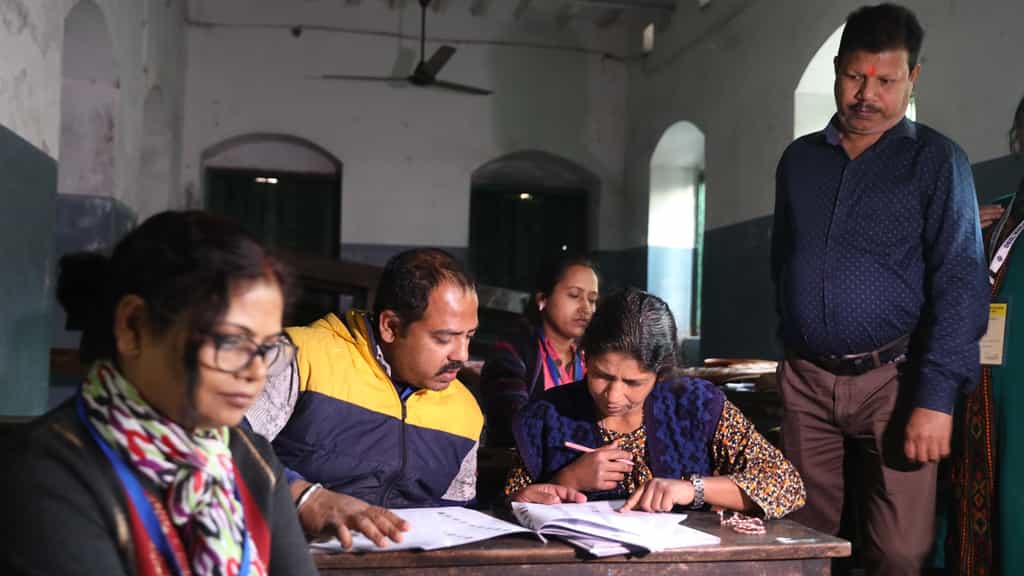
With the claims and objections process of the Special Revision of electoral rolls in Assam currently underway, people whose homes had been demolished in the state’s mass eviction exercises are now lining up for hearings.
In the last five years, large-scale eviction drives have taken place on forest land, sattra land, and other government land, affecting over 50,000 families — mostly Bengali-origin Muslims. With these families forced to make alternate living arrangements due to the demolition of the homes where they were registered as voters, several of them have received notices from their Electoral Registration Officers, summoning them for hearings due to their “shifting” address.
For instance, people who had been evicted in Hojai district during an eviction drive in the Lutumari Reserve Forest in November 2025 received notices on January 7 to report to the Hojai District Commissioner’s Office on January 12 for a hearing on an “objection to the inclusion” of their names in the electoral roll at that address.
“You are directed to be present at the hearing with such evidence as you may like to adduce. The ground of objection is permanently shifted (sic),” the notices said.
While this has triggered some concern among those who received the notices, Hojai election officer Aradhana Das maintains that “this is not a deletion mechanism”.
“In the hearings, the people brought all kinds of documents like land documents, rent agreements, Aadhaar cards, PAN cards and so on, though we had not asked them to. We gave them notices basically because they were in an evicted area, and they need to inform us where they have gone and are staying so that their vote can be transferred there accordingly. Many of them have moved out of the area and are living in their parents’ or other relatives’ homes. If these are in the same polling station, it will remain the same, and if elsewhere, it will be shifted accordingly. The verification will be done by the BLOs (block-level officers) and by the Gaon Buras (village headmen) as well,” she said.
However, with apprehensions persisting, the Hojai district unit of the All Assam Minority Students’ Union on Monday submitted a memorandum to the District Commissioner asking that the inclusion of evictees’ names in the electoral roll be “ensured” by holding awareness sessions and giving “reasonable opportunity” for filling Form 8 for shifting of residence “if the need arises”.
“They are Indian citizens and existing voters, and voting rights and encroachment are two completely separate matters. So, our demand is that wherever they are staying now, their voting rights should be ensured without any hassle,” said local AAMSU leader Monawar Hussain.
Similar notices have been received elsewhere as well. Rohim Badsha’s family was among over 90 families evicted in Nalbari district during an eviction drive on VGR land there last June. The families currently live in a make-shift camp-like setup close to where they had been evicted from.
“We all got notices and went for our hearings. There, they asked us where we are staying now, and we said we are staying close to the same place. That’s all that was said. We don’t know what’s next,” he said.
Others are still awaiting information on this front. Prodip Timung, the DC of Goalpara — a district where multiple evictions took place last year on over 900 hectares of land — said that the issuing of notices to such families has started.
Suleman Ali, whose home was demolished in an eviction drive in Goalpara’s Hasila Beel in June last year along with 600 other families, said that they have not yet received any information from their local BLO on their electoral roll status.
“Most of the people are staying in camp-like conditions on rent near our polling station itself. I am staying with a relative nearby. We had checked the draft electoral roll that had been published on December 27, and all our names were there, but we have not been told of anything yet,” he said.
DC Timung said he has been encouraging people who are natives of the district and have been evicted to stay in rented accommodation nearby.
“We have told them that if they take up rented accommodation nearby, they can establish their new address and they can be accommodated in the electoral roll smoothly. The people who were from nearby districts and were staying here and were evicted will go to their respective districts and can get their votes shifted there,” he said.
Unlike states such as West Bengal and Rajasthan, Assam is not undergoing a Special Intensive Revision (SIR), but a Special Revision of electoral rolls — a modified version of a summary revision in which the key component is house-to-house visits by BLOs to conduct physical verification of the voters in the existing lists.
Based on the house-to-house visits, a total of 4,78,992 deceased electors have been identified for deletion, and 5,23,680 “shifted” voters and 53,619 duplicate entries were identified for correction. The draft roll of 2,52,02,775 electors published on December 27 does not reflect these. Currently, the claims and objections process is underway. During this, the process of applying for deletions, corrections and additions, the need for which were identified in the house-to-house visits, will be undertaken. For instance, new electors can apply for a claim to be included in the roll by filling Form 6, and people who have moved from their earlier registered place can apply for shifting their votes by filling Form 8.
“A good percentage of such eviction-affected people have already applied for shifting their addresses. However, if there are such people who have been identified as shifted from their previous location but do not apply and fill the form for shifting their address, then it is possible that their names could be deleted. But even after the final list is published on February 10, if anyone says there has been a mistake and that they have been wrongfully removed from the voting list, there is a period of over a month to get that corrected,” said a senior state election official.
Editorial Context & Insight
Original analysis and synthesis with multi-source verification
Methodology
This article includes original analysis and synthesis from our editorial team, cross-referenced with multiple primary sources to ensure depth, accuracy, and balanced perspective. All claims are fact-checked and verified before publication.
Primary Source
Verified Source
The Indian Express
Editorial Team
Senior Editor
James Chen
Specializes in India coverage
Quality Assurance
Quality Assurance Editor
Fact-checking and editorial standards compliance