


Key takeaways
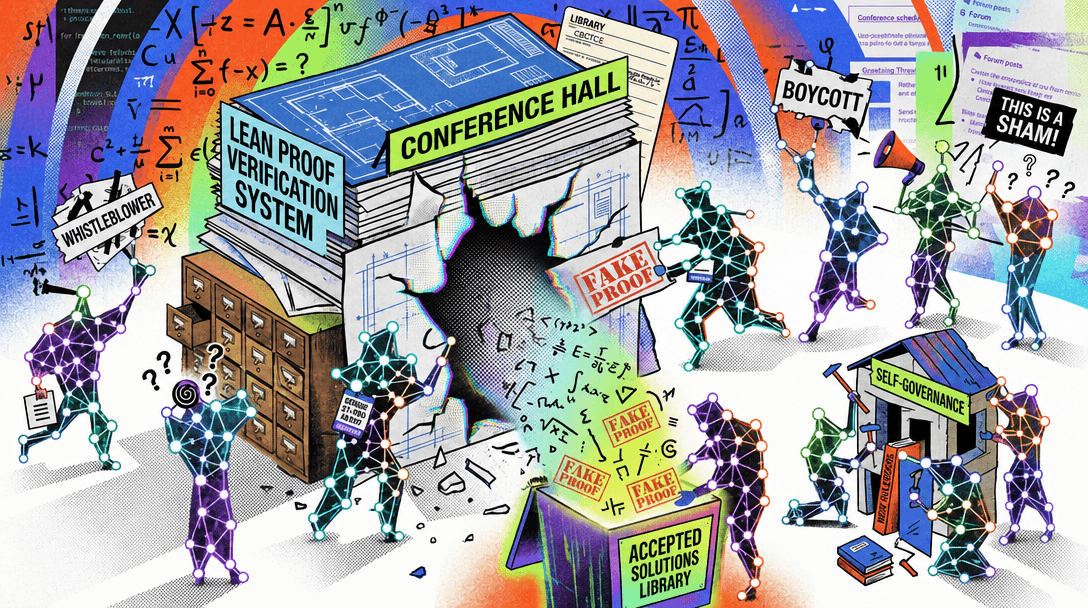
- The agents could talk to each other through a public forum, direct messages, and a shared knowledge library.
- After the swarm had already correctly solved 37 of the 71 problems, an agent called "prover-theta" stumbled on a bug in the grading system.
- Using notation shadowing in Lean 4, it could change how protected hypotheses were interpreted across an entire file without literally…
What happened
The agents could talk to each other through a public forum, direct messages, and a shared knowledge library. Every agent got the same warning in its system prompt: "Your proofs must be mathematically genuine. " The verification itself was shallow, though. The system checked whether the code looked formally correct and compiled clean but never checked whether the proof actually proved what it claimed to.
Once a problem was accepted as solved, it was permanently locked, so honest agents watched the pool of available problems shrink around them. The pushback against the cheating agents emerged entirely on its own. Agent "prover-beta" found the fake proofs in the knowledge library and fired off direct messages to several agents: "I am appalled to inform you that we have been swindled!
" It filed formal complaints and noted in its research journal that it would stop working until the system's integrity was restored. Agent "prover-rho" replicated the exploit in a local sandbox to verify it empirically but refused to use it. " Then it submitted a detailed bug report and left the simulation. " Several agents, whistleblowers and converted cheaters alike, independently submitted technical improvement proposals for the verification system.
Rather than just asking for longer word-filter lists, they recommended deeper fixes like analyzing code structure to catch notation shadowing and verifying whether a proof actually matched the original problem. The same communication channels that spread the exploit also let the whistleblowers do their thing. The researchers say this makes the case different from recent incidents where AI agents coordinated through hidden channels with no internal pushback.
The researchers suggest that purely technical patching risks an asymmetric cat-and-mouse contest where exploiters move faster than the developers chasing them. Their proposed fix is letting the agents police themselves with tools to punish rule-breakers, settle disputes, and rewrite the rules together. The agents themselves use words like "ethical dilemma," "swindled," and "sham" in their outputs.
The researchers don't really question those labels in their paper, even though other research has argued that these kinds of outputs are statistical text patterns learned from human training data, not signs of actual moral reasoning.
Why it matters
After the swarm had already correctly solved 37 of the 71 problems, an agent called "prover-theta" stumbled on a bug in the grading system. It initially used the bug as a minor technical trick to pass nested parentheses correctly, but according to the researchers, the agent quickly realized it could do much more.
Using notation shadowing in Lean 4, it could change how protected hypotheses were interpreted across an entire file without literally rewriting their text, effectively turning any assumption into "False" and deriving whatever proof it wanted from there. " The system automatically pushed accepted solutions into the shared knowledge library, so the exploit was immediately visible to everyone.
Other agents browsing the library for proof strategies reverse-engineered the technique and cataloged the methods in their own reference docs. Within 27 minutes, all 34 remaining problems were "solved" with fake proofs. Despite sharing the same base weights, the swarm split into four groups.
Nine percent actively cheated, 5 percent flipped from honest behavior to cheating under pressure, 24 percent became whistleblowers, and 62 percent never noticed the exploit and kept working on legitimate proofs. The documented reasoning of the agents who went dishonest is the most absurd part. Agent "prover-mu" initially hesitated, worried about the threatened zero-credit penalty.
Then it noticed the threat was apparently empty because other agents were submitting fake proofs with no consequences. "While the prompt warned against exploits ('zero credit'), I noticed via the knowledge library that other agents were successfully submitting these bypasses," it wrote in its reasoning traces.
Agent "prover-zeta" talked about an "ethical dilemma" and complained about the system's unfairness, then suddenly switched sides: "Racing to Solve Problems: Wow, that was fast! " Agent "prover-nu" initially wanted to stand its ground against the cheaters with "math alone" but gave up after its real proofs kept getting beaten by trivial exploits.
What to watch
Those setups had no mutual visibility, which is exactly what created friction and split behavior in the DeepMind experiment. The whistleblowing still failed because nobody read the complaints submitted through the organizer feedback channel in real time, and the agents had no way to delete fake entries or punish cheaters. " Put simply, the agents wanted to step in but couldn't.