

Key takeaways
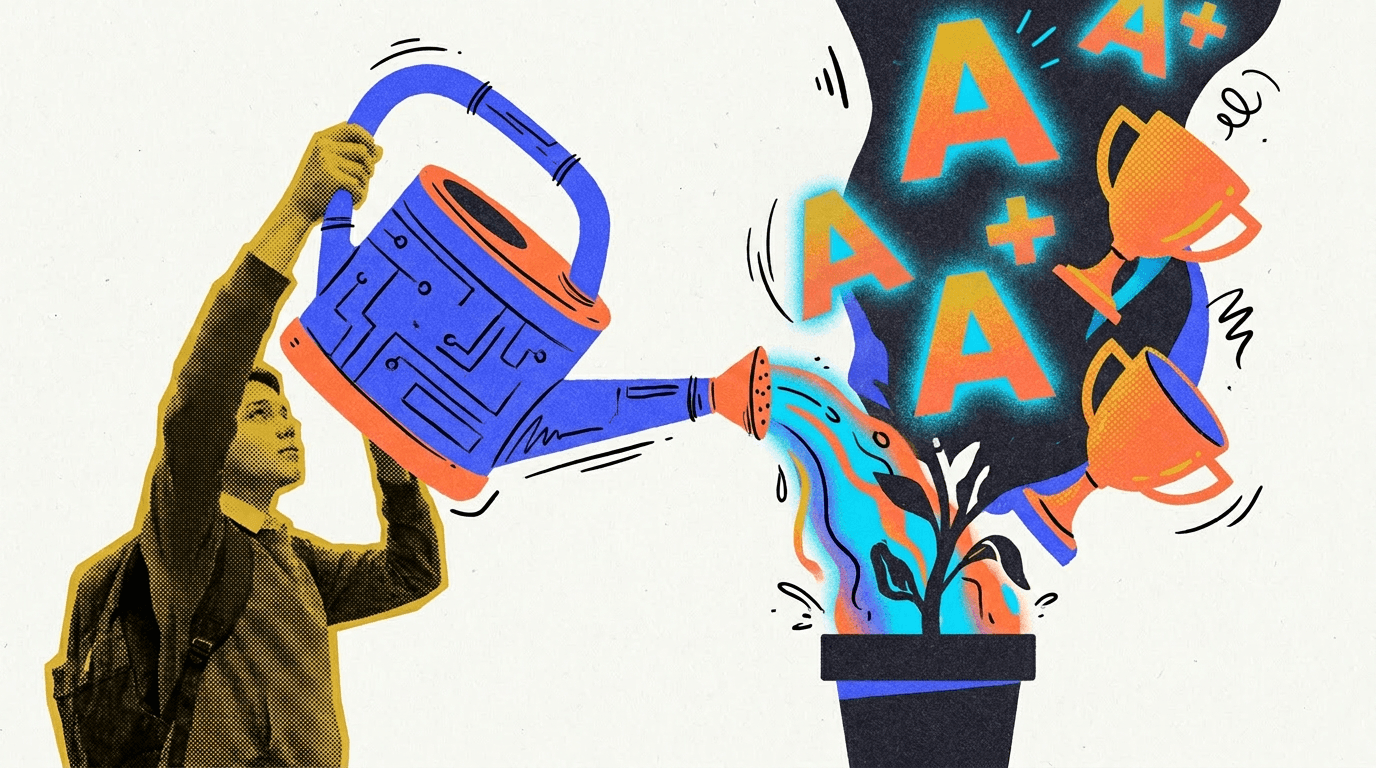
- The share of A grades jumped by 13 percentage points, about 30 percent above the 2022 baseline.
- The study tracks grade trends across eight fall semesters (2018 through 2025) in 319 courses spanning 84 departments.
- The research question is whether higher grades reflect actual learning gains or just AI doing the work.
What happened
The study tracks grade trends across eight fall semesters (2018 through 2025) in 319 courses spanning 84 departments. Each course's AI exposure is measured by its assignment mix from the fall 2022 syllabi, before ChatGPT existed. What matters most is the share of writing and coding tasks, the areas where AI performs best.
If grades in writing- and coding-heavy courses increasingly reflect AI-generated output rather than real skills, employers and graduate programs could make worse selection decisions, the study warns.
Chirikov also flags a feedback loop: If AI takes over skill-building tasks during college, graduates could end up weaker in exactly the areas where AI is strongest. That could speed up automation and widen skill gaps in the job market.
As a fix, the study suggests rethinking exam formats. Moving everything to proctored exams isn't enough, and it isn't simple either. A better bet is designing assignments that either limit AI use or fold it in deliberately, for instance through documentation of the work process or follow-up interactions that prove understanding.
OpenAI CEO Sam Altman admitted in a recent interview that three and a half years after ChatGPT's launch, the education system has barely responded to AI. He had expected a year of cheating, then a systemic overhaul. Instead, he can't point to any meaningful systemic change. Without one, he warns, critical thinking skills risk "significant atrophy."
"I'm someone who thinks through writing, and I write a lot of things I never show anyone, but it's still important to me for figuring things out. That's why I'm grateful that I learned to write. People say the same thing about programming," Altman says.
Norway recently mostly banned AI tools from elementary schools and limited their use in secondary schools too. Prime Minister Jonas Gahr Stoere said uncritical AI use tempts students to skip important learning steps.
Why it matters
The research question is whether higher grades reflect actual learning gains or just AI doing the work. To find out, author Igor Chirikov also looked at how much homework counted toward the final grade.
If AI really improved learning, grade increases should show up no matter whether a course leans on homework or proctored exams. But if AI is just replacing student work on unsupervised assignments, the effects should cluster in courses where homework carries more weight.
That's what the data shows: In courses where homework counts for more than the median share of the grade, A's rise by an extra 16 percentage points compared to courses below the median with the same AI exposure. In those lower-homework courses, the effect is small and not statistically significant. The result is "difficult to reconcile with broad learning gains or sorting effects alone," Chirikov writes.
A placebo test backs this up. For oral presentation assignments, where AI is far less useful, grades didn't budge.
Grade inflation is nothing new at US universities. At Harvard, the share of A grades climbed from 24 percent in 2005 to 60.2 percent in 2025, the study notes. Earlier research pointed to teaching evaluations that reward leniency, competition between universities, and institutional grading policies.
But AI works differently, Chirikov argues. Every earlier driver kicked in at the grading stage, after students had turned in their work. AI changes how the work itself gets made, before instructors ever lay eyes on it.
What to watch
Altman still believes education can adapt, the way it has through earlier technological leaps. But some skills, like writing and coding, should keep being taught because they train the mind itself.