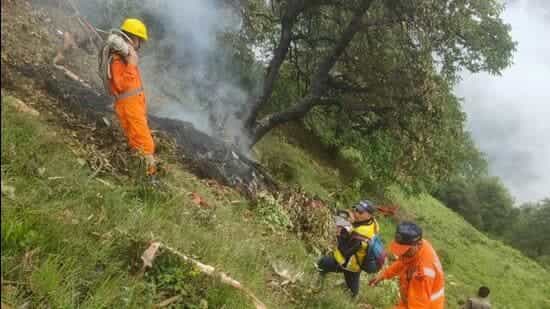
Dehradun: The chopper that crashed near Gaurikund in Rudraprayag district in June 2025, killing seven people on board, encountered cloud cover at the Kedarnath valley exit point, according to the preliminary findings of the Aircraft Accident Investigation Bureau (AAIB).
The Bell 407 chopper was en route from Kedarnath to Guptkashi as part of the Char Dham pilgrimage operations when it crashed on June 15, seven days after another helicopter carrying five pilgrims crash-landed on the Guptkashi-Gaurikund highway. On May 17, a heli ambulance from AIIMS Rishikesh on a rescue mission crash-landed near Kedarnath, damaging the tail rotor.
The series of accidents highlighted growing safety concerns surrounding helicopter services on the Char Dham route. The Kedarnath valley is infamous for its terrain-induced blind spots, making navigation extremely difficult, especially without the support of essential infrastructure like air traffic control (ATC) systems or dedicated weather stations.
On June 15, 2025, the chopper was allotted the first morning slot by the Uttarakhand Civil Aviation Development Authority (UCADA) between 6 am and 7 am, with operators permitted to commence flights from sunrise.
The AAIB report, seen by HT, said the pilot of the Bell 407, bearing registration VT-BKA and operated by M/s Aryan Aviation Pvt Ltd, arrived at the Guptkashi helipad around 4.30 am, underwent a breath analyser test, assessed weather conditions using CCTV footage of the valley, and carried out pre-flight checks, during which no abnormality was detected.
The report added that the helicopter took off from Guptkashi at around 5.10 am and landed uneventfully at Kedarnath at about 5.20 am.
After disembarking passengers brought from Guptkashi, VT-BKA took off from the Kedarnath helipad with six passengers. “CCTV footage showed no abnormality during take-off or while the helicopter entered the valley. As per standard operating procedures, helicopters are required to maintain an altitude of 8,500 feet while entering the Kedarnath valley and 9,000 feet while exiting. Accordingly, the pilot of VT-BKA was maintaining an altitude of 9,000 feet while approaching the valley exit point,” the report said.
“The operator’s operations team said that after the accident, they interacted with the pilot of VT-TBC, which was third in the flying sequence. During the interaction, the pilot of VT-TBC informed them that during the return leg to Guptkashi, when VT-BKA was near the valley exit point, its pilot made a radio transmission saying he could see clouds at the exit point. The pilot of VT-BKA subsequently called out, ‘cannot see anything, turning…’,” the report said, adding that no further radio transmission or distress call was received from the helicopter thereafter.
The report said that after analysing footage of the CCTV camera facing the valley entry/exit point, it was observed that “the valley exit point was covered with clouds and were moving down into the valley. The other two helicopters which were behind the accident helicopter VT-BKA were observed to have exited the valley at a lower altitude by avoiding the clouds.”
UCADA CEO Ashish Chauhan said several safety measures have been taken to improve flight safety in the Kedarnath region.
“We are setting up two control rooms at Sahastradhara (Dehradun) and Sersi (Rudraprayag) to enhance flight safety. These will include representatives from AAI, DGCA, and IMD, along with the chief base manager of UCADA. With better coordination and access to real-time data, decisions on granting flight permissions will be more informed and safety-driven,” Chauhan said.
Editorial Context & Insight
Original analysis & verification
Methodology
This article includes original analysis and synthesis from our editorial team, cross-referenced with primary sources to ensure depth and accuracy.