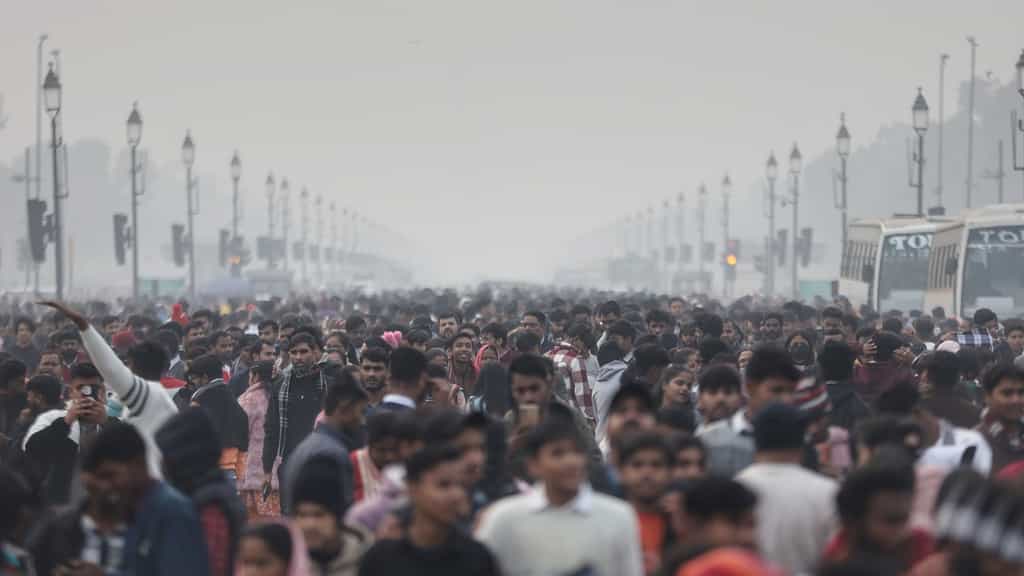
Amid Delhi-MCR continuing to battle foul air, the Capital and Noida have struggled to utilise the funds allocated under the National Clean Air Programme (NCAP) with most money either remained unspent or used scantly to primarily contain road dust, a study by the Foundation for Responsive Governance (ResGov) has revealed.
Last month, Delhi and Noida frequently topped pollution charts as the most polluted city in the NCR.
The study, ‘Financing Clean Air: What city-level data shows’, analyses NCAP allocations, releases, utilisation and air quality trends in the two cities between 2020-21 and 2025-26. The report has flagged persistent delays in fund disbursal, low utilisation and a mismatch between pollution sources and spending priorities, even as particulate matter levels remain far above prescribed standards.
Between 2020-21 and 2025-26, Delhi was approved Rs 113 crore under NCAP, marking just 54% of what it could have received had the city met the allocation ratio and performance-linked criteria in curtailing air pollution.
If Delhi had met performance benchmarks each year, the report notes, the Capital could have been allocated as much as Rs 209 crore during the 2020-21 and 2025-26 period.
Of the Rs 113 crore approved, Rs 81 crore (72%) had been released as of December 23, 2025. However, only Rs 14 crore amounting to only 12% of approved allocations was utilised. The expenditure was incurred by the Municipal Corporation of Delhi (MCD) and the New Delhi Municipal Council (NDMC), and used entirely on road dust and construction and demolition (C&D) waste control.
According to the study, the fund utilisation was highest in 2022-23, when 22% of available funds were spent, but dropped sharply thereafter. In 2024-25, only 2% of available funds were utilised, and no spending had taken place in 2025-26 at the time of reporting.
The report attributes delays partly to administrative bottlenecks, including the non-constitution of the MCD standing committee, which slowed tendering.
Meanwhile, air quality in Delhi has shown little signs of improvement over the years.
While PM10 levels declined slightly between 2017-18 and 2024-25, the period between 2019-20 and 2024-25 saw PM10 levels in the Capital rising from 192 µg/m³ to 213 µg/m³. NCAP began allocating funds to put air pollution at bay the year it started operations in 2019 .
Annual PM10 levels in Delhi have consistently exceeded annual NCAP targets, the national standard of 60 µg/m³ and the World Health Organisation (WHO) guideline of 15 µg/m³.
Meanwhile, Noida was allocated Rs 127 crore under NCAP between 2020-21 and FY 2025-26. As of January 4, this year, Rs 56 crore (44%) had been released, and Rs 30 crore around 24% of total allocations had been utilised.
For several years, utilisation was minimal. Between 2020-21 and 2024-25, only Rs 3 crore was spent, entirely on road dust mitigation, including water sprinklers, mechanised sweepers and anti-smog guns. Utilisation of funds rose only in 2025-26, though detailed break-ups of spending were not made publicly available.
The city’s air action plan identifies vehicles, road dust, construction, industries, garbage burning and agricultural waste burning as major pollution sources. However, until recently, nearly all NCAP funds were directed only at dust control.
PM10 levels in Noida declined by 32% between FY 2017-18 and FY 2024-25, falling from 229 µg/m³ to 155 µg/m³. Despite this improvement, the city failed to meet its annual PM10 targets between FY 2021-22 and FY 2024-25, and pollution levels remained well above national and international standards.
The report also flags that Delhi’s clean air actions continue to rely largely on a source apportionment study completed in 2018, based on data collected between 2016 and 2017. A real-time study submitted in 2023 was not formally approved, leaving planning dependent on outdated data.
Editorial Context & Insight
Original analysis & verification
Methodology
This article includes original analysis and synthesis from our editorial team, cross-referenced with primary sources to ensure depth and accuracy.
Primary Source
The Indian Express