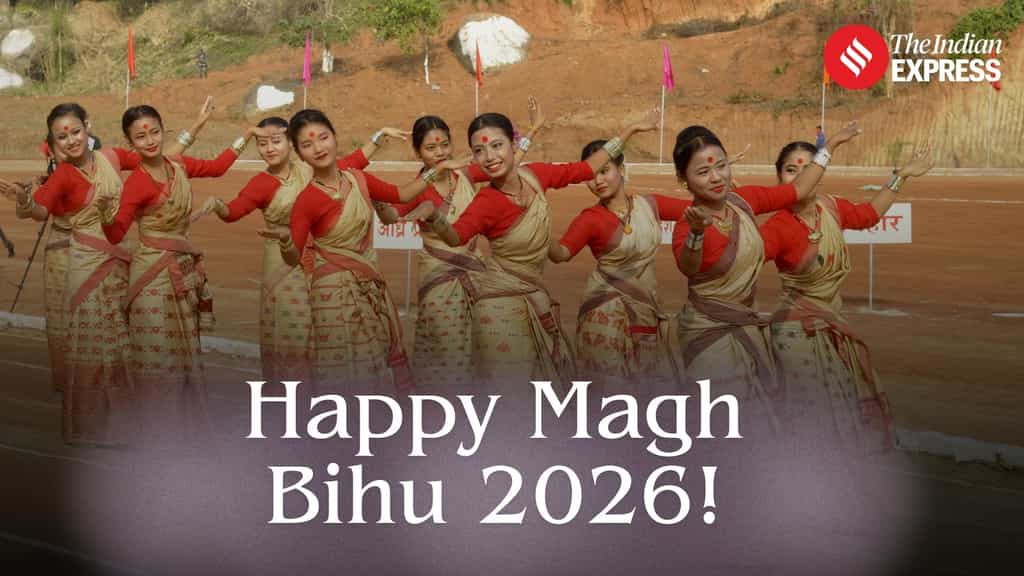
Magh Bihu 2026 Date: Here's all you need to know about the Assamese harvest festival.
Magh Bihu 2026 Date: Magh Bihu, a significant Assamese festival, celebrates the conclusion of the harvesting season in the month of Magh (between January and February).
Also known as Maghor or Boghali Bihu, it marks a minor shift in the earth’s rotational axis that signals the end of cold winters and the start of spring.
It is one of the three Bihu festivals celebrated by the community, and the name ‘Bhogali Bihu’ is derived from the word ‘Bhog’, which means eating and enjoying.
As the name implies, the celebrations include plenty of food as well as music and dancing, with bonfires made of green bamboo, fuel, hay, and dried banana leaves. People traditionally take baths before starting the blaze.
Magh, or Bhogali Bihu, occurs in the middle of January, during the month of Magh, hence the name. It is the last day in the month of Pooh, or Pausha.
This is the same day as Makar Sankranti and signals the beginning of the Sun’s journey northwards – Uttarayan.
The festival will be celebrated on 15 January 2026, falling on a Thursday.
The festival celebrations begin one day before the Bhogali Bihu, also known as the Uruka, which is the last day of the lunar month of Pousha.
On this day, a grand feast, known as bhog, is prepared on the first night of the festivities. Young men construct improvised thatched-roof shelters known as ‘bhelaghar’, and a ‘meji’ (bonfire) is built with hay and bamboo.
Women cook the feast in the bhelaghar, along with exquisite rice cakes known as Sunga Pitha, Til Pitha, and coconut laddoos. People spend the night beside these mejis singing songs and doing folk dances.
The next morning, people bathe, and the Meji is burned. It is thought that lighting a bonfire helps to bring an end to the winter season. Additionally, in the Assamese culture, traditional rituals like tekeli bhonga (pot-breaking) and buffalo combat, in addition to prayers to ancestral gods for benefits, are carried out during the festival.
Editorial Context & Insight
Original analysis and synthesis with multi-source verification
Methodology
This article includes original analysis and synthesis from our editorial team, cross-referenced with multiple primary sources to ensure depth, accuracy, and balanced perspective. All claims are fact-checked and verified before publication.
Primary Source
Verified Source
The Indian Express
Editorial Team
Senior Editor
Aisha Patel
Specializes in India coverage
Quality Assurance
Fact-Check Editor
Fact-checking and editorial standards compliance