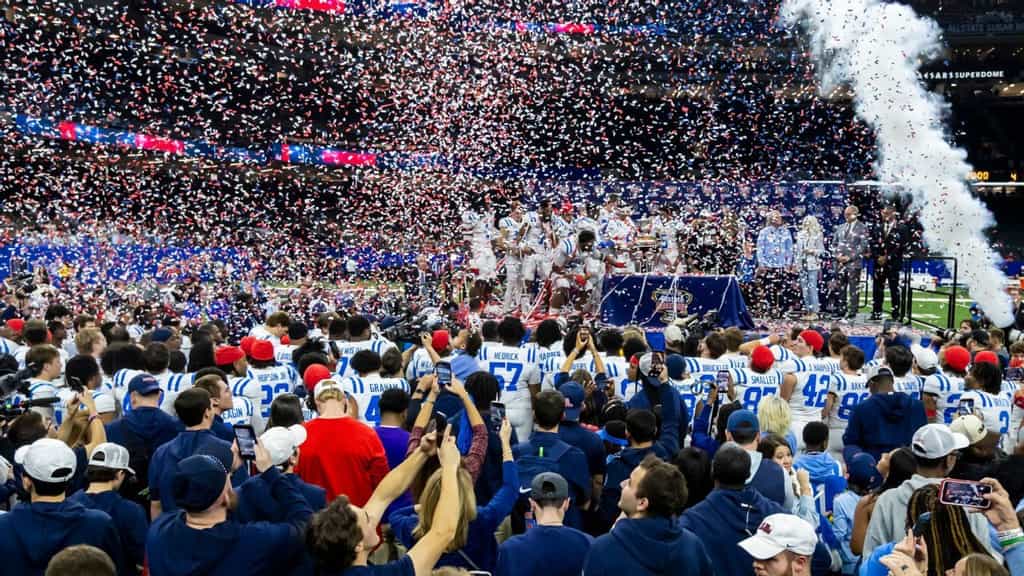
NEW ORLEANS -- We got into town the day before the Sugar Bowl, dropped our bags and went straight down into the French Quarter with all the other Ole Miss fans for the national quarterfinal game against Georgia. Galatoire's was, of course, booked, so we got in line at Felix's oyster bar. My father and his brothers loved Felix's and took me there as a child, telling stories of past trips down to see the Rebels in the Sugar Bowl. Years later, when my dad knew he was dying, he wanted to go to New Orleans one last time, to eat at all his favorite places, and that meant visiting his younger neon self at Felix's and maybe remembering a time before regret and sadness.
In line, I randomly ran into my friend Coleman, who owns a farm near ours along Highway 1 in the Delta. We laughed and hugged and talked duck hunting with the couple in line behind us, checking on how the birds were flying, and falling, in a wide alley stretching from Hazen, Arkansas, to Mississippi's Bobo Brake. Inside the restaurant, we all sat at the bar and got the bartender to change the television to the Texas game, so we could watch Archie Manning's grandson play. Sports mean different things to different people, but to me they have always been a portal to memory.
Mississippians flooded New Orleans in Chene hunting gear and lots of powder blue. There were a lot more Ole Miss fans in town than Georgia fans.
We joked that the Dawgs were saving their money for the next rounds in Phoenix and Miami.
We asked about hometowns, folks from Jackson and Gulfport and Tupelo and Sherard. Family text threads abandoned all topics but the Rebels. We ate dozens of oysters and drank Abita Ambers and Bloody Marys and we talked about the people we carried with us in spirit. I told the story, not for the only time in the next 24 hours, of the 2016 Sugar Bowl, the Rebels' first appearance in the game since my dad was in college and Archie Manning was the quarterback. I cried a lot before that game because my dad hadn't lived long enough to see the Rebels return. After it ended, when we'd won, my wife and I were walking down Poydras Street when I heard someone banging on the window from inside a Mexican restaurant. I looked through the glass and saw my dad's brother Will, my uncle, sitting with his children and grandchildren. We rushed inside and spent the next hour toasting our family, those present and those left behind.
"First time I ever saw him do a tequila shot!" Uncle Will's son said.
(And probably the only, I should add.)
That was 10 years ago. Will died in 2021, leaving an unfillable hole in his community in Yazoo City, and in my life and the lives of our family. I would love to hear his take on the dueling emotions of this season, or my father's take, who when J.R. Ambrose was declared ineligible in 1986 after some now quaint backroom payments groaned, "We can't even cheat right!" Ole Miss is now ground zero for the disintegrating old world of college football, with Lane Kiffin, after leaving the Rebels in the middle of a playoff run for SEC rival LSU, being branded in local media -- and especially in Oxford's vibrant bootleg merch market -- as a prostitute. Kiffin confronted, then apologized to, a local reporter who said Ole Miss fans had been trying to turn a "ho into a housewife," which is a window into the level of discourse and the bitterness of feelings. Ole Miss, known for our collective manners, has abandoned the moral high ground in our (earned) collective grievance, and if I can extend the coarse metaphor, Kiffin is either acting like the aforementioned "garden implement" or alternatively like the only one who understands, as a friend said to me, that head coaches are nothing more than "piano players in the whorehouse." That the mythical molding of men died the first time the first university cashed the first television check, and that if those presidents didn't want to be in the business of professional sports then maybe they shouldn't have gotten into the business of professional sports. Anyone who blames coaches or, even worse, players, has lost the plot. (I'm biased, and obviously have a financial rooting interest, but I think blaming television is also misguided, since our job is to show entertainment at a profit, not to protect the souls of educational systems from themselves.) So in our binary world, where the gray areas aren't allowed much oxygen, Kiffin is either the most dishonest man in the college game or the only person willing to see (and say) what it has become.
The truth of course is that these are complex, tectonic issues, exacerbated by the private equity funds circling the wounded game like apex predators, and so for those of us who love Ole Miss, the past month has been raw, eye-opening and sad. It also has been historically exciting and rich with possibilities the faithful haven't glimpsed since 1962.
That year, under the protection of federal marshals and the 101st and 82nd Airborne Divisions, James Meredith became the first Black student to enroll at Ole Miss. And that same fall, behind All-America quarterback Glynn Griffing, the football team went undefeated but was denied a national title by the voters. (The truth is that No. 1 USC was better and beat No. 2 Wisconsin in the Rose Bowl.) "Midnight Train to Georgia," maybe the most moving song I can think of about heartache and homesick regret, was written by the backup quarterback on that '62 team.
He sure found out the hard way that dreams don't always come true.
The cultural resonance of celebrating moral victories scratches a very old and proto-Mississippian itch. My most recent book, and my 2012 ESPN documentary about that 1962 season, are both rooted in the state's fight against a toxic yet stubborn Confederate Lost Cause mythology, which will be familiar to Mississippians but maybe not to people from other parts of the country. The glorious and honorable defeat has been part of my home's mythology for generations, as has the counterwork of Mississippians to tear it down. Understanding this history is essential to understanding current events.
The 1959 Ole Miss team, for instance, is one of the great teams in the history of the game, truly dominant, but it let a championship slip through its fingers on Halloween night when LSU star Billy Cannon fielded a punt on his own 11, late in the fourth quarter, down 3-0. He danced and spun through the entire defense, through the fog and darkness, and scored. LSU won 7-3. Cannon won the Heisman Trophy, which is now on display at a Baton Rouge rib joint. (Ole Miss fans hated LSU long before Kiffin.) The Halloween radio call has become liturgy. Whenever Ole Miss' baseball coach Jake Gibbs went to the mound at Alex Box Stadium in Baton Rouge, the LSU PA announcer would play the famous punt return. Gibbs, who played baseball and football for the Rebels, was the last tackler to miss Cannon before he scored.
The most famous game of Archie Manning's college career was a valiant 1969 loss, 33-32, against Alabama. The most famous game of Eli Manning's college career was a valiant 2003 loss, 17-14, against LSU with a trip to the SEC championship game on the line. That 2016 Sugar Bowl, the one that made so many Ole Miss fans nostalgic and emotional, was the last postseason game Hugh Freeze coached, before a sex scandal forced him to resign, the joy always tempered by the gut punch.
It's not an accident that one of the most revered players in program history is Chucky Mullins, who had everything taken from him when he was paralyzed during a 1989 game and still found enough of his voice to whisper, "It's time," in a pin-drop locker room before a meaningless bowl game that was not meaningless to those men in that room, or to the men, women and children waiting in the Liberty Bowl stands above. Mullins died two years later, and his deification is rooted not in death but in how he raged against it.
My mother once wrote a note to coach Ed Orgeron congratulating him on how hard his team fought in another late-season Ole Miss defeat. She used her engraved stationery.
Some Ole Miss fans might articulate this feeling differently than I, might have different language, but I bet every Rebel reading this understands the feeling I'm describing. Our fandom, our devotion exists around beautiful moments, like Archie Manning scrambling, or Dexter McCluster fielding a punt return, or Chris Mitchell laying wood on an Arkansas ball carrier at the goal line, but those moments always seemed bound up with disappointment, too.
That brings me to this Thursday game in Arizona, and to last Thursday night in New Orleans. We got to our seats in the Superdome, where I've seen the Saints win the NFC championship, and Taylor Swift and Guns N' Roses, and of course the Rebels. During the national anthem, sung by the great Irma Thomas, a lone Ole Miss fan, per tradition, shouted, "Go to hell, LSU!" I smiled.
Sitting directly in front of me was my friend Bruce from Oxford, who loves the beach in Alabama, and pirates and rum and Jimmy Buffett. I leaned over to my friend next to me and told him about Bruce, who I really respect. His wife was paralyzed by an 18-wheeler and he became her faithful caretaker, a real servant in his love for her. Her name was Trenia Reynolds, and her neck injury was the exact same as Chucky Mullins' and when she was in the ICU, Chucky came to her in a dream and she told him, "If you can do this, I can, too." We all hurt for Bruce when she died three years ago. Early in the quarterfinal game, when Trinidad Chambliss ran around in deepening loops behind the line of scrimmage, Bruce turned to me in a kind of euphoric nostalgia and said that looked exactly like Archie Manning in the 1970 Sugar Bowl, which he also attended, in a time before love and loss. He danced a beatific jig next to me and then kept pacing up and down the row, his nerves palpable and contagious.
The game stayed close deep in the fourth quarter, as you almost certainly know. The officials made several egregious calls, the kind that stoke Ole Miss conspiracy theories, and still the Rebels clawed back and took a lead. Georgia had the ball in the red zone with less than a minute left, down three, and the Ole Miss fans understood that the moment for heartache was near. This is where the superior opponent would punch the ball in, win by four, and we'd all walk out into the night, proud of the team and the way they played for us, trying to paper over another disappointment. But this time the Rebels held. The Dawgs managed only a tying field goal and then, orchestrating what I'm ready to call the greatest drive in program history, Chambliss went down the field in less than a minute and Lucas Carneiro kicked the game-winning three points. Carneiro will never buy a meal in the state of Mississippi again. (Lucas: Crawdad's in Merigold on me!)
We rushed down to the field. I felt the tears coming.
One of the veteran Ole Miss media guys had tears in his eyes, too.
We saw each other. We saw each other. "Your daddy would have loved this," he said.
We all sort of walked around in a daze. I saw three of the great college football reporters, Ross Dellenger, Mark Schlabach and Chris Low, taking notes. I was glad to be a fan and not have to go up and type. They, of course, were on top of the news, already looking forward to next week. The transfer portal would open in a few hours. Kiffin, word spread on field, had told Ole Miss assistants scheduled to join him in Baton Rouge after the playoff run that he expected them in the office the next morning. They wouldn't even take the team plane back. Joy mixed with anxiety, that old familiar feeling, and that while celebrating a historic victory, Ole Miss fans didn't know which assistant coaches would take the field in the national semifinal. But in the Superdome, as that news commingled with kids making confetti angels, anxiety didn't take over, at least not for me, and if this essay has a point, it's this: The emotional truth of the moment felt positive, and not like the wait for some unseen impending shoe to drop. Maybe it sounds naïve, and maybe it is. But the powerful gravity of those past losses seemed in that moment to be losing its pull. I love the quote by Myrlie Evers-Williams, Medgar Evers' widow, who said, "Yes, Mississippi was, but Mississippi is." Any time Mississippians look with eagerness toward the future, remembering but not longing for the past, we are emulating our better angels. It's a lot to ask of a late-game drive in a quarterfinal played by a bunch of kids who weren't yet born when Archie played, but believe me when I tell you that in the moment the game felt somehow new.
The crowd barked out a beautiful "Hotty Toddy," the chant that ends with, "We just beat the hell out of you," and we walked out of the dome, past the silent Georgia locker room, where they sat with their own thoughts and regrets. We walked into the first breaths of a new idea, born of this victory on this magic night. What if we are the people who win these games? Why not us? Ole Miss sits two wins away from a national championship, a wild thought for those of us who lived through the Steve Sloan coaching era. I wore a T-shirt. New Year's Day in Louisiana. People seemed stunned, smiling broadly, muttering "Hotty Toddy," alone with their thoughts. That's who flew out to Arizona this week: a people reborn into a new hope, which might be real or might be just the half-life glow of one glorious win.
I choose to believe it's real. We walked down Poydras Street and passed the same restaurant where I'd seen my Uncle Will 10 years ago. It was dark, closed for the night, with chairs on tables. I felt like our old selves were still in there, smiling at us as we walked past.
Tonight. Miami versus Ole Miss.
Editorial Context & Insight
Original analysis & verification
Methodology
This article includes original analysis and synthesis from our editorial team, cross-referenced with primary sources to ensure depth and accuracy.
Primary Source
www.espn.com - TOP