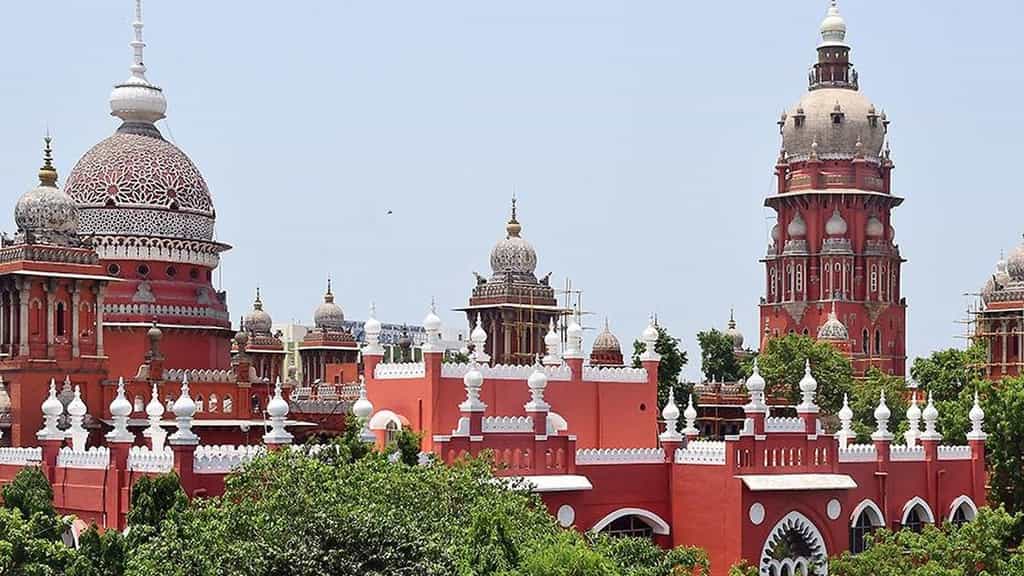
A Division Bench of the Madras High Court has stayed a single judge’s order against the registration and operation of caste-based socieities in the State but made it clear that the interim stay would be applicable only with respect to South Indian Senguntha Mahajana Sangam, which had preferred a writ appeal against the order.
First Bench of Chief Justice Manindra Mohan Shrivastava and Justice G. Arul Murugan granted the interim stay till February 11, 2026, and ordered notices to the Inspector General of Registration (IGR), Registrar of Societies, Chennai district, and a few other officials, seeking their response to the writ appeal.
The stay was granted after advocate S.P. Chockalingam, representing the appellant, told the court that his client had filed a writ petition in connection with the election to the registered society but the single judge had gone about issuing sweeping directions unconnected to the case before him.
“Taking into consideration the submission of learned counsel for the appellant that without there being any challenge to the name/title of the appellant society, directions have been issued wholly unconcerned with the issue that arose for consideration in the writ petition, it is directed that the impugned (under challenge) order shall remain stayed in so far as its application to the present appellant is concerned,” the Bench wrote.
It was Justice D. Bharatha Chakravarthy who had passed the orders under challenge in the appeal on April 16, 2025, while disposing of a batch of three writ petitions filed by South Indian Senguntha Mahajana Sangam based in Chennai, Tiruchengode Vatta Kongu Velalar Sangam from Namakkal district, and Poor Educational Fund, also from Chennai.
Disapproving of the practice of registering caste-based societies, the judge had directed the IGR to draw a list of societies that had been named after particular castes, functioning with the objective of promoting the interests of people belonging to that caste and offering membership only to them.
After drawing the list of all such societies across the State, the IGR was directed to issue notices to them with instructions to drop caste references from their names, amend their bylaws which perpetuate the caste system, and open membership to all without any restrictions based on caste.
He had further ordered that no school or college, be it government-run or a private institution, in the State should carry a caste appellation from the academic year 2025-26 and that notices must be issued to all schools and colleges which carry caste appellations, either directly or as a part of the names of donors, to drop such prefixes or suffixes.
If the school managements concerned fail to drop the caste appellations, their recognition should be withdrawn and the students of such schools should be transferred to other recognised institutions from the academic year 2026-27, the judge had said.
Then, the judge had also directed the State government to implement the recommendations made by a committee headed by retired judge K. Chandru to remove terms such as ‘Kallar Reclamation’ and ‘Adi Dravidar Welfare’ from the names of government schools.
Observing that constitutional courts could not entertain cases filed by caste-based associations, the judge had said, associations which perpetuate the caste system could not expect the High Court to come to their rescue and exercise its writ jurisdiction under Article 226 of the Constitution to resolve disputes related to such associations.
Lamenting that the caste system was not confined to one religion but cuts across almost all religions, the judge pointed out that Poor Educational Fund was a society that restricts membership to the Gavaras, Balijas, and Telagas belonging to the Catholic sect of Christianity.
“The caste system that is prevailing as on date has to do nothing with religion. As a matter of fact, it can be seen from the above that it is cutting across religion, and people are not willing to put down this burden from their head, and these fanatics will carry it even to the moon,” the judge had lamented.
Editorial Context & Insight
Original analysis and synthesis with multi-source verification
Methodology
This article includes original analysis and synthesis from our editorial team, cross-referenced with multiple primary sources to ensure depth, accuracy, and balanced perspective. All claims are fact-checked and verified before publication.
Editorial Team
Senior Editor
Aisha Patel
Specializes in India coverage
Quality Assurance
Quality Assurance Editor
Fact-checking and editorial standards compliance