UPSC Essentials brings to you its initiative for the practice of Mains answer writing. It covers essential topics of static and dynamic parts of the UPSC Civil Services syllabus covered under various GS papers. This answer-writing practice is designed to help you as a value addition to your UPSC CSE Mains. Attempt today’s answer writing on questions related to topics of GS-2 to check your progress.
🚨 Click Here to read the UPSC Essentials magazine for January 2026. Share your views and suggestions in the comment box or at manas.srivastava@indianexpress.com🚨
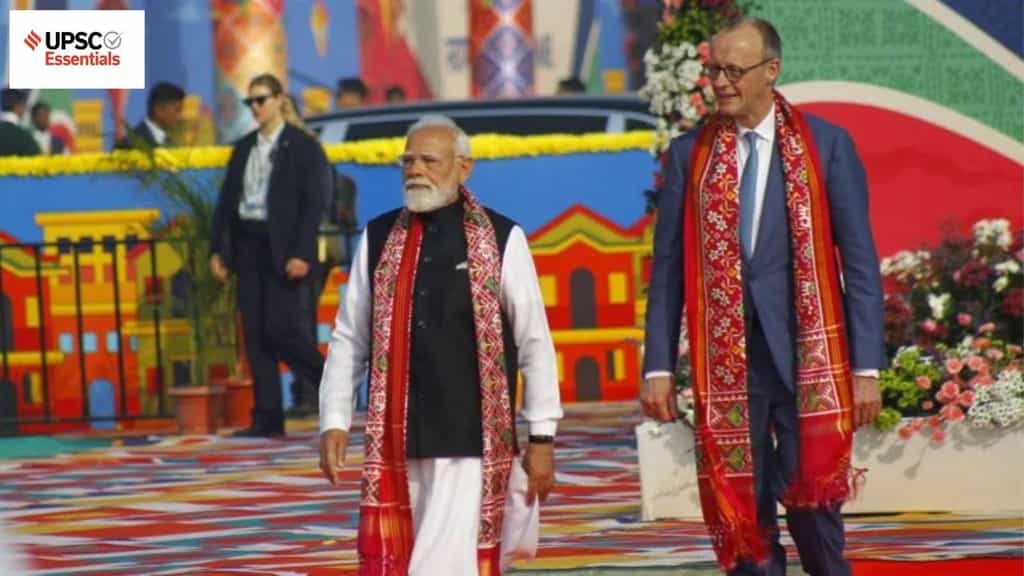
India’s engagement with Europe, especially Germany, reflects a shift towards a more diversified strategic geography. Discuss the significance of India-Germany relations in the context of global geopolitical disruptions.
The 74th Constitutional Amendment Act envisaged a strong framework for urban local governance. In the context of the Indore water contamination tragedy, discuss the effectiveness of monitoring systems for urban water supply in Indian cities.
Relevance:This question is relevant to GS-II (International Relations) as it reflects India’s shift towards a diversified strategic geography, highlighting the importance of India–Germany/Europe ties in maintaining strategic autonomy, multipolarity, and resilience amid global geopolitical disruptions.
Note: This is not a model UPSC answer. It only provides you with thought process which you may incorporate into the answers.
— India’s involvement with Germany is a purposeful “diversification of strategic geography.” In the face of global geopolitical disturbances such as the conflict in Ukraine, instability in West Asia, and supply chain vulnerabilities, this cooperation has evolved from a trade-focused relationship to a high-stakes strategic alliance.
— The recent visit of German Chancellor Friedrich Merz to India was not only about strengthening relationship objectives, but also about establishing new axes of international stability and sketching out a new geopolitical landscape.
— The Indian government has officially welcomed Germany’s “Policy Guidelines for the Indo-Pacific,” noting that Germany’s increased naval presence in the Indian Ocean aligns with India’s SAGAR (Security and Growth for All in the Region) vision.
— The Ind-German talks produced tangible outcomes across trade and security. On commerce, both sides reaffirmed their resolve to conclude the long-delayed EU-India free trade agreement by the end of this month, when European leaders will be in Delhi as honoured guests for Republic Day.
— Over the last four years, Germany has emerged as the world’s fourth-largest defence spender, after the US, China, and Russia. Over the last four years, Germany has emerged as the world’s fourth-largest defence spender, after the US, China, and Russia.
— A stronger commerce and security alliance also aligns with the long history of Indo-German interaction.
— The difference with 2026 is stark, yet the fundamental rationale maintains a certain consistency. After relying on American domination for much of the postwar period, Germany is now taking on increased responsibility for Europe’s security. India, which relied on the US to balance China for the last two decades, is now hedging by strengthening ties with Germany and Europe.
— The countries underlined the significance of collaboration in internet and data governance, artificial intelligence, semiconductors, Industry 4.0, and emerging technologies. The leaders praised the Indo-German Science and Technology Centre (IGSTC) for extending its tenure and promoting bilateral industry-academia strategic research in advanced manufacturing, medical technologies, sustainable production, bioeconomy, waste-to-wealth initiatives, and artificial intelligence for sustainability.
— India and Germany welcomed the establishment of Indo-German Centres of Excellence on Innovation (IG-CoE) with a focus on Digital Convergence, Battery Technology, Green Transportation, and Affordable Healthcare.
— The constraints of Germany, Europe, and India are well understood when compared to the size and might of the two main actors, the United States and China. However, India and Germany may gain more place for themselves by developing their bilateral connection and integrating it into a larger Indo-European framework.
— India and Europe cannot afford to rely entirely on an inward-looking US to tackle the threats posed by a tightening China-Russia continental alliance. This is where the Indo-European concept gains actual strategic significance.
— Initiatives such as the India-Middle East-Europe Economic Corridor, cooperation on critical minerals and green hydrogen, and enhanced maritime awareness across the western Indian Ocean all point in this direction.
‘The expansion and strengthening of NATO and a stronger US-Europe strategic partnership works well for India.’ What is your opinion about this statement ? Give reasons and examples to support your answer. (2023)
Relevance:This question is relevant to GS-II (Polity & Governance) as it links the 74th Constitutional Amendment with failures in urban decentralisation, municipal accountability, and monitoring of basic services like water supply, using a current case study to highlight gaps between constitutional intent and implementation.
(Express Photo)
— The 74th Constitutional Amendment gives municipalities a broad mandate, ranging from planning and land management to water supply, sanitation, environmental protection, and slum improvement.
— The 74th Amendment aimed to strengthen urban governance by granting Urban Local Bodies (ULBs) functions such as water supply, but its monitoring effectiveness has been mixed, with “governance deficits,” slow devolution, weak financial autonomy, and reliance on state agencies, resulting in fragmented control, limited capacity, and poor accountability, despite digital initiatives offering potential improvements in transparency and service delivery.
— According to official reports from the Ministry of Housing and Urban Affairs (MoHUA), NITI Aayog, and the Ministry of Jal Shakti, the effectiveness of monitoring systems for urban water supply in India is currently at a critical transition point. While “smart” technologies are proving highly effective in pilot cities.
About the Indore water contamination tragedy: The tragedy unfolding in Indore is disquieting. At least eight people have lost their lives, and more than 200 are in hospital after drinking contaminated water supplied by the city’s municipality.
— Smart Metering (IoT): By installing smart meters with Automatic Meter Reading (AMR), the water supply in the cities has proven to be highly effective.
— Sensor-based Pilots: To monitor pH, turbidity, and chlorine levels in real-time, the Jal Jeevan Mission (Urban) has begun implementing IoT sensors. These work very well in new “Drink from Tap”.
— Early Warning Systems: The Central Ground Water Board (CGWB) provides groundwater quality alerts to metropolitan municipalities on a regular basis, identifying locations with high levels of contaminants such as nitrate, fluoride, and arsenic.
— Many cities continue to rely on pipelines built during colonial times or in the years following independence. The Indore water delivery network, for example, is 120 years old.
— The 74th Constitutional Amendment gives towns a broad mandate, ranging from land management to water supply, sanitation, and environmental protection. More than 30 years later, urban governance bears little relation to the concept outlined in the groundbreaking Act. Local governments frequently struggle with financial issues. Indore’s tragedy demonstrates how municipal inertia stifles initiatives to update infrastructure, even in India’s cleanest city.
Analyse the role of local bodies in providing good governance at the local level and bring out the pros and cons of merging rural local bodies with urban local bodies. (2024)
The basis of providing urban amenities in rural areas (PURA) is rooted in establishing connectivity. Comment. (2013)
Editorial Context & Insight
Original analysis and synthesis with multi-source verification
Methodology
This article includes original analysis and synthesis from our editorial team, cross-referenced with multiple primary sources to ensure depth, accuracy, and balanced perspective. All claims are fact-checked and verified before publication.
Primary Source
Verified Source
The Indian Express
Editorial Team
Senior Editor
Dr. Elena Rodriguez
Specializes in India coverage
Quality Assurance
Associate Editor
Fact-checking and editorial standards compliance