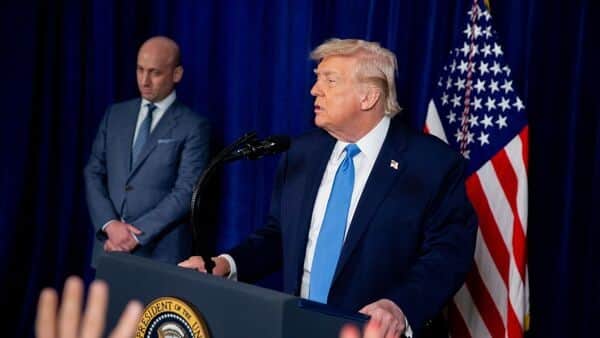
After US forces attacked Venezuela on Saturday and captured its president Nicolas Maduro over alleged acts of drug trafficking and narco-terrorism, President Donald Trump issued a stern warning to Cuba, Mexico, and Columbia, saying that other "troubling neighbours" could face the same fate.
Trump's decision to unilaterally sanction an attack on Venezuela was premised on allegations of drug manufacturing and trafficking, as well as sheltering cartels, and his warning to the other "troubling neighbours" followed a similar pattern.
Speaking to Fox News on Saturday, Trump, like in the case of Venezuela and Maduro, claimed that Mexico was being run by powerful drug cartels, and not by President Claudia Sheinbaum.
"Something’s going to have to be done with Mexico," Trump told the news outlet, adding, "They're [cartels] running Mexico. I've asked her numerous times would you like us to take out the cartels. 'No, no, no, Mr President, no, no, no, please.' So we have to do something."
Trump's comments on the other two "troubling" South American nations were similar.
Doubling down on his criticism of Maduro ally and Colombian President Gustavo Petro, Trump accused the South American leader of "making cocaine" and "sending it into the United States," as per Axios.
On the topic of Cuba, Trump asserted that it was a "failing nation"—"I think Cuba is going to be something we'll end up talking about," the US President said when asked about how the Caribbean country should react to Operation Absolute Resolve.
"We want to help the people. It's very similar in the sense that we want to help the people in Cuba, but we want to also help the people that were forced out of Cuba and living in this country," was Trump's assertion about Cuba.
Only this time, Trump's justification was not drugs, but the Iranian government's crackdown on protesters.
Following several deaths in Iran in recent protests, Trump warned that the US military was ready to respond.
"If Iran shots and violently kills peaceful protesters, which is their custom, the United States of America will come to their rescue. We are locked and loaded and ready to go (sic)," the US President said on his Truth Social Platform.
While the reasons for Trump's threats of military intervention in the four aforementioned countries differed, it should be noted that Colombia, Cuba, Iran, and Mexico all have one thing in common—they are oil producers.
“We’re going to have our very large United States oil companies, the biggest anywhere in the world, go in, spend billions of dollars, fix the badly broken infrastructure and start making money for the country,” Trump said, adding that the US would maintain a military presence in Venezuela to protect oil operations.
A quick look at data reveals that all four nations threatened by Trump have sizeable oil reserves as well, with Iran having the world's third largest reserves after Venezuela and Saudi Arabia, at an estimated 209 billion barrels, more than four times that of the US' 45 billion, as per OPEC.
While Mexico (5.1 billion), Colombia (2 billion), and Cuba have lesser reserves individually, their combined total is above 7 billion barrels—around 15% of the US' current reserves.
The US also leads in terms of global oil consumption, and accounted for 20% of the world total in 2022, as per the EIA.
Since coming to power in his second term, Trump has also changed the direction of US energy policy, pivoting from the Joe Biden administration's climate transition-oriented policy to one of energy dominance focused on fossil fuels—a shift encapsulated by his famous "Drill, baby, drill" slogan.
At the same time, energy needs have also escalated of late, driven by the AI race.
"We need to build and maintain vast AI infrastructure and the energy to power it," reads Trump's action plan on AI, released by the White House in July 2025.
"AI is the first digital service in modern life that challenges America to build vastly greater energy generation than we have today. American energy capacity has stagnated since the 1970s while China has rapidly built out their grid. America’s path to AI dominance depends on changing this troubling trend," Trump's plan asserts.
While it will take billions of dollars—$58 billion as per CNN—and years to update Venezuela's infrastructure to reach peak production levels, Trump's promise of opening up the South American country's reserves for US corporations signals a step in meeting the aforementioned goal of "vastly greater energy generation".
Against this backdrop, Trump's threats against the aforementioned oil producing nations, too, cannot be looked at in isolation.
Editorial Context & Insight
Original analysis & verification
Methodology
This article includes original analysis and synthesis from our editorial team, cross-referenced with primary sources to ensure depth and accuracy.
Primary Source
mint - news