CES serves a few different purposes — to give us the sense of what’s to come during the year, to introduce strange devices, and for companies to show off the newest technology. While there wasn’t as much of the first as I had hoped, there sure was a lot of the latter. TV manufacturers delivered enormous displays with additional subpixels, intriguing advancements on existing technologies, and the return of a stylish and slim favorite.
First launched back in 2017, LG’s Wallpaper TV redefined what a slim TV could be. After a few years away, the Wallpaper TV has returned with the W6. This new model is only 9 millimeters thick, has carved linear patterns around its perimeter for reinforced rigidity that looks stylish, and hangs flush against the wall. The TV uses the wireless Zero Connect Box 2.0, so you don’t have a bunch of cables from your sources to the TV (there is a thin power cable at the bottom left of the TV, though). The box is 35 percent smaller than its previous iteration and supports 4K signals up to 165Hz on all its HDMI ports, making it the first TV capable of that.
The W6 uses LG’s Primary RGB Tandem 2.0 panel and Hyper Radiant Color Technology. It should have a 20 percent increase in brightness over the G5, which I measured at over 2,400 nits. The W6 also has 12-bit color depth processing, which gives it more headroom when receiving the 10-bit signal sent from sources, causing fewer artifacts.
The main TV focus of the show for TCL was on its X11L SQD-Mini LED (so much so, that there weren’t any details revealed about its other TV lines). The TV uses blue LEDs — and not the RGB LEDs that most manufacturers were showing at CES — and TCL says it’s capable of an incredible 10,000 nits of brightness, has up to 20,000 dimming zones, and covers 100 percent of the BT.2020 color gamut.
This is because of two advancements TCL has made. The X11L is the only TV that uses reformulated quantum dots and an improved color filter developed by TCL CSOT (the company’s panel manufacturing division). Color on the TV looks spectacular, and thanks to all those dimming zones (and some great processing), the TV has excellent blooming control. This new innovation doesn’t come cheap, as the smallest size of 75 inches starts at $6,999.99, but it’s still a big step for mini LED.
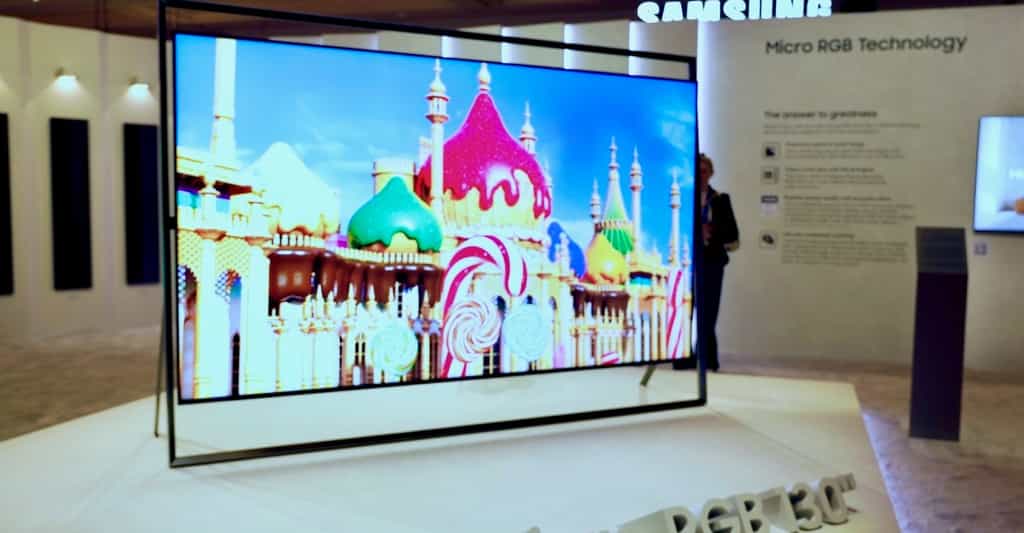
Back in August of 2025, Samsung officially launched its first Micro RGB TV, and in the days leading up to CES announced new sizes down to 55 inches would be coming in 2026. But when the doors opened at Samsung’s First Look event at CES, it was obvious they planned to impress. Attendees were greeted by the 130-inch R95H Micro RGB TV — Samsung’s largest micro RGB display.
The TV has Samsung’s Timeless Frame, which makes it look like the TV is suspended in air within the metal frame. The R95H is capable of 100 percent of BT.2020, has a glare-free screen, and supports HDR10+ Advanced. But while it’s impressive, the TV is only a prototype, so don’t go making space in your living room.
The company that started the whole RGB LED trend that now every manufacturer is a part of, with the Hisense UX, has now upgraded it with the new 116-inch UXS. But what’s fascinating is that it’s no longer just an RGB LED TV. It’s now an RGCB LED TV, as Hisense has added a cyan LED to the backlight of the UXS.
Hisense says there are a couple benefits to adding the cyan LED. First, it helps smooth the transition between blue and green, which can be prone to color crosstalk, affecting the color purity. Plus, it also helps reduce the blue light output in the range that can cause eyestrain and fatigue, as well as affect your circadian rhythms. The extra cyan LED also bumps up the BT.2020 coverage of the UXS to 110 percent.
LG’s flagship G6 has a lot of similarities with the W6 Wallpaper TV mentioned earlier. It also uses the Primary RGB Tandem panel with Hyper Radiant Color Technology which should be 20 percent brighter than last year’s G5. LG has said that the G6 will have deeper blacks than before, and it has a reflection free technology with less than 0.5 perfect reflectance to keep those blacks nice and inky, no matter the lighting condition.
Follow topics and authors from this story to see more like this in your personalized homepage feed and to receive email updates.
Editorial Context & Insight
Original analysis & verification
Methodology
This article includes original analysis and synthesis from our editorial team, cross-referenced with primary sources to ensure depth and accuracy.
Primary Source
The Verge