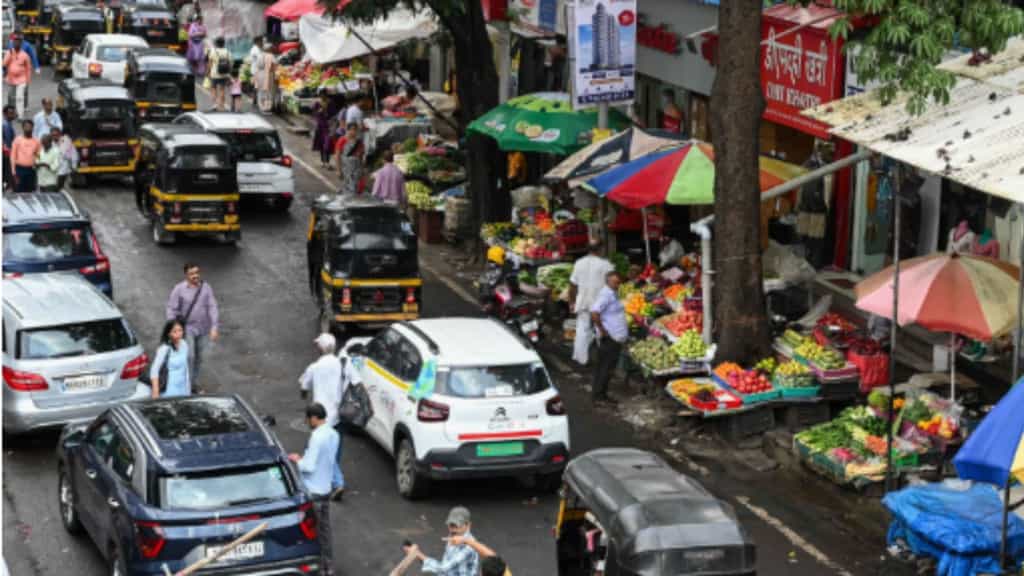
As Mumbai is gearing up for the civic elections on January 15, an issue that continues to affect the lives of citizens is the menace of illegal hawkers across Mumbai’s island city and suburbs. The issues caused by illegal hawkers include encroached footpaths and inadequate road space, which even lead to road accidents.
However, despite being the most cash-rich civic body in the country, the Brihanmumbai Municipal Corporation (BMC) is yet to bring out an end to this menace. The BMC’s data shows that there are 32,415 hawkers in Mumbai.
However the data extracted from the hawkers’ union shows that the hawker footfall in Mumbai stands at 3,50,000-4,00,000, at least. Furthermore, the BMC’s record states that Mumbai roughly has a footpath network of 4,000 km. Meanwhile, civic officials said that more than 50% of these footpaths are captured by hawkers creating sheer inconvenience for the public.
After the Street Vendors (Protection of Livelihood and Regulations of Street Vending) Act got passed in 2014, the BMC had received 99,435 applications from vendors for allotment of hawking pitches.
The proposed hawking pitches would be designated space of one square meter, where the hawkers would carry out their business. The regulation also ordered formation of a Town Vending Committee (TVC) that would give input and suggestion at the local level. This committee will also work towards allocating dedicated pitches and shopping zones for hawkers by freeing up encroached public spaces.
Therefore, collectively to curb the issue of hawker menace in Mumbai, the civic administration had mooted the implementation of a hawkers’ policy that will also work towards legalising vendors and hawkers, thus making it easier for the administration to identify illegal hawkers and launch a crackdown on them. However, nearly a decade later the policy is yet to see the light of the day.
“The draft of this policy was formulated in 2020, however due to the pandemic outbreak its implementation couldn’t happen. The body of elected representatives got dissolved in 2022 and since four years now we don’t have an elected body. Therefore, once the corporators come back to power then only a policy could be chalked since this will require serious consultation among public and private stakeholders,” said a civic official.
By issuing a 2024 ruling, the Bombay High Court had also directed the civic authorities to start preparing the formulation of the TVC that would determine the policy. However, officials said that it could be implemented only after the body of representatives came into place.
Meanwhile, speaking to The Indian Express, candidates who will be contesting the elections on January 15, said that the formulation and drafting of a hawkers’ policy is one of the key objectives for them once they are elected to their offices.
Sandeep Patel, BJP candidate who would be contesting the election for the second time, said that the hawker’s policy is a long term plan that is going to change the entire walkability situation in Mumbai.
“A primary area that I want to focus on once I am back in the office is formulating a uniform hawkers’ policy to ensure the roads are free for pedestrians to walk. In the next two years my target is to make two of the most encroached areas in Mumbai – Siddharth Nagar as well as Gajanan Marg – entirely hawker-free,” Patel said.
In March last year, the BMC had also initiated a drive to remove hawkers from public spaces as part of its “pedestrian first” policy. However, the hawkers came back to the same places from where they were removed, a few weeks later.
Last year, in November, as many as 67 illegal hawkers were removed from Colaba. The move was catapulted by former corporator Makarand Narwekar who had raised complaints on this issue with the civic administration. Narwekar said that the only permanent method to solve this issue is to bring a proper hawking policy.
“More than 50% of the stalls at Colaba causeway, which were removed, were illegal and the rampant encroachments have made the footpaths completely non-walkable and unsafe for pedestrians. Therefore only a proper policy can bring a permanent end to this issue,” Narwekar said.
Editorial Context & Insight
Original analysis & verification
Methodology
This article includes original analysis and synthesis from our editorial team, cross-referenced with primary sources to ensure depth and accuracy.
Primary Source
The Indian Express