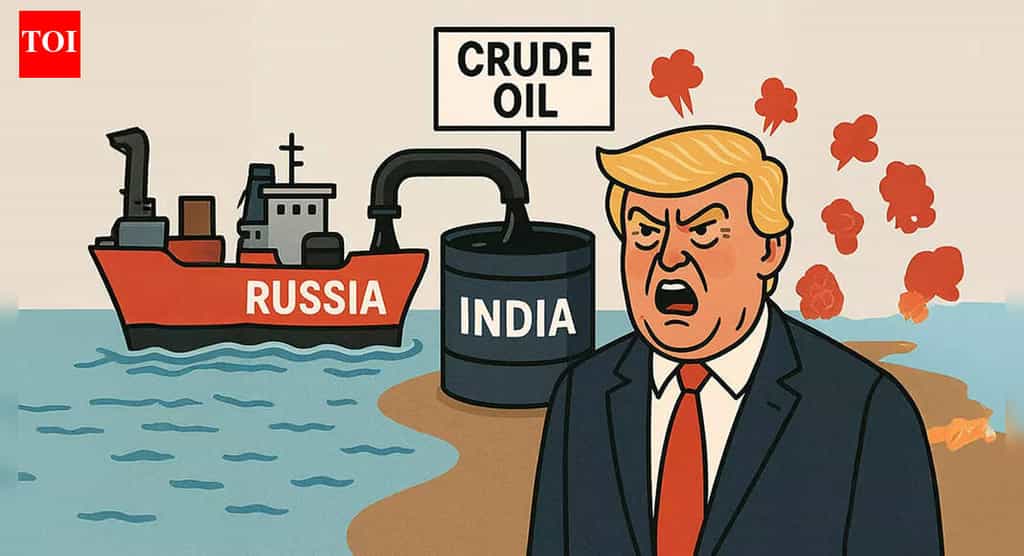
Will India face 500% tariffs from the US soon? It’s a question that’s on the mind of everyone after US Senator Lindsey Graham said that President Donald Trump has given the go ahead for a bill that looks to impose 500% tariffs on countries trading with Russia.
What’s important to understand is that while China and India are the largest importers of Russian crude oil, it is only India which has faced Trump’s wrath on the issue.Senator Lindsey Graham said he held a “very productive meeting” with Trump at the White House on Wednesday, during which the President cleared the bipartisan Russia sanctions legislation that has been under discussion for several months.
“This will be well-timed, as Ukraine is making concessions for peace, and Putin is all talk, continuing to kill the innocent.
This bill will allow President Trump to punish those countries who buy cheap Russian oil, fuelling Putin’s war machine,” Graham said in a post on X on Wednesday.“This bill would give President Trump tremendous leverage against countries like China, India and Brazil to incentivise them to stop buying the cheap Russian oil that provides the financing for Putin’s bloodbath against Ukraine,” he added.Graham said he was hopeful of securing a “strong” bipartisan vote on the legislation, possibly as early as next week.
So, what will happen to the India-US trade dynamics if the bill is passed? According to Global Trade Research Initiative (GTRI) founder Ajay Srivastava, a 500% tariff on goods - and potentially on services via secondary measures - could effectively halt India’s $120 billion US exports!
Graham, along with Senator Richard Blumenthal, has introduced the Sanctioning Russia Act of 2025, which proposes secondary tariffs and sanctions on “countries that continue to fund Putin’s barbaric war in Ukraine.” The bill outlines a 500 per cent tariff on secondary purchases and resale of Russian oil and has been co-sponsored by nearly every member of the Senate Foreign Relations Committee.
“President Trump and his team have made a powerful move, implementing a new approach to end this bloodbath between Russia and Ukraine... However, the ultimate hammer to bring about the end of this war will be tariffs against countries, like China, India and Brazil, that prop up Putin’s war machine by purchasing cheap Russian oil and gas,” Graham and Blumenthal said in a joint statement last year.
Trump has already imposed tariffs of up to 50 per cent on Indian goods, among the highest levied globally, including a 25 per cent component linked to India’s purchases of Russian energy.Senator Lindsey Graham has said Trump has given his consent to the legislation that would empower the US Congress to levy tariffs as high as 500 per cent on nations that continue to purchase Russian oil.Although China and India account for the bulk of Russia’s crude exports, recent US trade measures have targeted only India with 25% penal tariffs, a pattern that is widely expected to persist, according to GTRI. China, despite being a major buyer, has so far avoided punitive action. US officials are concerned that retaliatory steps by Beijing could include restrictions on rare-earth supplies, which are critical for American high-technology and defence manufacturing.“The same selective logic is likely to prevail under Senator Lindsey Graham’s proposed legislation. Even if the bill were to clear the Senate - a remote prospect - it would in practice target India alone, while China would remain beyond reach,” says GTRI.So far, President Donald Trump has refrained from pursuing tariff actions through Congress, preferring instead to invoke presidential emergency powers under the International Emergency Economic Powers Act. However, the tariff strategy is currently facing legal challenges, with a Supreme Court decision likely soon. In contrast, the Graham proposal would have to pass the Senate, adding another layer of uncertainty to its prospects.Even assuming the bill becomes law, questions remain over how a 500 per cent tariff would actually be implemented, notes GTRI. While US customs authorities are empowered to impose duties on physical goods, there is no statutory framework to levy tariffs on services. Any escalation, therefore, would likely take the form of taxing US companies on payments made for services sourced from India, the GTRI report says.The 50% tariff has already inflicted significant damage. A 500% tariff would effectively shut down India’s goods and services exports to the United States, now exceeding $120 billion annually.“India must take a clear position on Russian oil imports and convey it decisively to Washington,” Ajay Srivastava says.“The broader contradiction is hard to ignore. US lawmakers speak of “punishing” countries for purchasing Russian oil even as Washington moves aggressively to seize Venezuela’s oil assets. This is not a rules-based trading order; it is worse than the law of the jungle, as it is unevenly applied,” he adds.
Editorial Context & Insight
Original analysis & verification
Methodology
This article includes original analysis and synthesis from our editorial team, cross-referenced with primary sources to ensure depth and accuracy.
Primary Source
Times of India