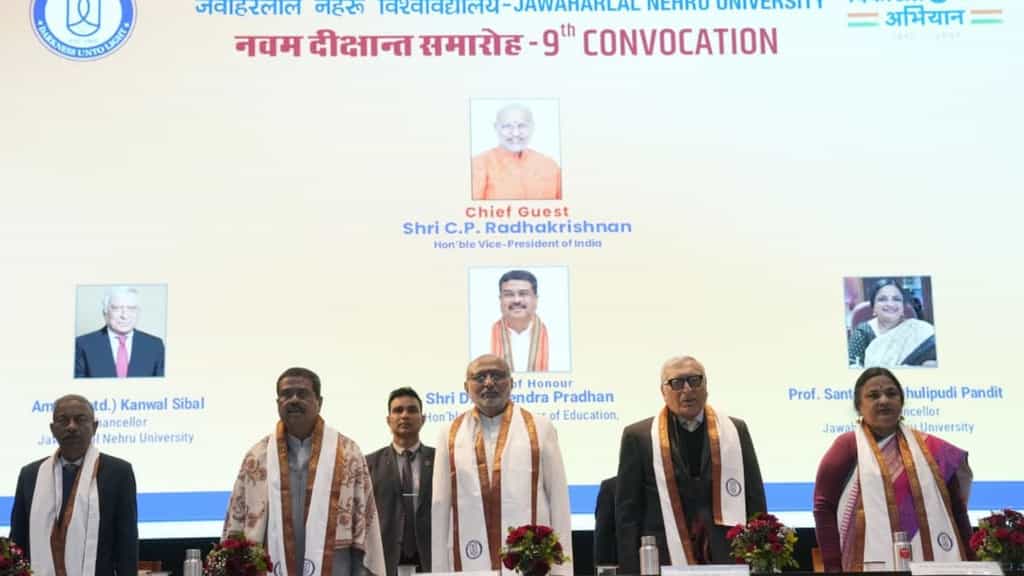
Radhakrishnan also appreciated what he described as the university’s “inclusive atmosphere” and its efforts to promote equity and social inclusion in student admissions and faculty recruitment. (Image: @VPIndia/X)
Vice-President of India C P Radhakrishnan Monday called upon young graduates to uphold “intellectual honesty,” social inclusion and national responsibility while addressing Jawaharlal Nehru University’s 9th convocation ceremony in Delhi.
Congratulating graduating students, the Vice-President, who was the chief guest at the event, urged them to dedicate “their knowledge and skills to the service of the nation,” according to a government statement.
Recalling the teachings of Swami Vivekananda on his birth anniversary, Radhakrishnan said that “education must go beyond degrees to build character, strengthen intellect and empower individuals to stand on their own feet”.
He said education and “proper training alone” would enable India’s youth to realise Prime Minister Narendra Modi’s vision of a “Viksit Bharat @2047.”
Referring to India’s civilisational legacy, the Vice-President cited ancient centres of learning such as Nalanda and Takshashila, and said Indian scriptures and classical texts — including the Upanishads, Bhagavad Gita, Kautilya’s Arthashastra and Thiruvalluvar’s Thirukkural — have “consistently placed learning at the centre of societal and ethical life”.
He emphasised that true education shapes conduct and character and is not limited to the acquisition of degrees. He also stressed that “modern science and traditional values must grow together”.
Referring to JNU’s democratic ethos, he said that “debate, discussion, dissent and even confrontation are essential elements of a healthy democracy,” but added that such processes “must ultimately lead to a conclusion”. Once a decision is taken, he said, there must be “a collective willingness to cooperate in its implementation to ensure smooth and effective administration”.
He commended the university leadership for expanding academic engagement into civilisational and emerging fields, including the establishment of new Centres for Hindu, Jain and Buddhist Studies at the School of Sanskrit and Indic Studies.
He also praised JNU’s initiatives to promote Indian languages through the Special Centre for Tamil Studies and chairs and programmes in Assamese, Odia, Marathi and Kannada, observing that “knowledge creation must flourish in mother tongues” in line with the National Education Policy.
In his concluding remarks, the Vice-President urged graduates to uphold three responsibilities — “intellectual honesty in the pursuit of truth, social inclusion to reduce inequalities, and active contribution to national development.” He called on them to remain guided by constitutional values and India’s civilisational ethos, and to respect their parents and teachers.
Union Education Minister Dharmendra Pradhan, JNU Chancellor Kanwal Sibal, Vice-Chancellor Santishree Dhulipudi Pandit, senior officials, faculty members, graduating students were present at the convocation
Editorial Context & Insight
Original analysis and synthesis with multi-source verification
Methodology
This article includes original analysis and synthesis from our editorial team, cross-referenced with multiple primary sources to ensure depth, accuracy, and balanced perspective. All claims are fact-checked and verified before publication.
Primary Source
Verified Source
The Indian Express
Editorial Team
Senior Editor
Shiv Shakti Mishra
Specializes in India coverage
Quality Assurance
Associate Editor
Fact-checking and editorial standards compliance