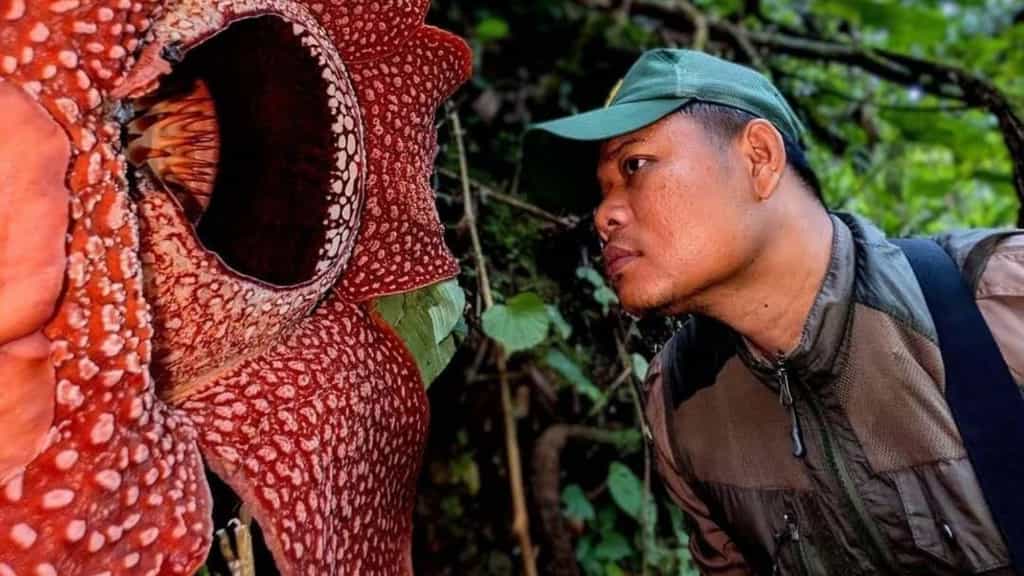
Biologist witnesses ultra-rare Rafflesia bloom in Sumatra rainforest (Photo: Reddit/natureismetal)
In the rainforests of Western Sumatra, something remarkable happened. Indonesian conservationist Septian Andriki, popular as Deki, dropped to his knees in awe after finding a botanical gem that had not been seen for over ten years: Rafflesia Hasseltii, one of the world’s rarest and most elusive flowers. “It has been 13 years of waiting,” he told the BBC.
Deki and his team spent nearly 13 years, 23 hours trekking through dense jungle, climbing steep hills, and always mindful that tigers inhabit these forests. However, the breakthrough occurred earlier this year after a local ranger sent them a photo that seemed to show a Rafflesia bud.
Rafflesia, often referred to as the “stinking corpse lily,” is renowned among botanists. It’s enormous bloom — sometimes up to one metre across and weighing more than 6 kilograms. The flower emits a strong odour of decaying flesh, luring carrion flies for pollination.
The timing of this discovery makes it even more special. Rafflesia has a slow and hidden life cycle: This brief blooming window makes witnessing it in the wild an almost impossible stroke of luck. “The life cycle of the Rafflesia is nine months long, like a baby in the womb,” Deki shared after the historic discovery of the rare flower.
The rediscovery started when a ranger in West Sumatra noticed the early signs of a Rafflesia bud and sent a message. This gave Deki and a team led by plant expert Dr Chris Thorogood new hope, so they got ready for the trip. The two had found several Rafflesia species during a 2021 expedition, but Rafflesia hasseltii had always escaped them. For Dek, the finding was like witnessing the birth of a child.
According to multiple reports, Deki has dedicated much of his life to protecting and finding rare plants in Indonesia. During the pandemic, he started working more closely with Dr Thorogood to document Rafflesia species throughout Sumatra.
Indonesia remains the world’s largest producer of palm oil, and the rapid expansion of plantations has resulted in the conversion of large areas of rainforest. These forests are home to Rafflesia, as well as tigers, orangutans, hornbills, and many other lesser-known species.
With this extraordinary discovery, Deki hopes that the future generation will still be able to experience the rainforest and its wonders.
Editorial Context & Insight
Original analysis and synthesis with multi-source verification
Methodology
This article includes original analysis and synthesis from our editorial team, cross-referenced with multiple primary sources to ensure depth, accuracy, and balanced perspective. All claims are fact-checked and verified before publication.
Primary Source
Verified Source
The Indian Express
Editorial Team
Senior Editor
Shiv Shakti Mishra
Specializes in India coverage
Quality Assurance
Associate Editor
Fact-checking and editorial standards compliance