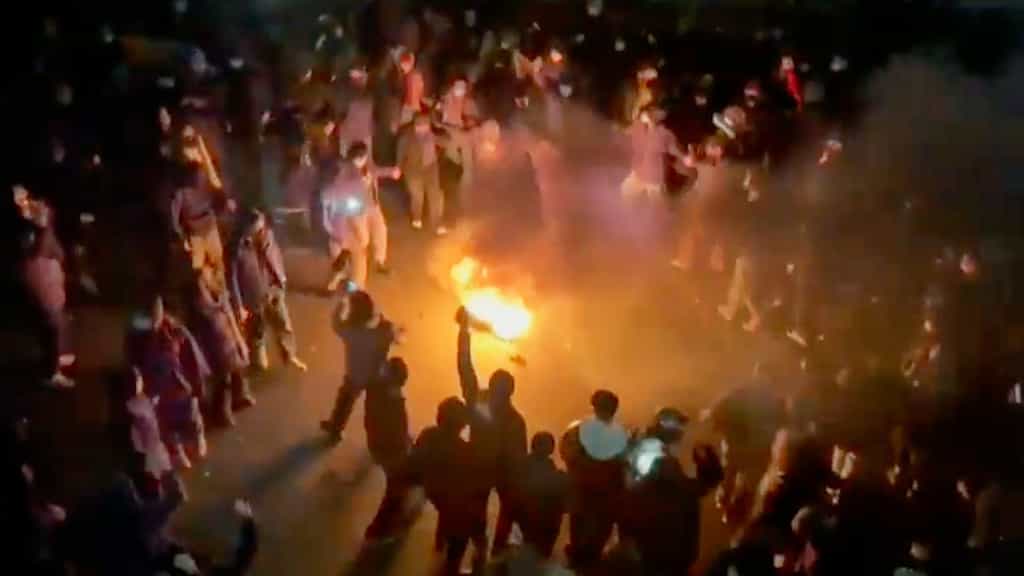
The number of people killed in anti-government protests across Iran has risen dramatically to more than 500, according to the US-based Human Rights Activists News Agency, as Donald Trump says he is weighing a range of responses to the escalating unrest.
Details on the protests are scarce as a communications blackout is still in effect across Iran's 31 provinces, with demonstrations, which began at the end of December over a sharp decline in the value of the rial currency, continuing into their third week.
They have since transformed into the most significant challenge to the regime for several years.
The Human Rights Activists News Agency said on Sunday that at least 544 people have died during the disorder - up from 116 deaths recorded by the end of Saturday.
It added that it has also received 579 other reports of deaths that remain under investigation, which would bring the total to 1,123.
More than 10,681 individuals have also been transferred to prisons following arrest, the non-government organisation said.
It added in an update earlier on Sunday that most of the victims were killed by live ammunition or pellet gunfire, predominantly from close range.
State TV showed dozens of body bags on the ground at the coroner's office in Tehran, saying the dead were victims of events caused by "armed terrorists", as well as footage of people gathered outside the Kahrizak Forensic Medical Centre in the capital waiting to identify bodies.
It comes as Mr Trump and his national security team have been weighing a range of potential responses against Iran.
"The military is looking at it, and we're looking at some very strong options," the US president told reporters on Sunday night.
Asked about Iran's threats of retaliation, he replied: "If they do that, we will hit them at levels that they've never been hit before."
It followed Mr Trump's similar remarks on Friday that the US would hit Tehran "very hard" if the government "start[s] killing people".
Earlier on Sunday, US foreign secretary Marco Rubio discussed the situation in Iran with Israeli Prime Minister Benjamin Netanyahu.
Citing an Israeli source, Reuters news agency reported that Mr Rubio and Mr Netanyahu did discuss the possibility of a US intervention in Iran in a phone call on Saturday.
Israel is now on high alert for a possible US intervention in Iran amid ongoing anti-government protests, three Israeli sources also told the news agency.
A US official confirmed only that the conversation took place, not its content.
Separately, the Israeli prime minister praised the "demonstrations for freedom," adding: "The people of Israel, and indeed the entire world, marvel at the immense bravery of the citizens of Iran.
"We all hope that the Persian nation will soon be freed from the yoke of tyranny."
Speaker: US strikes would make bases 'legitimate targets'
Meanwhile, Tehran has warned that the US military and Israel would be "legitimate targets" if America uses force to protect demonstrators.
Mohammad Baagher Qalibaf, the speaker of the Iranian parliament, said: "In the event of an attack on Iran, both the occupied territory and all American military centres, bases and ships in the region will be our legitimate targets.
"We do not consider ourselves limited to reacting after the action and will act based on any objective signs of a threat."
While Mr Qalibaf was speaking, MPs in parliament shouted "Death to America!"
On Sunday, Iran's president, Masoud Pezeshkian, addressed the protests for the first time in an interview with regime-linked national media.
During the interview, he said "terrorists" linked to foreign powers were killing people, burning mosques and attacking public property, and that Iran's enemies were looking to "sow chaos and disorder" by "ordering riots".
However, Mr Pezeshkian said the Iranian establishment was ready to listen to its people, and that the government was determined to resolve people's economic problems.
He then urged citizens to distance themselves from "rioters and terrorists," who he said were trying to "destroy the entire society".
Editorial Context & Insight
Original analysis and synthesis with multi-source verification
Methodology
This article includes original analysis and synthesis from our editorial team, cross-referenced with multiple primary sources to ensure depth, accuracy, and balanced perspective. All claims are fact-checked and verified before publication.
Editorial Team
Senior Editor
Sofia Andersson
Specializes in World coverage
Quality Assurance
Associate Editor
Fact-checking and editorial standards compliance