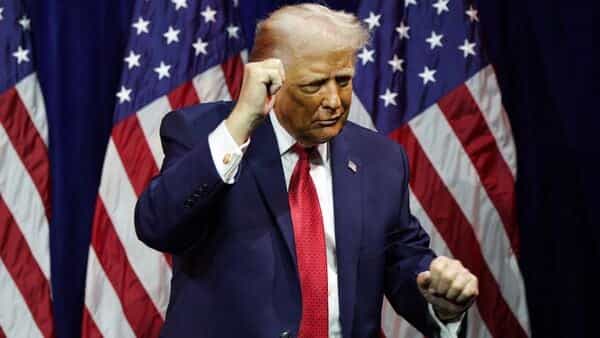
US President Donald Trump has proposed a dramatic expansion of American defence spending, unveiling plans to raise the military budget to $1.5 trillion in 2027 — a 50 per cent increase from earlier projections — as Washington confronts escalating tensions across the Western Hemisphere and the Arctic.
Writing on Truth Social, Trump framed the proposal as a response to what he described as an increasingly perilous global landscape, arguing that the expanded funding would underpin a vastly strengthened armed force capable of deterring any adversary.
Trump said the higher budget would allow the United States to build what he called a “Dream Military”, asserting that it would keep the country “SAFE and SECURE, regardless of foe”. He acknowledged that he had previously favoured a $1 trillion defence budget, but said economic conditions had shifted decisively in favour of a more ambitious plan.
The announcement comes as the administration pursues a more confrontational foreign policy posture, including the recent US operation to seize Venezuelan leader Nicolás Maduro and transfer him to the United States to face drug trafficking charges.
US military assets continue to gather in the Caribbean, while Trump has also spoken openly about asserting control over Greenland and suggested military action could be considered in Colombia.
Secretary of State Marco Rubio has further fuelled unease among regional observers by warning that long-time adversary Cuba “is in trouble”.
Trump credited sharply higher tariff revenues for enabling the expanded defence outlay, claiming the income generated would have been “unthinkable in the past”, particularly during the previous administration. He said the increased funds would make it possible not only to strengthen US military power, but also to reduce national debt and deliver what he described as a dividend to moderate-income Americans.
According to data from the Bipartisan Policy Center, the US government collected $288.5 billion in gross revenue last year from tariffs and excise taxes, up from $98.3 billion in 2024 — a substantial rise, though still well short of covering all of the administration’s stated fiscal ambitions.
The proposed increase would come on top of an estimated $175 billion boost to defence spending already enacted under last year’s Republican-backed tax and spending legislation. The current military budget for 2026 stands at $901 billion.
Despite Republican control of the White House, the proposal is expected to face resistance on Capitol Hill. Democrats have traditionally pushed to maintain parity between defence and non-defence spending, while fiscal conservatives within Trump’s own party have warned against further widening the federal deficit.
Trump, however, insisted he was comfortable pursuing the surge in military spending, citing the revenue generated through tariffs imposed on both allies and rivals since his return to office.
President Donald Trump abruptly changed his tone Wednesday about his Colombian counterpart, Gustavo Petro, saying they had exchanged a friendly phone call and he’d even invited the leader of the South American country to the White House.
“It was a Great Honor to speak with the President of Colombia, Gustavo Petro, who called to explain the situation of drugs and other disagreements that we have had,” Trump posted on his social media site. “I appreciated his call and tone, and look forward to meeting him in the near future.”
He wrote that the upcoming meeting would take place at the White House.
That came mere days after Trump said in the wake of the U.S. operation to oust Venezuelan President Nicolás Maduro over the weekend that “Colombia is very sick too” and accused Petro of ”making cocaine and selling it to the United States."
As the United States prepares to seize control of Venezuelan oil and the administration of Donald Trump hardens its stance toward Cuba, Mexico has emerged as a key fuel supplier to Havana.
It’s a role that could further complicate already strained relations with the Trump administration, even though the Mexican government insists that exports to the island have not increased.
Mexican President Claudia Sheinbaum acknowledged on Wednesday that “with the current situation in Venezuela, Mexico has become an important supplier” of crude oil to Cuba, but asserted that “no more oil is being sent than has been sent historically; there is no specific shipment.”
She added that those shipments are made via “contracts” or as “humanitarian aid,” but offered no concrete figures on the number of barrels exported.
'The blackouts are going to intensify'
Alongside the budget proposal, Trump issued a stark warning to major defence firms, singling out Raytheon over its use of stock buybacks. He threatened to cut off Pentagon business unless the company invested more heavily in manufacturing capacity and curtailed shareholder payouts.
“Either Raytheon steps up, and starts investing in more upfront Investment like Plants and Equipment, or they will no longer be doing business with Department of War,” Trump wrote. “Also, if Raytheon wants further business with the United States Government, under no circumstances will they be allowed to do any additional Stock Buybacks, where they have spent Tens of Billions of Dollars, until they are able to get their act together.”
The president also signed an executive order directing the Pentagon to review defence contractors’ performance and to restrict stock buybacks and executive incentive pay where companies fall short on government contracts.
The comments rattled defence stocks, with shares of major contractors falling sharply. Raytheon’s parent company RTX Corp. slipped 2.5 per cent, while rivals Northrop Grumman and Lockheed Martin recorded steeper losses.
Raytheon is a cornerstone of the US defence industrial base, producing key weapons systems including the Tomahawk cruise missile, Javelin and Stinger missiles, and the Sidewinder air-to-air missile, as well as jet engines through its subsidiary Pratt & Whitney.
Editorial Context & Insight
Original analysis & verification
Methodology
This article includes original analysis and synthesis from our editorial team, cross-referenced with primary sources to ensure depth and accuracy.
Primary Source
mint - news