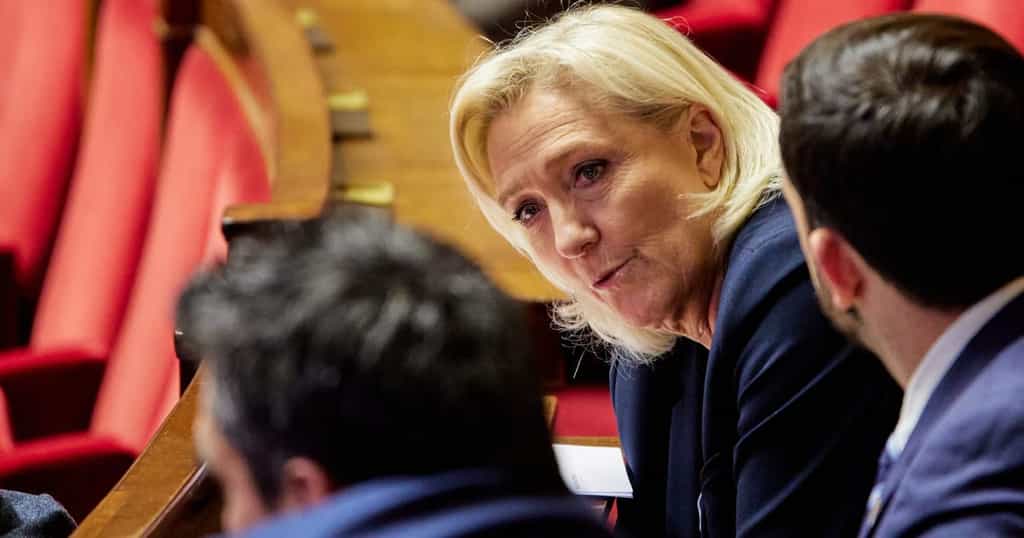
The far-right party is adamant it doesn’t want the White House’s backing.
PARIS — Marine Le Pen and her troops are making it clear that they’re not jumping into bed with U.S. President Donald Trump’s administration despite their shared ideology.
The far-right National Rally has in recent days gone out of its way to tamp down any hint of a political romance with the White House after German news outlet Der Spiegel reported that team Trump considered sanctioning the French judges who convicted Marine Le Pen of embezzlement and handed her a five-year election ban, effectively barring her from next year’s presidential race.
After the verdict was handed down, U.S. President Donald Trump likened Le Pen’s judicial woes to his own and said her conviction was an example of “using Lawfare to silence Free Speech.”
Le Pen will be back in court next week to appeal the verdict.
Though the State Department has since denied the Spiegel report as “stale and false,” the mere hint of a National Rally-MAGA liaison was enough to quickly put the party on the defensive — especially given that Washington sanctioned a French judge at the International Criminal Court that issued an arrest warrant for Israeli Prime Minister Benjamin Netanyahu.
In a press release dated Wednesday, the National Rally said it condemned the sanctions against the ICC judge and watches closely for “any pressure of unacceptable nature on the judicial branch.” In the same statement, it slammed the initial Spiegel report as “fake news” and chastised the press for picking it up.
Three National Rally officials contacted by POLITICO also expressed unease at the unconfirmed report.
“We have always rejected foreign interference from one side or the other,” Renaud Labaye, a close adviser to Le Pen and high-ranking member of her party, the National Rally, said Thursday. “We stand by that.”
Alexandre Sabatou, a member of the France-U.S. friendship group in the National Assembly who traveled across the Atlantic for Trump’s inauguration, said Tuesday that “as a staunch defender of France as a sovereign nation, it bugs me.”
The National Rally has been forced to play a delicate dance when it comes to support from Trump, whose administration last month hinted that it was ready to throw its weight between “patriotic European parties” in its bombshell national security strategy.
However, Trump is largely unpopular in France, even among the far-right party’s supporters, and many voters recognize that his administration is pursuing economic and geopolitical policies that aren’t in France’s interest. Overtures from the White House to intervene in French and European politics also run counter to the National Rally’s pledge to protect French geostrategic independence — especially from American hegemony — rooted in the politics of legendary Gen. Charles De Gaulle.
The debate around potential foreign interference comes as the country’s judicial branch is already under intense political pressure over high-profile cases, including the trial of former President Nicolas Sarkozy and Le Pen’s appeal.
Editorial Context & Insight
Original analysis & verification
Methodology
This article includes original analysis and synthesis from our editorial team, cross-referenced with primary sources to ensure depth and accuracy.
Primary Source
POLITICO