US President Donald Trump told reporters that Iran "wants to negotiate", adding that the meeting with the Islamic Republic's leadership is being organized.
However, the US leader said Washington "may have to act" before the meeting due to the ongoing protests in the country and the violence against protesters.
"I think they're tired of being beat up by the US," Trump said on board Air Force One.
EU top diplomat Kaja Kallas said she will propose new sanctions on Iran due to the "brutal repression of protesters," as she put it.
In an interview with the German newspaper Die Welt, Kallas said that while the bloc already has "sweeping sanctions" against Iran in place, more sanctions could be on their way.
"I am prepared to propose additional sanctions in response to the regime's brutal repression of protestors," she said.
According to the German news agency dpa, the initial focus of the newly suggested sanctions will likely be on individuals responsible for violence against protesters. This could include EU travel bans and asset freezes for government ministers.
Daniel Gerlach, a Middle East expert and the editor-in-chief of Zenith magazine, said that while the protests in Iran are raging, the country's opposition is anything but organized.
"The Iranianregime has made sure such opposition would never exist," he told DW News.
Most of the some five million Iranians who live abroad, Gerlach says, oppose the Islamic Republic for political, social or economic reasons.
Those seeking the return of the Shah — who was ousted by Ayatollah Khomeini in the 1979 Islamic revolution — might be vocal and well-organized, but they remain a minority, Gerlach said.
"Very rarely have people inside Iran said it would be a good idea to reestablish the monarchy," he added.
Regarding the Iranian regime's current situation, Gerlach says the situation is far from looking like it is going to collapse.
According to the journalist, the Islamic Republic's five pillars — the intelligence service, the Revolutionary Guard, the clerics, the judiciary — all seem to be intact rather than weakening or defecting to the protesters' side.
US President Donald Trump said he is considering several responses to the protests in Iran, with some of the responses involving the military.
"Iran is starting to cross (my red line)," he said on board the Air Force 1.
"We are looking at it very seriously, the military is looking at it and we're looking at some very strong options," Trump told reporters, labeling the options considered as "very strong."
The US leader said he will also speak to Elon Musk about the possibility of Iranians using the billionaire's Starlink system, which allows access to the internet through a satellite.
To view this video please enable JavaScript, and consider upgrading to a web browser that supports HTML5 video
US President Donald Trump will hold a briefing with senior officials on Tuesday, discussing ways to respond to the protests in Iran, the Wall Street Journal reported, citing US officials.
The list of potential US moves includes further sanctions on the Islamic Republic's government, applying cyber weapons against the Iranian military and military strikes.
Meanwhile, the Israeli new outlet The Jerusalem Post reported, citing sources, that President Trump "has essentially decided" to help the protesters in Iran.
"What (Trump) has not yet decided is the 'how' and the 'when'," the sources were quoted saying.
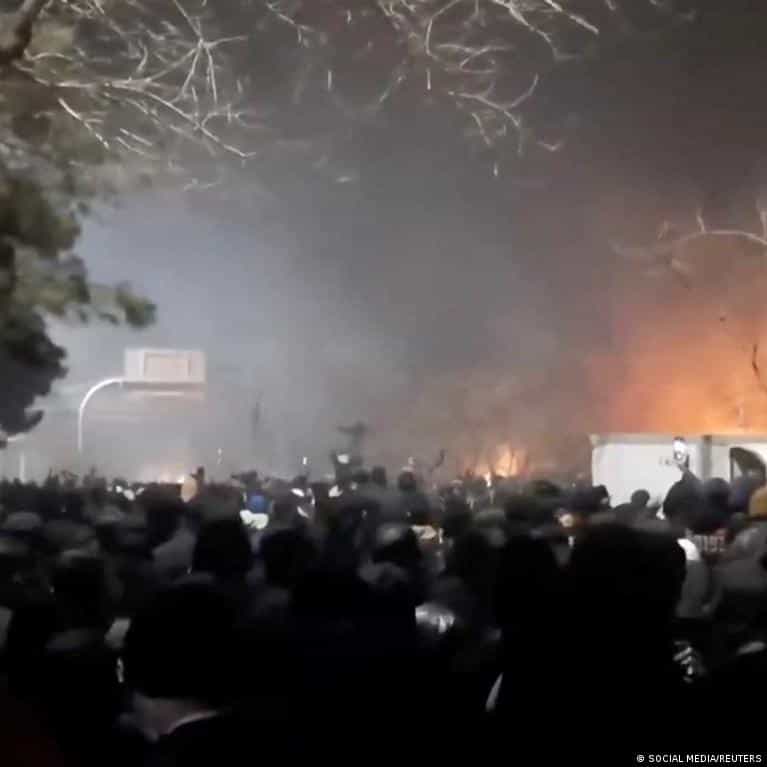
Iran's government on Sunday declared three days of national mourning for members of security forces killed in two weeks of protests, state television reported.
The government described the protests as "riots," hailing what it described as "martyrs" who had waged an "Iranian national resistance battle" against the United States and Israel.
Tehran has accused its geopolitical rivals of foreign interference and stoking the protest movement.
Iranian President Masoud Pezeshkian announced a "national resistance march" planned for Monday.
Marina Miron, a military analyst from King's College London, has told DW that any potential US intervention in Iran would likely avoid a large logistical footprint.
She emphasized that a deployment of ground troops was unlikely, despite the presence of US forces in neighboring countries such as Syria, Iraq, Jordan, Kuwait, and the UAE. Instead, Miron suggested that the US would more plausibly carry out precision strikes, potentially involving special forces.
She explained that the top US military priority would be to neutralize Iran's long-range missile capabilities, especially given threats against American bases and Israel. She said the Iranian leadership had already made it clear that they might target both.
"This is a kind of option the US might be considering," she said. "And it could have the capability to execute it very quickly."
Asked about non-military tools available to Washington, Miron noted that options like information campaigns would be more difficult due to Iran’s nationwide internet blackout. She said these activities could still take place on the ground, but the blackout made dissemination harder.
"There could be an alternative way… on the ground to conduct such operations," she said. "And, of course, we have economic measures that could be implemented, but I think at this stage it wouldn't change very much."
She added that diplomacy remained an available tool, with the military option as "the blunt instrument" held in reserve as a last resort.
United Nations Secretary-General Antonio Guterres has expressed shock at the violent crackdown on protesters in Iran.
"The Secretary-General is shocked by the reports of violence and excessive use of force by the Iranian authorities against protesters in multiple locations across the Islamic Republic of Iran, resulting in scores of deaths and many more injuries in recent days," Guterres said, according to a statement delivered by his spokesman, Stephane Dujarric.
"The Secretary-General urges the Iranian authorities to exercise maximum restraint and to refrain from unnecessary or disproportionate use of force," the statement read.
Guterres called for Tehran to lift its communications blackout and take other "steps that enable access to information" in Iran.
As protests in Iran are being violently put down amid the darkness of a total internet blackout, DW spoke with human rights lawyer Omid Shams about the contradiction between the Iranian president's conciliatory statements suggesting his willingness to listen to protesters' demands while at the same time the regime labels protesters "terrorists," and "enemies of god" — accusations punishable by death.
Shams said that President Masoud Pezeshkian's seemingly conciliatory rhetoric was "just for the international community and those who are not really familiar with the situation on the ground in Iran."
"We documented this before in the Woman, Life, Freedom movement when the government started calling protesters insurgents, terrorists, combatants, which is, legally speaking, absolutely baseless. That was a code for the first surge in death tolls on September 21 in 2022."
He said that Iranian authorities were using similar language now, which he described as a "code for massacre."
"This regime — we should know that it's a totalitarian theocracy — is an ideological regime that has no place anywhere. It's an outlaw regime, completely detached from the international community, has no respect whatsoever for its domestic or international obligations," Shams said.
"We should understand that there is no legitimacy whatsoever for this regime to continue ruling this country."
He suggested that Iran's government has not been stable in recent years, saying that its goal since the 2022 "Woman, Life, Freedom" movement has just been to "survive."
Shams argued that cracks were starting to appear within Iran's security apparatus.
"Well, this regime came to power through a revolution. So from day one, they fortified themselves first and foremost against their own people and against any potential revolution or change. That's why they created the Islamic Revolutionary Guard [(IRGC)]," he said.
"But even inside that organization there ... there are thousands of Revolutionary Guards, that are not supporting this regime, but they are very afraid," he said, adding that the IRGC had issued statements warning its forces not to resist orders to shoot.
EU Parliament President Roberta Metsola hailed demonstrators in Iran as "brave" and called on them to continue protesting.
"The killing must stop. The innocent and persecuted must be released. The repression must end," Metsola said in a post on the platform X.
"To those brave girls, students, men and women on the streets: This is your time," she said.
"Know that any regime that blocks communication is a regime that is terrified of its own people," she said, referring to Iran's multi-day near-total internet blackout.
Nazenin Ansari, Iranian journalist and managing editor of the news outlet Kayhan London, told DW that the current demonstrations in Iran are different to previous major protest waves in that they have a clear figurehead in Iran's exiled crown prince.
"These protests are nothing new, they started in 2017," she said, adding that she was referring to protests that are "very secular and [don't] use any religious or Islamic rhetoric."
"So what is different with these protests today … is that it has a leader, and that is Prince Reza Pahlavi," she said.
Reza Pahlavi is the son of the last shah of Iran, Mohammad Reza Pahlavi, who was deposed in 1979 in the Islamic Revolution that led to the establishment of a clerical regime in the traditionally Shiite Muslim country.
Ansari compared the demonstrations to previous protest waves in 2017 and 2019, as well as the 2022 "Woman, Life, Freedom" movement that was sparked by the death of Kurdish woman Jina Mahsa Amini in police custody.
"This is why the [current] protests are being galvanized," she said, referring to the figure of Reza Pahlavi as a leader, adding that "various political currents" in the opposition were working together.
Ansari said that a joint letter put out by opposition figures calling for international support — and that she herself also signed — was important in that it shows that the "the opposition … [is] together," contrary to the government rhetoric that would have that it is a "divided opposition."
Asked what kind of action she would like from other countries in support of the protests, she pointed to Iran's internet blackout, saying: "provide free internet, provide access to information."
She called for the world to "cut the internet" to Supreme Leader Ali Khamenei and other members of Iranian leadership, as well as for countries around the world to "recall [their] ambassadors."
The death toll from Iran's crackdown on nationwide protests has risen sharply to at least 544 people, activists have said.
The US-based Human Rights Activists News Agency (HRANA) said more than 10,600 people have been detained.
According to the group, 496 of those killed were protesters and 48 were members of the security forces, adding that the toll is likely to rise further.
It said widespread internet shutdowns and blocked phone lines inside Iran have made it increasingly difficult to assess the scale of the unrest from abroad.
The activist group said its figures are based on cross-checked reports from activists inside and outside Iran and noted it has provided accurate casualty counts during previous waves of unrest. Iran's government has not released overall casualty figures
Journalists and rights groups are reporting that protesters are being killed in large numbers, according to information trickling out of Iran.
With an internet blackout and phone lines blocked, its been difficult to get an accurate picture of developments unfolding.
German-Iranian activist Daniela Sepheri spoke to DW about the dangers facing those who've taken to the streets.
"It's extremely dangerous for the people to go out and protest and they still do it. We are getting reports, horrible repords of massacres," Sepheri said.
She went on to say that regime security forces were directly targeting protesters and were "coming inside the hospitals to kidnap the wounded."
Sepheri spoke of the difficulty in verifying the numbers of dead and injured being reported.
"It's [very] difficult to verify the numbers that we are getting because of the Internet shutdown. Through Starlink it is possible to get some of the videos. Iranian exile media is verifying them all day long," Sepheri explained.
"We can only assume that there must be thousands of people that have been murdered only in these last two or three days," Sepheri said.
On the question of why the regime was going to such measures to clamp down on protests, Sepheri said: "This is the only answer that the regime has, and this has been going on for decades. We have seen it in protests before, that the regime can only answer with violence because they do not care for the people's demands."
Sepheri said the type of violence was unlike anything she had ever seen before.
"But this kind of crackdown is the most brutal that we have ever seen," she said, adding: "Me personally, I have never seen anything like this before."
"The gap between rich and poor is so big that there is no middle class even left anymore in Iran and the richer the elite gets the poorer the people get," Sepheri said.
On the topic of how much longer the regime could last, Sepheri said she didn't believe Iran's leadership could hold onto power for much longer.
"I don't think that the regime can hold on for too long. The regime is weaker than ever before internationally. For example, in Syria, there is no Assad anymore or there's no Maduro in Venezuela as well," Sepheri said, adding that Iran's international partners were being taken down one after the other.
"People are not supporting this regime anymore. So the regime is fighting for its survival, but so are the people in Iran," Sepheri said.
Venezuela and Iran have been close economic and ideological partners for years and US actions in capturing Nicolas Maduro would have been cause for alarm in Tehran.
US President Donald Trump has also been threatening to take action should Iran kill protesters.
On the question of what happens next, Sepheri said she hoped for Iranians to choose their own destiny.
"My hope is that the people in Iran can change their future and change their country according to their own will, have free elections and a referendum," Sepheri said.
Touching on whether a collapse of Iran's clerical regime could lead to a restoration of the Iranian monarchy, Sepheri said: "This is something the people in Iran have to decide. There are some people who want the shah back, some people who don't," she said, adding that members of ethnic minority groups largely "do not want the shah back."
The exiled son of Iran's last shah, Reza Pahlavi, has said he wishes to return to Iran and play a political role.
His father, Mohammad Reza Pahlavi, was deposed in the 1979 Islamic Revolution.
Iran is highly ethnically and linguistically diverse, with a little over 60% of the population being made up of ethnic Persians.
Areas inhabited by the Kurdish and Baloch minorities have been major sites of unrest across multiple protest waves in Iran.
Israel's prime minister, Benjamin Netanyahu, hailed Iranian protesters and said he hoped for improved relations between Israel and Iran.
"We all hope that the Persian nation will soon be freed from the yoke of tyranny, and, when that day comes, Israel and Iran will once again be loyal partners in building a future of prosperity and peace for both peoples," Netanyahu said.
Iran was one of Israel's few allies in the Middle East between 1948, when Israel was founded, and 1979, when Shah Mohammad Reza Pahlavi was ousted in the Islamic Revolution.
Since then, Iran and Israel have been major regional adversaries, with Tehran also supporting the Palestinian militant group Hamas, as well as other militias that have come to blows with Israel such as Lebanon's Hezbollah and Yemen's Houthis.
Editorial Context & Insight
Original analysis and synthesis with multi-source verification
Methodology
This article includes original analysis and synthesis from our editorial team, cross-referenced with multiple primary sources to ensure depth, accuracy, and balanced perspective. All claims are fact-checked and verified before publication.
Primary Source
Verified Source
Deutsche Welle
Editorial Team
Senior Editor
Marcus Thompson
Specializes in World coverage
Quality Assurance
Associate Editor
Fact-checking and editorial standards compliance