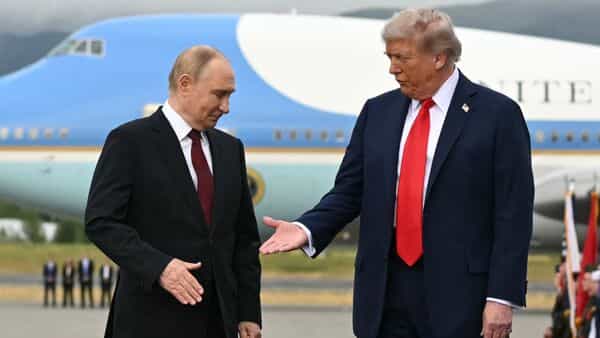
Republican Senator Lindsey Graham said Wednesday that US President Donald Trump has approved moving forward with a bipartisan sanctions bill aimed at countries that continue doing business with Russia, and that it could reach a congressional vote as soon as next week.
Graham said Trump gave the go-ahead for the legislation during a meeting between the two earlier that day.
The legislation, which Graham has been working on with fellow Republicans and Democrats for months, would impose sanctions on countries doing business with Russia, including buyers of its energy exports, over Moscow's failure to negotiate a peace deal with Ukraine, Reuters reported.
Russia invaded Ukraine in 2022.
“This bill will allow President Trump to punish those countries who buy cheap Russian oil fueling Putin’s war machine,” Graham said, citing China, India and Brazil as potential targets of the legislation.
Graham, a senator from South Carolina, said he is looking forward to a "strong bipartisan vote" on the legislation to take place as early as next week.
Leaders in the Senate and House of Representatives have held off bringing the legislation to a vote as Trump has preferred to impose tariffs on goods imported from India, the world's second-leading buyer of Russian oil after China. Reuters reported.
A U.S. official told Reuters in November that Trump would sign the legislation if it passed, but would insist on specific language ensuring he remained in control of the sanctions, according to the report.
Efforts to end the nearly four-year war in Ukraine have gained momentum since November. On Tuesday, the United States joined a broad group of Ukraine’s allies in pledging security guarantees, which leaders said would include binding commitments to support Ukraine if Russia launches another attack.
Russia, however, has not indicated any readiness to compromise. This comes after Kyiv sought changes to a U.S. proposal that had initially aligned with Moscow’s key demands. The Kremlin has also given no public indication that it would accept a peace agreement that includes the security guarantees proposed by Ukraine’s allies.
Earlier, Trump said that Prime Minister Narendra Modi was unhappy about the high tariffs imposed on India for buying Russian oil. "I have a very good relationship with PM Modi, but he is not happy with me as India is paying high tariffs. But now they have reduced it very substantially, buying oil from Russia," Donald Trump said.
The tariffs, totalling 50%, were imposed due to India's significant purchases of Russian oil, which the US sees as supporting Russia's economy amid the Ukraine conflict.
Trump's remarks came a day after he warned that Washington could further raise tariffs on Indian goods if New Delhi does not address US concerns over Russian oil imports.
"They wanted to make me happy, basically. Modi is a very good man; he is a good guy. He knew I was not happy, and it was important to make me happy," he said.
Speaking at the House GOP Member Retreat, Trump suggested that while relations between the two countries remain friendly, the tariff issue has introduced some strain.
India has previously dismissed President Trump’s claim that Prime Minister Narendra Modi had assured him New Delhi would stop buying Russian oil, clarifying that no such discussion or commitment had occurred.
However, India’s crude oil imports are expected to fall to a three-year low this month, driven by a punitive U.S. tariff on Indian goods and tighter sanctions on Russia. The Trump admin has argued that India’s purchases of discounted Russian oil help fund Moscow’s war in Ukraine.
India and Russia have set a target of boosting bilateral trade to $100 billion by 2030. Trade between the two countries surged more than fivefold, from about $13 billion in 2021 to nearly $69 billion in 2024–25, largely driven by India’s energy imports.
However, bilateral trade slipped to $28.25 billion during April–August 2025, reflecting a drop in crude oil purchases. At the same time, India is seeking new markets to offset the impact of the steep 50% tariff imposed by President Donald Trump on Indian goods.
Russia, meanwhile, is looking to import more Indian products to rebalance trade that is currently heavily skewed toward energy, Deputy Kremlin Chief of Staff Maxim Oreshkin said at a business conference in New Delhi earlier on Thursday.
Editorial Context & Insight
Original analysis & verification
Methodology
This article includes original analysis and synthesis from our editorial team, cross-referenced with primary sources to ensure depth and accuracy.
Primary Source
mint - news