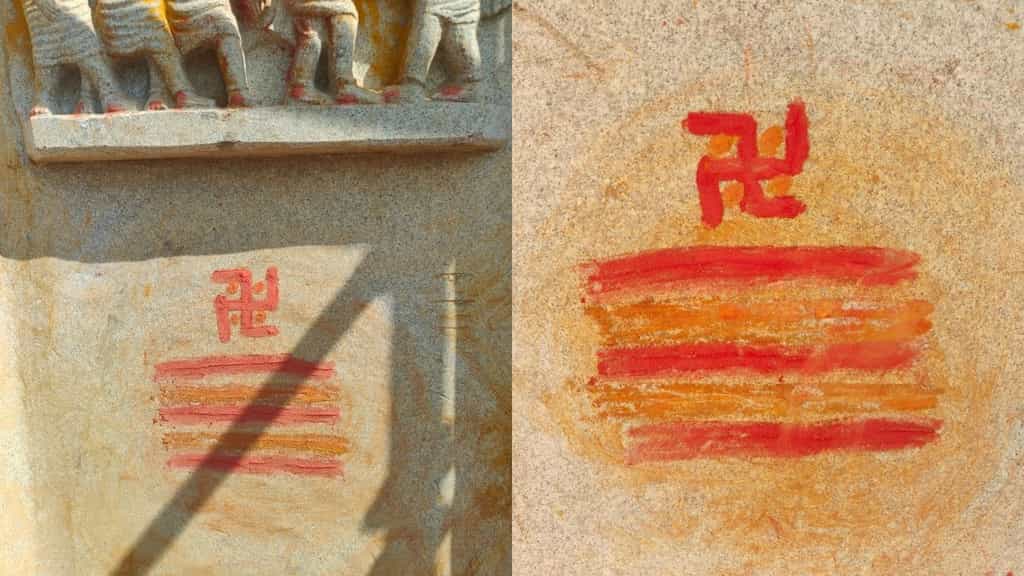
The left-facing swastika is not unique to tribal traditions alone but is also found in Buddhist traditions in South Asia. (Express photo)
As Telangana prepares for the Medaram Jatara – South Asia’s largest biennial tribal festival – debate over the provenance of the left-facing swastika has once again resurfaced.
According to tribal history experts, the left-facing swastika, engraved on several pillars of Medaram’s tribal shrine – the Sammakka-Saralamma temple – is a common symbol in tribal history. This comes as the Congress government gears up for the jatara from January 28-31, setting up a 50-bed hospital and readying over 3,000 buses for deployment. It also coincides with a Rs 200-crore facelift for the temple, supported by the Telangana government.
In Medaram village in Telangana’s Mulugu district, tribal researcher M Arun Kumar said the left-facing swastika is a tribal symbol, unlike the right-facing swastika in Hindu tradition.
“The left-facing swastika is a recurring motif in Koya tribal tradition,” Arun Kumar told The Indian Express. “We narrowed down on several such pictorial traditions to inscribe on the 32 pillars of the temple,” he added. The temple now has 7,000 such pictorial depictions, of which the swastika stands out the most, Kumar said.
According to Kumar, who holds a doctorate in Koya tribal studies, the swastika is a tribal symbol that was later adopted by Hinduism. “The left-facing swastika dates back to the Indus Valley civilisation,” Kumar said.
Bhangya Bhukya, a professor of Modern Indian History at the University of Hyderabad, endorsed this view: “The left-facing swastika is a common symbol across Adivasi communities in Telangana. Other than the Koyas, Lambadas also draw the left-facing swastika.”
According to Kumar, the temple will also have Shivling-like structures on which the swastika will be depicted. “Belief in Lord Shiva is tribal in nature,” Kumar said. “The swastika will greet people, reminding them of tribal traditions that are unique in the country.”
Medaram Jatara attracts the largest number of devotees in the country after the Kumbh Mela. In the past, the jatara has recorded a footfall of 10 million people. The temple worships two goddesses – Sammakka and Saralamma – a mother and daughter who safeguarded Medaram for long.
“It is said that the mother-daughter duo stood up to Kakatiya rulers who wanted to annex Medaram to their kingdom. But as per our research, Sammakka-Saralamma were chieftains of the region even before the Kakatiyas,” Kumar said. He cited palm-leaf scriptures in the Koya language to back his theories. According to Koya oral tradition and folklore, some tribal chiefs who went hunting found a newborn baby girl, Sammakka, emitting light while playing amid tigers. The chiefs took her to their habitation, and the head of the tribe adopted her and brought her up as a chieftain. She had three children – Sarakka, Nagulamma and Jampanna.
“In the rebuilding of this temple, several Koya researchers have given support,” Kumar said, adding that his team alone has at least 10 researchers. The left-facing swastika, however, has drawn the ire of some organisations, which have called it a distortion of Hindu history. “The researchers who introduced the left-facing swastika have no basis for including it,” said Arvind Arya, a Warangal-based researcher who opposes the symbol, told The Indian Express.
Arun Kumar, however, said the left-facing swastika is not unique to tribal traditions alone but is also found in Buddhist traditions in South Asia. “The temple is sacred for Koyas and Gonds (two tribes), and we will continue with our traditions no matter what opposition comes our way,” he said.
Editorial Context & Insight
Original analysis and synthesis with multi-source verification
Methodology
This article includes original analysis and synthesis from our editorial team, cross-referenced with multiple primary sources to ensure depth, accuracy, and balanced perspective. All claims are fact-checked and verified before publication.
Primary Source
Verified Source
The Indian Express
Editorial Team
Senior Editor
Dr. Elena Rodriguez
Specializes in India coverage
Quality Assurance
Associate Editor
Fact-checking and editorial standards compliance