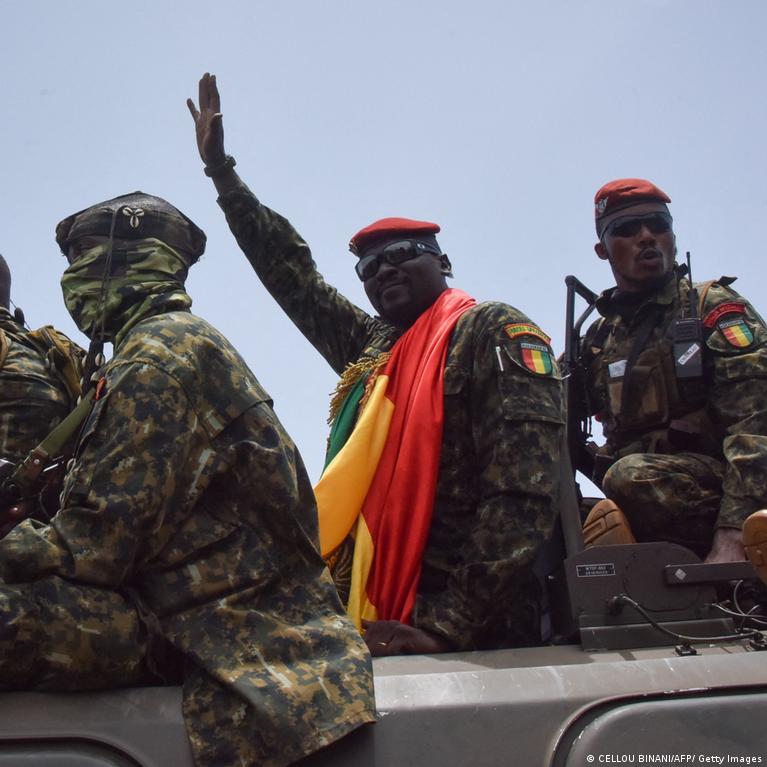
For more than four years now, General Mamady Doumbouya has been serving as Guinea's "transitional president," having led a coup d'etat against then-President Alpha Conde on September 5, 2021.
Doumbouya had originally promised to return power to civilians, but it appears that he has changed his mind, as he is now running for the election scheduled for December 28.
The country's new constitution, which was adopted in September, will allow the future president to serve a seven-year term. Voters will get to choose between nine candidates, but Doumbouya's eight rivals are largely unknown to the general public in Guinea, as the most important opposition politicians in the country have been excluded from the election.
Guinea's new constitution also stipulates that presidential candidates must have their main residence in the country.
Using this new prerequisite, two opposition heavyweights living in exile were stopped from running for office in one fell swoop: Former Prime Minister Sidya Toure, chairman of the Union of Republican Forces Republicaines (UFR) party, and former Prime Minister Cellou Dalein Diallo, chairman of the Union of Democratic Forces of Guinea (UFDG) party.
Guinean authorities had suspended the entire UFDG at the end of August — alongside several other parties. The suspension was initially intended to last for 90 days, but in the case of the UFDG, that has now been extended: In a statement issued two weeks before the election, the Guinean Ministry of Territorial Administration and Decentralization said that the documents submitted by the party showed "significant shortcomings" for its participation.
It added that the UFDG now has six months to "bring its political organization fully into line with the new legal provisions." Otherwise, the party will lose its legal status.
Among various criticisms, the ministry underscored the fact that the UFDG has not held a party conference since Guinea's junta dissolves government without explanation in 2015; however, authorities at the same time prohibited the UFDG from doing just that at the beginning of this year — again with little rhyme or reason.
Since 2022, the military government led by Doumbouya has banned all demonstrations in the country and has arrested, prosecuted, or driven into exile several opposition leaders.
At the same time, reports of abductions and kidnappings of political opponents have increased significantly.
Amnesty International says that this has created a "climate of terror," and has joined 24 other Guinean and international human rights organizations to call on "authorities to comply with their international human rights obligations, to which they committed themselves in April 2025 before the UN Human Rights Council."
According to the election commission, 66 people originally submitted their presidential candidacies to the Supreme Court. However, the vast majority of candidates were squarely rejected.
Makale Camara, former foreign minister and the only woman among the remaining nine candidates, hopes to boost her chances by focusing on connecting with citizens: "My strategy is to mingle with the people, especially women. Wherever I can find young people," says the chairwoman of the Front for National Alliance (FAN) party.
Ibrahima Toure, of the Union for Progress and Renewal (PRUN) party, is one of the candidates who was not approved to run — as a person who splits his time between Guinea and Germany.
His platform would have been the country's education system — or rather a lack thereof: "The education system is a disaster. The classrooms are dilapidated and completely broken. Those who have no money cannot send their children to school."
Toure also criticizes the country's judiciary, describing it as "corrupt." "People are kidnapped, and there is no way to file a lawsuit. If one is filed, it is not taken seriously because the government simply has its hand in it."
Together with several other parties, Toure has decided to support Faya Millimouno, chairman of the Liberal Bloc (BL) party, who is one of the total of nine approved candidates on the ballot.
Millimouno told DW that the initial support for Doumbouya right after the coup has long dwindled: "Very big promises were made. We know what we have today. We know what we are experiencing today under [Doumbouya's] government. In fact, his team has come to deceive Guineans," Millimouno explained, denouncing a "strategy of terror" which he says is aimed at suppressing dissenting voices.
On the other hand, there still is support for the strongman in certain camps: Alassane Diallo is a supporter of the controversial leader, who lives in Germany.
Diallo is optimistic about the December 28 polls: "I am convinced that Doumbouya is the right man for the job. He is the one who is capable of bringing Guineans together, uniting them across all their differences and getting them to work," he told DW, saying he fully expected constitutional order to return to the country after the elections.
The general's campaign headquarters are located in the city of Kankan, which was also the political stronghold of the ousted former president Alpha Conde. "In Kankan, for example, there is a project to build a 15 kilometer-long, two-lane road. We owe that to the arrival of the president," says activist Lamine Touta Kaba.
Perhaps unsurprisingly, there's also praise for the leader from his closest ranks: Sports Minister Keamou Bogola Haba, for instance, sees an impeccable record in his leadership: "Four years of positive results in terms of security, the economy, and leadership — and thus also in terms of stability," he said.
It is perhaps that sense of stability that is election serves as a test for, though the outcome might already be decided.
To view this video please enable JavaScript, and consider upgrading to a web browser that supports HTML5 video